

BLOG
When a food safety problem occurs, correcting the immediate issue is only the first step.
A product may contain a foreign material, a microbiological result may exceed a specification, a customer may report a food safety complaint, or an internal audit may identify a serious non-conformity.
The critical question is:
Why did the problem happen in the first place?
This is where Root Cause Analysis (RCA) becomes an essential part of an effective food safety management system.
A properly conducted Root Cause Analysis helps food manufacturers move beyond treating symptoms and identify the underlying reasons a problem occurred. It can also help organizations develop corrective and preventive actions that reduce the likelihood of recurrence.
In this guide, we explain how to conduct Root Cause Analysis in food manufacturing, the most common RCA methods, how to investigate food safety incidents, and how to develop effective corrective actions.
Reviewed by Reza Eslami
CEO & Co-Founder, Arnika
25+ years of experience in food safety, HACCP, SFCR, SQF, GMP, and regulatory compliance.
→ View full profile
What Is Root Cause Analysis?
Root Cause Analysis is a systematic process used to identify the underlying cause or causes of a problem rather than simply correcting its immediate symptoms.
In food manufacturing, RCA can be used when investigating:
- Food safety incidents
- Customer complaints
- Foreign material complaints
- Microbiological failures
- Chemical or allergen incidents
- Labeling errors
- Product specification failures
- Process deviations
- Equipment failures
- Environmental monitoring failures
- Internal audit findings
- Supplier-related problems
- Non-conformities identified during certification audits
- Regulatory inspection findings
- Product recalls
For example, replacing a damaged piece of equipment may correct an immediate problem.
However, Root Cause Analysis asks a deeper question:
Why did the equipment fail, and why was the failure not identified before it affected the product?
The answer could involve maintenance procedures, inspection frequency, employee training, equipment design, preventive maintenance, or another underlying system issue.
Why Root Cause Analysis Is Important in Food Manufacturing
Food manufacturers operate complex systems involving people, equipment, ingredients, processes, suppliers, sanitation, storage, transportation, and documentation.
A failure in one area can affect food safety somewhere else in the process.
Simply correcting the immediate problem may not prevent it from happening again.
For example:
Problem: A piece of plastic is found in a finished product.
Immediate correction: Remove affected product and inspect the production line.
Root Cause Analysis: Determine where the plastic originated, why the component failed, why the failure was not detected, and whether similar equipment or processes present the same risk.
Corrective action: Repair or replace the equipment component and strengthen the relevant inspection or preventive maintenance controls.
This approach addresses the system behind the incident rather than only the incident itself.
Root Cause Analysis vs. Correction vs. Corrective Action
These terms are often confused during food safety investigations.
Immediate Correction
A correction addresses the immediate problem.
Examples include:
- Holding affected product
- Removing contaminated material
- Reworking product where permitted
- Cleaning and sanitizing equipment
- Replacing damaged components
- Correcting an incorrect label
A correction does not necessarily address why the problem occurred.
Root Cause Analysis
Root Cause Analysis determines why the problem occurred.
It looks beyond the immediate failure and examines contributing factors and underlying causes.
Corrective Action
Corrective action addresses the cause identified through the investigation and is intended to prevent recurrence.
For example:
Problem: Incorrect allergen declaration.
Immediate Correction: Place affected product on hold and correct the label.
Root Cause: Label verification was not consistently performed during the product changeover.
Corrective Action: Revise the label verification procedure, establish a documented verification step, and train responsible employees.
This distinction is important because correcting a problem without addressing its root cause can allow the same failure to happen again.
When Should a Food Manufacturer Conduct Root Cause Analysis?
Not every minor deviation requires an extensive investigation.
However, Root Cause Analysis should be considered when an issue has a significant food safety, regulatory, quality, customer, or operational impact.
Examples include:
Food Safety Complaints
A complaint involving:
- Foreign material
- Allergens
- Chemical contamination
- Microbiological concerns
- Illness allegations
- Spoilage
- Packaging failures
may require a structured investigation.
Foreign Material Incidents
Foreign material investigations should determine:
- What the material is
- Where it came from
- How it entered the product
- Why existing controls did not prevent or detect it
- Whether other products may be affected
Microbiological Failures
Examples include:
- Positive pathogen results
- Elevated indicator organisms
- Environmental monitoring failures
- Repeated product testing failures
The investigation should consider the process, sanitation, environmental conditions, sampling, personnel practices, equipment, and other relevant factors.
Allergen Incidents
Allergen-related incidents can involve:
- Incorrect labels
- Cross-contact
- Product changeovers
- Ingredient errors
- Storage problems
- Cleaning failures
These incidents require careful investigation because the potential consumer risk can be significant.
Audit Non-Conformities
Internal, customer, regulatory, or third-party certification audits may identify recurring or significant non-conformities.
RCA can help determine whether the issue is isolated or indicates a broader system weakness.
How to Conduct a Root Cause Analysis in Food Manufacturing
A structured process helps ensure that the investigation is based on evidence rather than assumptions.
Clearly Define the Problem
Start by describing exactly what happened.
Avoid vague statements such as:
“There was a food safety issue.”
Instead, document:
- What happened?
- When did it happen?
- Where did it happen?
- Which product was involved?
- Which lot or batch was involved?
- How was the problem detected?
- What quantity may be affected?
- What food safety or quality risk exists?
A clear problem statement establishes the scope of the investigation.
Contain the Problem
Before investigating the root cause, control the immediate risk.
Depending on the situation, this may include:
- Placing product on hold
- Stopping production
- Segregating affected materials
- Increasing inspections
- Suspending the affected process
- Preserving samples
- Reviewing traceability records
- Notifying responsible management
- Assessing whether regulatory notification or recall procedures may apply
Containment prevents the problem from continuing while the investigation is underway.
Collect Evidence
A strong Food Manufacturing Investigation should be based on documented evidence.
Depending on the incident, evidence may include:
- Production records
- Batch records
- HACCP records
- CCP monitoring records
- Preventive control records
- Sanitation records
- Environmental monitoring results
- Maintenance records
- Calibration records
- Employee training records
- Supplier documentation
- Ingredient specifications
- Product testing results
- Complaint information
- Photos
- Samples
- Equipment inspection findings
- Traceability records
- Interview information
Avoid making conclusions before the evidence has been reviewed.
Map the Process
Understanding the process can reveal where the failure occurred.
Review the relevant steps from:
Receiving → Storage → Processing → Production → Packaging → Finished Product → Distribution
Ask:
- Where could the problem have been introduced?
- Where could it have been detected?
- Which controls were supposed to prevent it?
- Which controls were supposed to detect it?
- Did those controls operate as intended?
Process mapping is particularly useful for complex manufacturing investigations.
Identify Possible Causes
Once the evidence has been collected, identify potential causes.
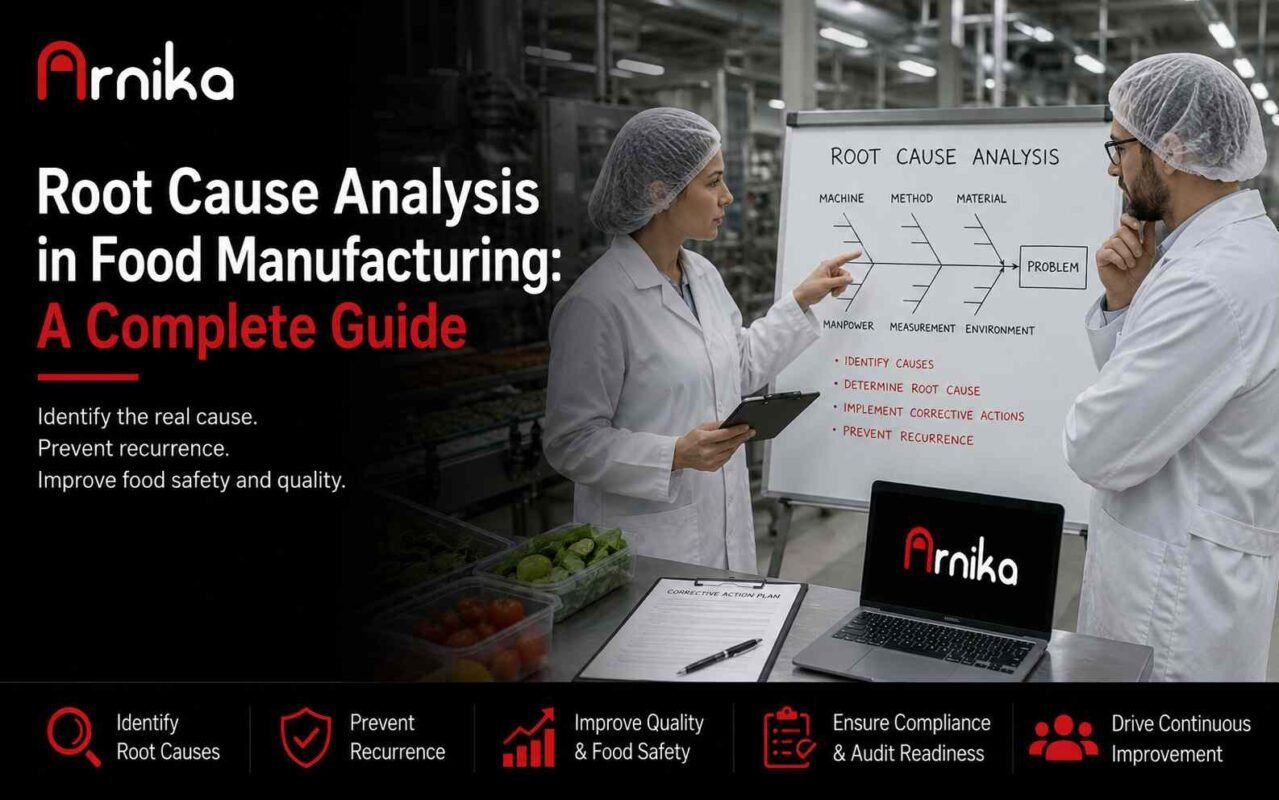
A useful framework is the 6M approach:
Man — People
Consider:
- Training
- Competency
- Work instructions
- Human error
- Staffing
- Supervision
- Communication
Machine — Equipment
Consider:
- Equipment failure
- Equipment design
- Preventive maintenance
- Wear and tear
- Calibration
- Equipment settings
Method — Process
Consider:
- Procedures
- Work instructions
- Changeovers
- Sanitation procedures
- Process controls
- Verification activities
Material
Consider:
- Ingredients
- Packaging materials
- Suppliers
- Specifications
- Receiving controls
- Storage conditions
Measurement
Consider:
- Testing
- Monitoring
- Calibration
- Sampling
- Inspection
- Verification
Environment
Consider:
- Temperature
- Humidity
- Sanitation conditions
- Facility design
- Traffic flow
- Pest activity
- Cross-contamination risks
This framework helps investigators avoid focusing only on employee error.
Use the “5 Whys” Technique
The 5 Whys method is one of the simplest tools for Root Cause Analysis.
The investigator repeatedly asks “Why?” until the underlying cause becomes clearer.
Example: Foreign Material Incident
Problem: Plastic was found in a finished product.
Why 1: Why was plastic present in the product?
Because a plastic component on the processing equipment had broken.
Why 2: Why did the component break?
Because it had become damaged and worn.
Why 3: Why was the damaged component still in service?
Because the component was not included in the preventive maintenance inspection.
Why 4: Why was it not included?
Because the preventive maintenance program did not identify that component as requiring routine inspection.
Why 5: Why was the component not identified?
Because the equipment risk assessment and maintenance program had not been reviewed after the equipment was modified.
The investigation has now moved beyond:
“The plastic broke.”
to a deeper system-level issue involving the maintenance and risk assessment program.
That is much more useful for preventing recurrence.
Determine the Root Cause
Not every contributing factor is necessarily the root cause.
A useful investigation distinguishes between:
Immediate Cause
The direct reason the problem occurred.
Contributing Cause
A factor that increased the likelihood or severity of the problem.
Root Cause
The underlying system or process failure that allowed the problem to occur and/or remain undetected.
For example:
Immediate cause: Damaged equipment component.
Contributing cause: Component wear was not detected.
Root cause: Preventive maintenance and equipment inspection procedures did not adequately address the component.
This distinction makes corrective actions much more effective.
Develop Corrective Actions
Corrective actions should directly address the root cause.
Depending on the investigation, actions may include:
- Revising procedures
- Updating HACCP documentation
- Improving preventive maintenance
- Increasing inspection frequency
- Changing equipment
- Improving sanitation procedures
- Strengthening supplier controls
- Updating specifications
- Improving employee training
- Adding verification steps
- Improving monitoring
- Revising environmental monitoring
- Improving documentation
- Conducting additional product testing
Avoid corrective actions that only address the symptom.
For example:
Weak corrective action: Retrain employees.
Training may be appropriate, but if the real problem is an inadequate procedure or poorly designed process, training alone may not prevent recurrence.
Verify Effectiveness
A corrective action is not complete simply because it has been implemented.
The organization should determine whether the action actually worked.
Effectiveness checks may include:
- Reviewing subsequent production records
- Conducting additional inspections
- Reviewing complaint trends
- Monitoring test results
- Performing internal audits
- Reviewing maintenance records
- Observing employee practices
- Checking whether similar deviations have occurred
For example:
If the root cause was inadequate equipment inspection, simply updating the inspection checklist is not enough.
The business should verify that:
- The checklist was implemented.
- Employees are using it.
- Inspections are being completed correctly.
- Problems are being identified.
- Similar incidents are no longer occurring.
Common Root Cause Analysis Tools
Different problems may require different RCA methods.
5 Whys
Best for relatively straightforward problems where the cause-and-effect relationship can be followed logically.
Fishbone Diagram
Also known as an Ishikawa diagram, this tool organizes potential causes into categories such as:
- People
- Equipment
- Methods
- Materials
- Measurement
- Environment
It is useful for brainstorming and complex investigations.
Pareto Analysis
Useful when multiple types of problems are occurring.
It can help identify which causes or failure categories account for the greatest proportion of incidents.
Process Mapping
Useful for understanding where a failure may have entered or escaped a manufacturing process.
Failure Mode and Effects Analysis
FMEA can help organizations proactively identify potential failures and assess their risks before incidents occur.
Common Mistakes in Food Manufacturing Investigations
Even experienced food businesses can make mistakes during investigations.
Blaming the Employee
Employee error may be the visible cause, but investigators should ask why the system allowed the error to occur.
Was the procedure clear?
Was training adequate?
Was the process difficult to perform correctly?
Was supervision appropriate?
Stopping at the First Cause
Finding one cause does not necessarily mean the investigation is finished.
Ask whether another underlying system failure allowed the problem to happen.
Conducting an Investigation Without Evidence
Conclusions should be supported by records, observations, testing, interviews, and other relevant evidence.
Correcting the Product but Not the Process
Removing affected product solves the immediate problem but may not prevent recurrence.
Using Training as the Default Corrective Action
Training is important, but it should not automatically be the answer to every problem.
Not Verifying Effectiveness
A corrective action should be evaluated after implementation to determine whether the issue has actually been controlled.
Root Cause Analysis and HACCP
Root Cause Analysis is closely connected to an effective HACCP system.
When an investigation identifies a failure in a hazard control, the business should determine whether its HACCP system needs to be reviewed.
Questions may include:
- Was the hazard correctly identified?
- Was the control measure appropriate?
- Was the critical limit appropriate?
- Was monitoring performed correctly?
- Was verification adequate?
- Were deviations handled appropriately?
- Does the HACCP plan need to be updated?
A recurring problem may indicate that the food safety system requires broader review rather than a single corrective action.
Root Cause Analysis and Preventive Control Plans
For Canadian food businesses operating under the Safe Food for Canadians Regulations (SFCR), investigation and corrective action activities should be considered within the organization’s overall preventive control and compliance system.
A Preventive Control Plan should be supported by appropriate preventive controls, monitoring, verification, records, and procedures relevant to the business.
When a significant food safety problem occurs, the organization should assess the issue, control affected product where necessary, investigate the cause, and determine appropriate corrective action.
Businesses should also distinguish between specific regulatory requirements and additional procedures they establish as part of their broader food safety management system.
Root Cause Analysis and Food Recalls
Root Cause Analysis can also play an important role during a food recall or potential recall situation.
The investigation may help determine:
- What caused the food safety problem?
- Which products may be affected?
- Which lots are affected?
- How far did the affected product travel?
- Why did existing controls fail?
- What corrective actions are required?
- What controls should be strengthened?
However, RCA should not delay necessary actions to protect consumers.
When a potential health or safety risk is identified, food businesses should follow their established recall and notification procedures and meet applicable regulatory requirements.
For more information, see our guide to Food Recall Management in Canada.
How Arnika Can Help With Food Manufacturing Investigations
Food safety incidents can be difficult to investigate, especially when the cause is not immediately obvious.
Arnika supports Canadian food businesses with practical food safety consulting, including:
- Root Cause Analysis
- Food Manufacturing Investigation
- Food complaint investigations
- Foreign material investigations
- Corrective and preventive actions
- HACCP system review
- Preventive Control Plan review
- Food safety audits
- Prepare for CFIA inspection
- Food safety training
- Food testing support
- GFSI certification support
Our approach focuses on understanding the actual cause of a problem and developing practical corrective actions that can be implemented and verified.
When Should You Consider Professional Food Safety Consulting?
Consider professional support when:
- The root cause cannot be identified internally.
- A food safety incident has significant potential impact.
- A complaint may involve a serious food safety hazard.
- Similar problems continue to occur.
- A regulatory or customer audit identifies significant non-conformities.
- A recall or potential recall is being considered.
- Your HACCP or food safety system may need to be reassessed.
- Corrective actions are not producing the expected results.
- Your business needs an independent investigation.
An experienced food safety consultant can provide an objective perspective and help organize the investigation around evidence, risk, and effective corrective action.
Conclusion
Root Cause Analysis is more than asking why a food safety problem occurred.
It is a structured process for understanding what happened, identifying the underlying causes, evaluating weaknesses in the food safety system, and implementing corrective actions that reduce the likelihood of recurrence.
For food manufacturers, effective Root Cause Analysis can strengthen HACCP systems, improve preventive controls, support audit readiness, reduce recurring problems, and improve overall food safety performance.
The goal should not simply be to fix today’s problem.
The goal is to understand why it happened and make the system stronger so it is less likely to happen again.
If your business is dealing with a food safety incident, complaint, non-conformity, or recurring problem, Arnika can help with Root Cause Analysis and Food Manufacturing Investigation across Canada.
Contact Arnika to discuss your food safety investigation and corrective action needs.
FAQs
What is Root Cause Analysis in food manufacturing?
Root Cause Analysis is a structured process used to identify the underlying reasons a food safety, quality, or process problem occurred. It goes beyond correcting the immediate problem and focuses on preventing recurrence.
What is a Food Manufacturing Investigation?
A Food Manufacturing Investigation is a structured examination of a food safety, quality, process, or customer-related incident to determine what happened, why it happened, what products may be affected, and what corrective actions are necessary.
What is the 5 Whys method?
The 5 Whys is an RCA technique that repeatedly asks “Why?” to move from an immediate problem toward its underlying cause.
Is employee error always the root cause?
No. Employee error may be an immediate cause, but the investigation should also determine whether procedures, training, equipment, supervision, process design, or other system factors contributed to the problem.
What is the difference between correction and corrective action?
A correction addresses the immediate problem, while corrective action addresses the underlying cause to help prevent the problem from happening again.
Can Root Cause Analysis be used for food recalls?
Yes. RCA can help determine why a food safety problem occurred, identify contributing factors, and support appropriate corrective actions during or after a recall investigation. However, necessary recall and regulatory actions should not be delayed while waiting for a complete RCA.
About the Author
Reza Eslami has more than 25 years of experience helping Canadian food manufacturers, processors, importers, distributors, and retailers strengthen food safety systems, investigate food safety incidents, implement HACCP, develop Preventive Control Plans (PCPs), and prepare for regulatory inspections and Food Safety Certification.