
BLOG
Understanding BRCGS requirements is an important step for food manufacturers and processors preparing for certification or responding to customer requirements.
The BRCGS Global Standard Food Safety provides a framework for managing product safety, integrity, legality and quality in food and food-ingredient manufacturing, processing and packing operations. BRCGS Food Safety is currently in Issue 9, which was launched in 2022 and remains the current issue of the standard.
For Canadian food businesses, BRCGS certification can be relevant when a retailer, customer, brand owner or supply-chain partner specifies a GFSI-recognized certification programme.
This guide explains the main areas covered by the BRCGS Food Safety Standard, what businesses should review before an audit, and how a Canadian food facility can prepare its food safety system for certification.
Reviewed by Reza Eslami, CEO & Co-Founder of Arnika, with more than 25 years of experience in food safety, quality, HACCP, GMP, SFCR and certification readiness.
What Is the BRCGS Food Safety Standard?
The BRCGS Global Standard Food Safety is an internationally used standard for food and food-ingredient manufacturing, processing and packing operations.
The standard provides requirements covering product safety, integrity, legality and quality, together with operational controls intended to help sites consistently produce safe and compliant products. BRCGS states that the Food Safety Standard is now in its ninth issue and is used by sites around the world.
BRCGS Food Safety is also recognized by the Global Food Safety Initiative (GFSI). GFSI recognition is separate from certification: GFSI benchmarks and recognizes certification programmes, while certification is performed by an applicable certification body. BRCGS Food Safety Issue 9 achieved GFSI recognition in 2024.
For a broader explanation of BRCGS certification in Canada, see Arnika’s BRCGS Certification Canada page.
What Are the Main BRCGS Requirements?
BRCGS Issue 9 is organized into major sections covering management, HACCP, the food safety and quality management system, site standards, product control, process control, personnel, production risk zones and traded products.
The exact requirements that apply to a site depend on its activities, products, processes and certification scope. Businesses should always work from the current official BRCGS Standard and applicable interpretation and position statements rather than relying on a generic checklist.
Senior Management Commitment
Senior management plays an important role in the food safety and quality system.
The site should demonstrate appropriate management commitment, resources, responsibilities, communication and support for maintaining the system.
Management involvement should not be limited to signing documents. The objective is to demonstrate that food safety and product quality are part of the organization’s ongoing management process.
HACCP and the Food Safety Plan
HACCP is a central component of BRCGS Food Safety Issue 9.
Businesses need an appropriate food safety plan based on hazard analysis and relevant preventive controls.
Depending on the operation, this includes consideration of:
- Biological hazards
- Chemical hazards
- Physical hazards
- Allergen hazards
- Process-related risks
- Raw material hazards
- Product-specific hazards
- Environmental and operational risks where applicable
The HACCP system should reflect the actual products, processes, equipment and operating conditions of the site.
A generic HACCP plan copied from another facility is unlikely to provide an adequate representation of the risks at the site.
For more information, see Arnika’s HACCP guide.
Food Safety and Quality Management System
A BRCGS-certified site needs an effective management system supported by appropriate documentation, procedures, records and verification.
The system should provide evidence that food safety and quality controls are:
- Defined
- Implemented
- Monitored
- Verified
- Corrected when necessary
- Maintained over time
Documentation should support the actual operation rather than becoming paperwork that employees cannot realistically follow.
Important system elements can include:
- Document control
- Internal audits
- Corrective actions
- Complaint management
- Traceability
- Supplier management
- Training and competency
- Product specifications
- Verification activities
- Management review
- Continuous improvement
BRCGS specifically emphasizes continual improvement, food safety culture and core competencies within Issue 9.
Site Standards and GMP
Site standards are an important part of BRCGS audit preparation.
The facility should be maintained in a condition that supports hygienic food production and effective contamination control.
Areas to review may include:
- Building condition
- Facility layout
- Zoning
- Personnel movement
- Product flow
- Equipment condition
- Cleaning and sanitation
- Pest management
- Waste handling
- Water and utilities
- Drainage
- Maintenance
- Storage
- Environmental conditions
Good Manufacturing Practices (GMP) provide an important operational foundation for these controls.
Arnika’s GMP guide provides more information about GMP in Canadian food operations.
Product Control
BRCGS requirements also cover controls that help ensure products meet defined safety, legal, quality and customer requirements.
Depending on the operation, product controls may include:
- Product specifications
- Ingredient specifications
- Packaging specifications
- Product testing
- Shelf-life controls
- Allergen information
- Labelling controls
- Product release
- Complaint investigation
- Product authenticity
- Product integrity
Imported ingredients and finished products may require additional supplier and verification controls depending on the business model.
Process Control
Process controls should be designed around the actual food manufacturing process.
Depending on the facility, this may include:
- Process parameters
- Critical control points
- Monitoring
- Corrective actions
- Equipment controls
- Temperature controls
- Time controls
- Foreign-material controls
- Allergen changeovers
- Cleaning and sanitation
- Rework controls
- Product identification
The purpose is to demonstrate that significant process risks are controlled consistently and that deviations are handled appropriately.
Personnel, Training and Competency
Employees are an essential part of BRCGS implementation.
Training and competency should be appropriate to the employee’s responsibilities and the food safety risks associated with their work.
Depending on the operation, training may include:
- Food hygiene
- GMP
- HACCP
- Allergen control
- Cleaning and sanitation
- Food safety procedures
- Traceability
- Corrective actions
- Food safety culture
- Internal auditing
BRCGS also identifies food safety culture and core competencies as important areas within Issue 9.
Arnika provides Food Safety Training for Canadian food businesses.
BRCGS Food Safety Issue 9 and 2026 Updates
Is Issue 9 Still the Current BRCGS Food Safety Standard?
Yes. BRCGS Global Standard Food Safety Issue 9 remains the current Food Safety Standard as of September 2026.
BRCGS is also continuing the revision process for the next issue. The public consultation on Issue 9 closed in February 2026 as part of the development process for a future revision.
This means companies preparing for certification should continue working from Issue 9 and its current supporting guidance until BRCGS officially introduces the next issue and transition requirements.
2026 Position Statements
Businesses preparing for audits should also check the current BRCGS position statements.
BRCGS published updated Food Safety Issue 9 position statements that became effective on August 10, 2026.
This is important because audit preparation should be based on the current standard, interpretation guidance and applicable position statements, not only an older checklist.
BRCGS provides Issue 9 guidance materials, including the Food Safety Standard, Interpretation Guidelines and key-change information through its official resources.
How to Prepare for a BRCGS Audit
Effective BRCGS preparation should start well before the certification audit.
Define the Certification Scope
Determine the products, processes, facilities and activities that will be included in the certification scope.
The scope should accurately represent what the site produces and the activities carried out at the facility.
Review the Current BRCGS Requirements
Obtain the current official BRCGS Standard and relevant interpretation and supporting documents.
Do not rely solely on an old third-party checklist.
BRCGS itself recommends understanding the scope and requirements of the Standard before preparing for certification.
Conduct a Gap Assessment
Compare your current system and site conditions against the applicable BRCGS requirements.
A practical gap assessment should look beyond documentation and examine whether procedures are actually implemented.
Review HACCP and Prerequisite Programs
Make sure the HACCP system reflects:
- Current products
- Current ingredients
- Current processes
- Current equipment
- Current hazards
- Current control measures
Also review prerequisite programs such as:
- GMP
- Sanitation
- Pest control
- Allergen control
- Supplier approval
- Maintenance
- Personal hygiene
- Traceability
- Recall
For additional information, see Arnika’s Prerequisite Programs for HACCP.
Review Records
An auditor will need evidence that procedures are actually being followed.
Review records such as:
- Monitoring records
- Sanitation records
- Training records
- Internal audits
- Corrective actions
- Supplier records
- Traceability tests
- Complaint investigations
- Verification records
- Calibration records
Conduct Internal Audits
Internal audits should verify both the documented system and its implementation.
A strong internal audit program can identify problems before the certification audit.
Arnika provides Food Safety Auditing Services for businesses preparing for certification and customer audits.
Correct Non-Conformities
Don’t simply close audit findings on paper.
Investigate root causes, implement appropriate corrective actions and verify that the corrective action is effective.
Train Employees
Employees should understand the procedures relevant to their responsibilities.
Auditors may interview employees and observe how procedures are implemented in practice.
Conduct a Mock Audit
A mock audit can help the site understand how its system performs under realistic audit conditions.
A useful mock audit should include:
- Document review
- Record review
- Facility inspection
- Employee interviews
- Process observation
- Traceability testing
- Corrective-action review
Select the Certification Body
BRCGS recommends choosing a BRCGS-registered Certification Body through its directory to perform the certification audit.
Arnika can help prepare the site, but the certification audit and certification decision are performed by the applicable independent certification body.
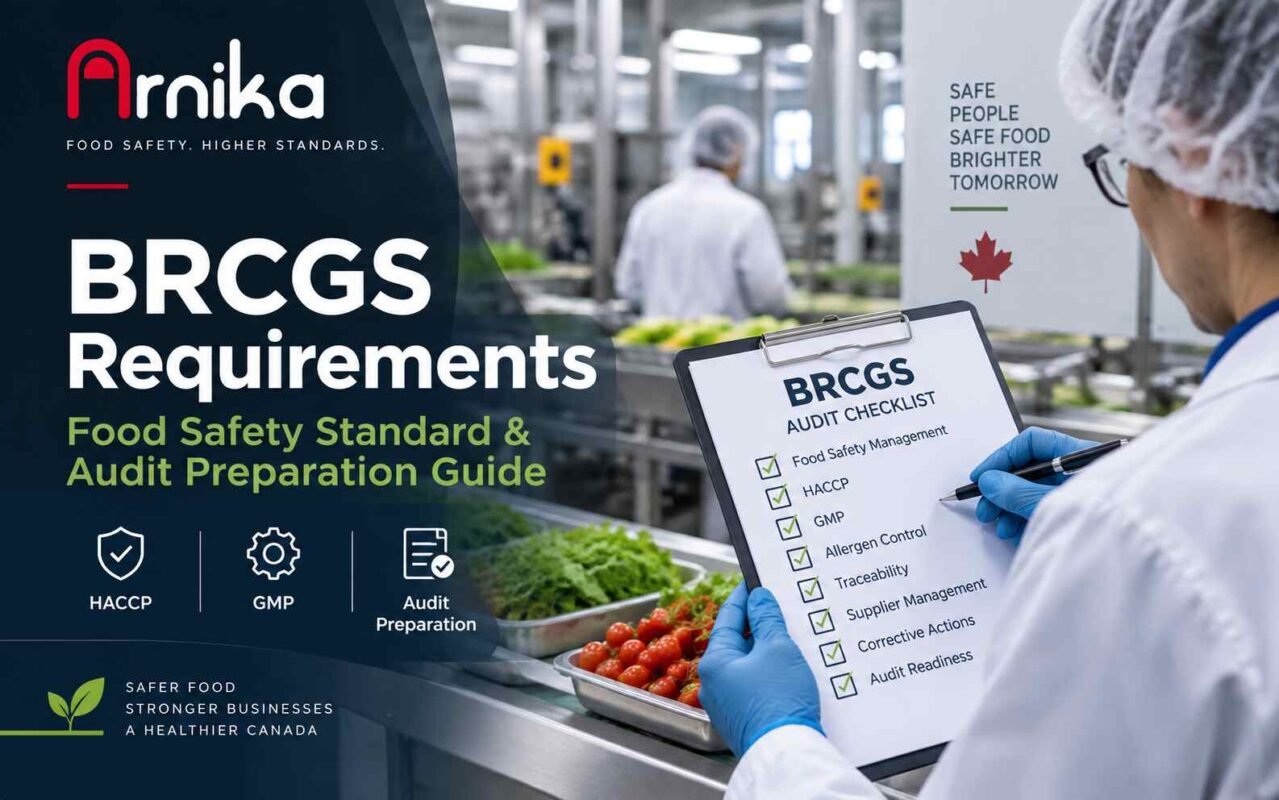
BRCGS Audit Preparation Checklist
Before a certification audit, review at least the following areas:
Food Safety System
- HACCP current and implemented
- Hazard analysis reviewed
- CCPs and controls verified
- Verification activities completed
GMP and Site Standards
- Cleaning and sanitation effective
- Pest control current
- Maintenance completed
- Facility conditions acceptable
- Equipment hygienically maintained
- Storage conditions appropriate
Supplier Management
- Approved suppliers documented
- Specifications current
- Supplier risk assessment completed
- Supplier monitoring implemented
Product and Process Control
- Product specifications current
- Process controls implemented
- Allergen controls verified
- Product identification maintained
- Traceability tested
Documentation and Records
- SOPs current
- Records complete
- Corrective actions closed
- Internal audits completed
- Training records current
People
- Employees trained
- Responsibilities understood
- Hygiene requirements followed
- Food safety culture activities implemented
Audit Readiness
- Mock audit completed
- Outstanding gaps prioritized
- Corrective actions verified
- Management aware of certification status and risks
This is a practical preparation checklist, not a replacement for the official BRCGS Standard, Interpretation Guidelines or official self-assessment tools.
Common BRCGS Audit Preparation Mistakes
Treating BRCGS as a Documentation Project
Having a large collection of SOPs does not automatically demonstrate effective implementation.
Auditors look for evidence that systems are being followed in practice.
Using a Generic HACCP Plan
The HACCP system should reflect the actual operation.
A template that does not reflect the site’s products and processes can create significant gaps.
Ignoring Food Safety Culture
Food safety culture is an explicit area within Issue 9 and should not be treated as a slogan or poster campaign.
Leaving Corrective Actions Until the Last Minute
Corrective actions should address root causes and be verified for effectiveness.
Ignoring Supplier Risks
Supplier approval and monitoring need to reflect the risks associated with ingredients, packaging and services.
Focusing Only on the Audit Day
Certification readiness should be demonstrated through the site’s routine operations and records, not created immediately before the auditor arrives.
Is BRCGS the Same as GFSI?
No.
GFSI and BRCGS have different roles.
GFSI is the benchmarking organization, while BRCGS operates certification programmes such as the Global Standard Food Safety.
BRCGS Food Safety Issue 9 has achieved recognition against GFSI benchmarking requirements.
The certification process itself is conducted through a BRCGS-registered Certification Body.
For more information about GFSI and recognized certification schemes, see Arnika’s GFSI guide.
BRCGS Certification and Canadian Regulatory Compliance
BRCGS certification and Canadian regulatory compliance are related, but they are not the same thing.
A Canadian food business may need to meet applicable requirements under Canadian food legislation and the Safe Food for Canadians Regulations (SFCR) while also meeting customer or certification requirements.
BRCGS certification does not replace applicable Canadian regulatory obligations.
For Canadian businesses, certification preparation should therefore consider both:
Regulatory requirements
and
BRCGS requirements
Arnika can help businesses coordinate their HACCP, GMP, preventive controls, regulatory systems and certification-readiness activities.
How Arnika Helps With BRCGS Audit Preparation
Arnika provides BRCGS certification-readiness support for Canadian food businesses.
Depending on the project, our support can include:
- BRCGS gap assessments
- HACCP review
- Prerequisite-program review
- GMP assessment
- Documentation review
- Internal audits
- Mock audits
- Employee training
- Corrective-action support
- Traceability assessment
- Supplier-control review
- Certification-readiness planning
Arnika’s objective is to help businesses identify gaps, strengthen implementation and prepare effectively for their certification audit.
For our commercial BRCGS service, see BRCGS Certification Support in Canada.
Certification itself is conducted by the applicable independent BRCGS-registered certification body.
Conclusion
BRCGS requirements cover much more than documentation.
A successful certification system needs effective HACCP, GMP, prerequisite programs, site standards, product controls, process controls, training, supplier management, traceability, corrective actions and food safety culture.
For Canadian food businesses preparing for BRCGS certification, the most effective approach is to start with the current Issue 9 requirements, conduct a realistic gap assessment, strengthen implementation, verify the system through internal audits and ensure employees understand their responsibilities.
Because BRCGS updates supporting documents and position statements, certification preparation should always use the current official materials. BRCGS’s current position statements for Food Safety Issue 9 became effective August 10, 2026.
For businesses that need professional support, Arnika provides BRCGS gap assessments, consulting, training, mock audits and certification-readiness support across Canada.
Learn More About BRCGS Certification Support in Canada
BRCGS Certification FAQs
What are the main BRCGS requirements?
BRCGS Food Safety Issue 9 covers areas including senior management commitment, HACCP, the food safety and quality management system, site standards, product control, process control, personnel, production risk zones and traded products.
What is BRCGS Food Safety Issue 9?
Issue 9 is the current edition of the BRCGS Global Standard Food Safety. It was launched in 2022 and became applicable to certification audits from February 2023.
Is BRCGS certification required in Canada?
BRCGS certification is not a universal legal requirement for every Canadian food business. It may be required by a retailer, customer, brand owner or supply-chain partner depending on the business relationship and market requirements.
Is BRCGS recognized by GFSI?
Yes. BRCGS Food Safety Issue 9 achieved GFSI recognition in August 2024.
Who performs a BRCGS certification audit?
The certification audit is performed by a BRCGS-registered Certification Body. BRCGS provides a directory to help sites select a certification body.
How should a company prepare for a BRCGS audit?
Preparation should include reviewing the current standard, conducting a gap assessment, reviewing HACCP and prerequisite programs, checking site conditions, verifying records, training employees, completing internal audits, closing corrective actions and conducting a realistic mock audit.
What is the difference between BRC and BRCGS?
“BRC” is still commonly used informally, but BRCGS is the current brand terminology associated with the organization and its standards.
Can Arnika help prepare a company for BRCGS certification?
Yes. Arnika provides BRCGS gap assessments, HACCP and GMP review, documentation support, internal audits, mock audits, employee training and corrective-action support for Canadian food businesses.
Official sources for this article
For the regulatory/certification facts in this article, the primary sources are BRCGS and GFSI: