
HACCP Prerequisite Programs: Complete Guide & Checklist in Canada
Food safety does not begin with a Critical Control Point (CCP). Before a food business develops and operates an effective HACCP system, it needs a controlled environment where basic food hygiene and operational conditions are consistently maintained.
This foundation is provided by HACCP prerequisite programs (PRPs).
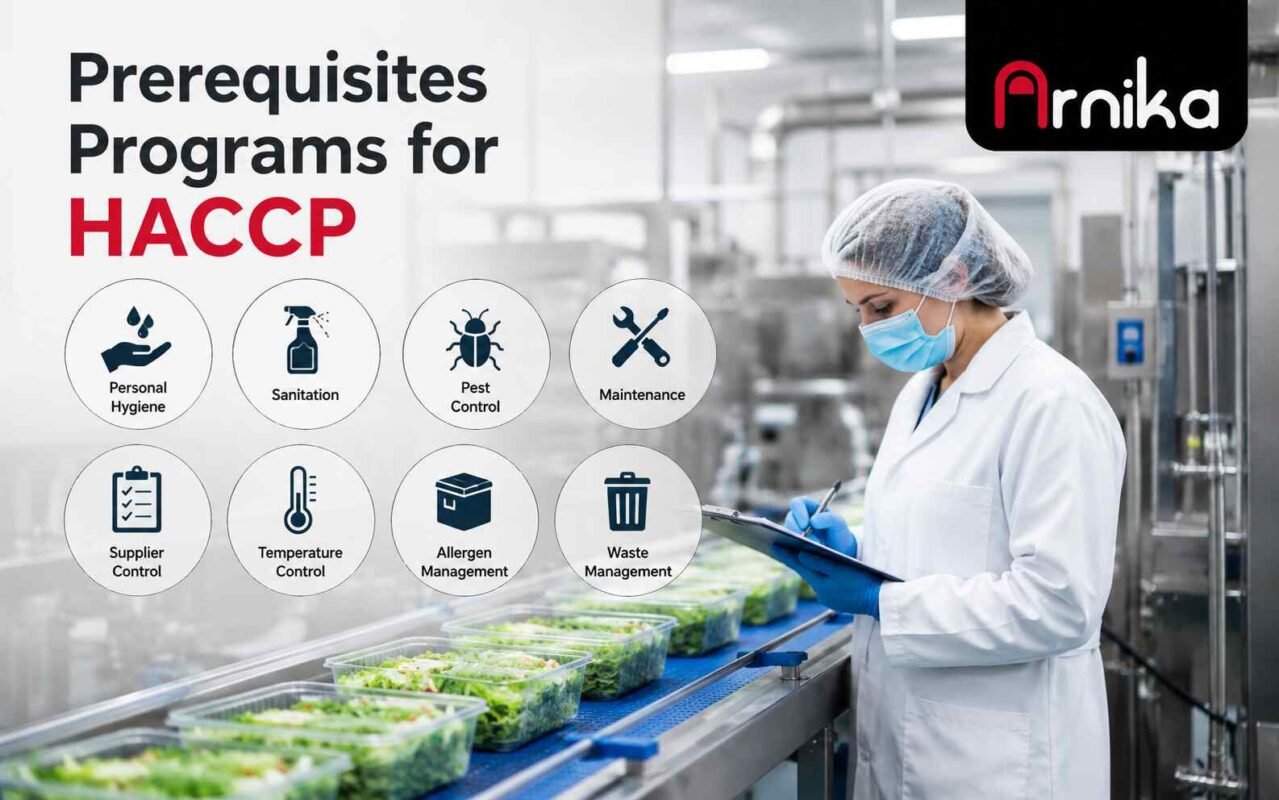
Prerequisite programs establish the basic conditions and practices needed to produce safe food. They address areas such as facility design, sanitation, personnel hygiene, pest control, equipment maintenance, supplier controls, storage, traceability, and training.
For Canadian food businesses, these programs are also closely connected to the preventive controls required under the Safe Food for Canadians Regulations (SFCR) and the development of a Preventive Control Plan (PCP). CFIA guidance identifies prerequisite programs as part of the foundation supporting food safety systems and HACCP implementation.
Whether you operate a food manufacturing facility, processing plant, warehouse, bakery, meat facility, dairy operation, beverage plant, or other food business, well-designed prerequisite programs help create the conditions necessary for effective hazard control.
Reviewed by Reza Eslami
CEO & Co-Founder, Arnika
25+ years of experience in food safety, HACCP, SFCR, SQF, GMP, and regulatory compliance.
→ View full profile
What Are HACCP Prerequisite Programs?
HACCP prerequisite programs are the foundational food safety procedures and conditions that must be established and maintained before, and alongside, a HACCP system.
They control general food safety conditions throughout the operation rather than focusing only on hazards at individual Critical Control Points.
Examples include:
- Good Manufacturing Practices (GMP)
- Personnel hygiene
- Cleaning and sanitation
- Pest control
- Equipment maintenance
- Facility maintenance
- Supplier approval and control
- Receiving and storage controls
- Allergen management
- Water and ice safety
- Waste management
- Traceability and recall
- Employee training
- Transportation controls
- Documentation and record keeping
The exact programs required depend on the nature of the food business, its processes, products, hazards, and applicable regulatory requirements.
CFIA’s Food Safety Enhancement Program approach identifies prerequisite programs addressing areas such as premises, purchasing and receiving, equipment, personnel, sanitation and pest control, recall, and operational prerequisite programs.
Why Are Prerequisite Programs Important for HACCP?
HACCP is designed to control significant food safety hazards through a systematic approach. However, HACCP is not intended to replace basic hygiene and operational controls.
For example, a HACCP plan may identify a cooking step as a Critical Control Point for controlling a biological hazard. But the HACCP plan does not replace the need for:
- Clean equipment
- Hygienic employees
- Effective sanitation
- Pest prevention
- Proper facility maintenance
- Safe ingredient receiving
- Proper storage
- Allergen controls
- Employee training
These conditions are established through prerequisite programs.
Codex guidance states that prerequisite programmes, including good hygiene practices, should be established and operational before HACCP is applied.
In simple terms:
Prerequisite programs create the foundation. HACCP focuses on controlling significant hazards that require specific process controls
PRP vs HACCP: What Is the Difference?
One of the most common questions in food safety is the difference between a prerequisite program and a HACCP plan.
Prerequisite Programs
PRPs establish the general conditions necessary for safe food production.
Examples include:
- Sanitation
- Personal hygiene
- Pest control
- Facility maintenance
- Supplier controls
- Equipment maintenance
- Training
HACCP
A HACCP system focuses specifically on significant biological, chemical, and physical hazards associated with a product and process.
It includes:
- Hazard analysis
- Identification of Critical Control Points
- Critical limits
- Monitoring
- Corrective actions
- Verification
- Record keeping
The relationship can be summarized as:
PRPs → Controlled environment → Hazard analysis → HACCP controls → Safe food
CFIA’s HACCP guidance similarly explains that hazards should first be assessed against existing prerequisite programs and other control measures before determining whether additional controls, including CCPs, are required.
What Are the Main HACCP Prerequisite Programs?
There is no single universal list containing exactly seven PRPs for every food business.
The appropriate programs depend on the operation, products, processes, hazards, and regulatory requirements.
Common prerequisite programs include the following.
1. Premises and Facility Controls
The design, construction, layout, and maintenance of a food facility should support safe food production.
Controls may include:
- Facility layout
- Separation of raw and ready-to-eat areas
- Appropriate floors, walls, and ceilings
- Adequate drainage
- Ventilation
- Lighting
- Handwashing facilities
- Controlled employee access
- Prevention of cross-contamination
- Structural pest prevention
A well-designed facility makes sanitation and hygienic operations easier to maintain.
2. Good Manufacturing Practices (GMP)
Good Manufacturing Practices (GMP) provide a framework for maintaining consistent food safety and manufacturing conditions.
GMP programs commonly address:
- Personal hygiene
- Facility sanitation
- Equipment
- Production practices
- Storage
- Documentation
- Employee responsibilities
- Contamination prevention
GMP and other prerequisite programs work together to establish the basic conditions needed for an effective food safety system.
3. Sanitation and Cleaning Program
An effective sanitation program defines how facilities, equipment, utensils, and food-contact surfaces are cleaned and sanitized.
A sanitation program should establish:
- What must be cleaned
- How it is cleaned
- Which chemicals are used
- Chemical concentrations
- Cleaning frequency
- Responsible employees
- Verification methods
- Corrective actions
- Required records
Some facilities also use Sanitation Standard Operating Procedures (SSOPs) to document specific sanitation activities.
4. Personal Hygiene Program
Employees can introduce biological, chemical, or physical hazards into food production.
A personal hygiene program may include:
- Proper handwashing
- Protective clothing
- Hair restraints
- Personal protective equipment
- Illness reporting
- Rules concerning jewellery and personal items
- Employee movement controls
- Hygienic behaviour
- Training requirements
Personnel hygiene is therefore an important component of food safety prerequisite programs.
5. Pest Control Program
Pests can introduce microorganisms, allergens, foreign materials, and other contaminants into a food facility.
A pest control program should address:
- Facility inspection
- Pest prevention
- Pest-proofing
- Monitoring devices
- Pest activity records
- Corrective actions
- Approved pest control chemicals
- Contractor management
- Trend analysis
Regular verification helps identify potential problems before they become food safety incidents.
6. Equipment Maintenance and Calibration
Food processing equipment must be maintained in a condition that supports safe production.
The program may include:
- Preventive maintenance
- Equipment inspection
- Calibration
- Repair procedures
- Lubricant controls
- Replacement parts
- Maintenance records
- Post-maintenance sanitation
Equipment that is poorly maintained can contribute to contamination, process failure, or inaccurate measurements.
7. Supplier Approval and Control
Food safety begins before ingredients arrive at the facility.
A supplier control program should establish criteria for:
- Supplier approval
- Ingredient specifications
- Packaging specifications
- Certificates and documentation
- Supplier performance
- Supplier audits, where appropriate
- Incoming material verification
- Corrective actions
Supplier controls help businesses manage hazards associated with raw materials and ingredients.
8. Receiving and Storage Controls
Food ingredients, packaging, and finished products should be received and stored under appropriate conditions.
Controls may include:
- Receiving inspections
- Temperature checks
- Packaging integrity
- Lot identification
- Allergen identification
- Storage temperatures
- FIFO or FEFO practices
- Separation of incompatible materials
- Protection from contamination
These controls help maintain product safety from receiving through production and distribution.
9. Allergen Control Program
Allergen cross-contact is a significant concern for many food businesses.
An allergen control program may include:
- Identification of allergens
- Ingredient segregation
- Production scheduling
- Dedicated equipment where appropriate
- Cleaning procedures
- Verification
- Employee training
- Label review
- Changeover controls
- Allergen storage controls
Effective allergen management should be integrated into the facility’s overall food safety system.
10. Water and Ice Quality
Water and ice that come into contact with food or food-contact surfaces should be suitable for their intended use.
Controls may include:
- Water source verification
- Potability testing
- Ice handling procedures
- Water distribution controls
- Backflow prevention
- Sampling and testing where appropriate
- Corrective actions
The specific requirements depend on the operation and applicable regulations.
11. Waste Management Program
Food waste and other waste materials should be managed to prevent contamination.
A waste management program may address:
- Waste containers
- Waste storage
- Waste removal frequency
- Separation of waste
- Cleaning of waste areas
- Employee responsibilities
- Pest prevention
Proper waste management also supports effective sanitation and pest control.
12. Traceability and Recall Program
Food businesses need systems that allow products and ingredients to be identified and traced.
A traceability program may include:
- Supplier identification
- Lot codes
- Production records
- Distribution records
- Product identification
- Customer information
- Recall procedures
- Mock recalls
- Recall effectiveness checks
CFIA guidance includes recall and notification within its prerequisite-program framework for food businesses.
13. Employee Training Program
Employees need appropriate knowledge and skills to perform their responsibilities safely.
Training may cover:
- Food hygiene
- GMP
- HACCP
- Sanitation
- Allergen control
- Personal hygiene
- Equipment operation
- Chemical handling
- Preventive controls
- Corrective actions
- Documentation
Training should be appropriate to the employee’s responsibilities and reviewed when processes, equipment, products, or requirements change.
14. Transportation and Distribution Controls
Food safety controls should continue after products leave the production area.
Transportation controls may address:
- Vehicle cleanliness
- Temperature control
- Product protection
- Separation of incompatible products
- Loading procedures
- Transportation records
- Delivery conditions
The objective is to prevent contamination or deterioration during transportation and distribution.
HACCP Prerequisites Program Checklist
A practical PRP checklist can help food businesses determine whether the basic food safety conditions are established.
Facility
- Facility layout supports hygienic production
- Raw and finished products are appropriately separated
- Floors, walls, ceilings, and drains are maintained
- Lighting and ventilation are adequate
- Handwashing facilities are available
Personnel
- Personal hygiene procedures are documented
- Handwashing requirements are established
- Illness reporting procedures are in place
- Employees receive appropriate food safety training
Sanitation
- Cleaning procedures are documented
- Cleaning schedules are established
- Sanitizer requirements are defined
- Cleaning effectiveness is verified
- Sanitation records are maintained
Equipment
- Preventive maintenance is scheduled
- Equipment is properly maintained
- Calibration requirements are identified
- Maintenance activities are documented
Pest Control
- Pest prevention measures are established
- Monitoring is conducted
- Pest activity is documented
- Corrective actions are implemented
Suppliers
- Suppliers are approved
- Ingredient specifications are defined
- Supplier performance is monitored
- Corrective actions are documented
Storage and Receiving
- Incoming materials are inspected
- Temperature requirements are established
- Storage areas are maintained
- Lot identification is maintained
- Allergens are appropriately identified and controlled
Traceability and Recall
- Products can be traced
- Supplier records are maintained
- Distribution records are maintained
- Recall procedures are documented
- Recall exercises are conducted where appropriate
Documentation
- Procedures are documented
- Records are maintained
- Responsibilities are assigned
- Verification activities are documented
- Corrective actions are recorded
How to Develop HACCP Prerequisite Programs
Developing effective PRPs requires more than creating documents and putting them in a binder.
Step 1: Understand Your Operation
Identify:
- Products
- Ingredients
- Processes
- Equipment
- Employees
- Facility layout
- Storage activities
- Transportation activities
Understanding the operation helps determine which prerequisite programs are appropriate.
Step 2: Identify Food Safety Requirements
Review the regulatory and customer requirements applicable to your operation.
For Canadian food businesses, this may include requirements under the Safe Food for Canadians Regulations (SFCR) and applicable provincial or territorial requirements.
CFIA describes a Preventive Control Plan as a written plan demonstrating how hazards are identified and prevented, eliminated, or reduced to an acceptable level.
Step 3: Identify Required PRPs
Determine which prerequisite programs are needed for your operation.
Typical programs include:
- GMP
- Sanitation
- Pest control
- Personal hygiene
- Equipment maintenance
- Supplier control
- Allergen control
- Traceability
- Recall
- Training
- Receiving and storage
Step 4: Document Each Program
Each program should clearly explain:
What is being controlled?
Who is responsible?
How is the control performed?
When is it performed?
What records are required?
How is effectiveness verified?
This approach makes the program practical rather than simply creating documents for compliance purposes.
Step 5: Train Employees
Employees must understand the procedures relevant to their work.
Training should be documented and refreshed when necessary.
CFIA guidance emphasizes employee training in areas such as food hazards, hygiene, cross-contamination prevention, allergen prevention, HACCP principles, sanitation, maintenance, and food operations.
Step 6: Implement the Programs
The programs must be put into practice.
This means employees actually follow:
- Cleaning procedures
- Hygiene requirements
- Receiving procedures
- Pest control procedures
- Maintenance schedules
- Allergen controls
- Documentation requirements
A PRP is only effective when it is implemented consistently.
Step 7: Monitor and Verify
Monitoring determines whether procedures are being followed.
Verification provides evidence that the programs are working as intended.
Verification activities may include:
- Record review
- Internal audits
- Visual inspections
- Environmental or microbiological testing where appropriate
- Calibration checks
- Observation of employees
- Review of corrective actions
CFIA notes that verification activities help demonstrate that preventive controls, monitoring activities, and corrective actions are consistently implemented and effective.
Step 8: Correct Problems and Improve
When a deviation occurs, investigate the cause and take appropriate corrective action.
Examples include:
- Re-cleaning equipment
- Repairing damaged facilities
- Retraining employees
- Rejecting non-conforming ingredients
- Correcting documentation
- Investigating pest activity
- Updating procedures
PRPs should be reviewed when there are significant changes to products, processes, equipment, ingredients, regulations, or other conditions affecting food safety.
How Do PRPs Fit Into a HACCP Plan?
The relationship between PRPs and HACCP is extremely important.
A simplified food safety system looks like this:
Prerequisite Programs
↓
Basic hygiene and operational controls
↓
Hazard Analysis
↓
Determine appropriate control measures
↓
Critical Control Points where applicable
↓
Monitoring + Corrective Action + Verification + Records
PRPs manage the general conditions of the operation.
The HACCP plan then focuses on significant hazards that require specific controls.
During hazard analysis, a food business should determine whether a hazard is already controlled by a prerequisite program. If it is not adequately controlled, the HACCP team determines whether additional process controls or a CCP are required. CFIA’s HACCP methodology specifically incorporates this relationship.
PRP, OPRP and CCP: What Is the Difference?
These terms are sometimes confused.
PRP — Prerequisite Program
A PRP establishes general conditions for safe food production.
Example: facility sanitation.
OPRP — Operational Prerequisite Program
An OPRP is an operational control measure used to control a significant food safety hazard, but it does not necessarily meet the criteria for a CCP.
The terminology and classification depend on the food safety management standard being applied.
CCP — Critical Control Point
A CCP is a step where control is essential to prevent, eliminate, or reduce a food safety hazard to an acceptable level.
Example: a validated cooking process designed to control a specific biological hazard.
Therefore, not every food safety control is a CCP.
HACCP Prerequisite Programs and Canada's Preventive Control Plan
For Canadian food businesses, prerequisite programs should also be considered in the context of the Preventive Control Plan (PCP) required under the SFCR for businesses to which the requirements apply.
CFIA explains that Canada’s preventive control requirements are based on internationally recognized food hygiene principles, including GMP and HACCP principles.
A PCP can include controls related to:
- Sanitation
- Hygiene
- Facility maintenance
- Equipment
- Receiving
- Storage
- Processing
- Traceability
- Recall
- Preventive controls
- Hazard analysis
- Monitoring
- Verification
- Corrective actions
- Record keeping
The exact requirements depend on the nature of the food business and its activities.
For Canadian businesses, PRPs should therefore be developed as part of an integrated food safety system rather than treated as isolated documents.
Common Problems With HACCP Prerequisite Programs
Many businesses have PRP documents but still struggle with implementation.
Common problems include:
1. Generic Procedures
Procedures are copied from templates without being adapted to the actual facility.
2. Poor Employee Understanding
Employees may sign training records without understanding what they are expected to do.
3. Incomplete Records
Activities may be performed but not documented properly.
4. Weak Verification
The company checks whether forms are completed but does not verify whether the program is actually effective.
5. Outdated Programs
Procedures may no longer reflect current equipment, products, processes, or regulations.
6. PRPs Not Connected to HACCP
The HACCP team may fail to consider existing prerequisite controls when conducting hazard analysis.
Effective PRPs should therefore be facility-specific, implemented, monitored, verified, and periodically reviewed.
Examples of HACCP Prerequisite Programs by Food Industry
Different food businesses may require different combinations of prerequisite programs.
Dairy Processing
Important programs may include:
- Sanitation
- Personal hygiene
- Equipment maintenance
- Temperature control
- Water quality
- Pest control
- Allergen management
Meat Processing
Programs may include:
- Sanitation
- Pest control
- Employee hygiene
- Equipment maintenance
- Raw material controls
- Temperature controls
- Traceability and recall
Bakery
Programs may include:
- GMP
- Allergen control
- Sanitation
- Pest control
- Ingredient receiving
- Equipment maintenance
- Personal hygiene
Ready-to-Eat Food Production
Additional emphasis may be placed on:
- Environmental hygiene
- Cross-contamination prevention
- Personnel hygiene
- Allergen controls
- Sanitation verification
- Temperature control
- Environmental monitoring where appropriate
The appropriate PRPs should always be determined according to the specific operation and hazards.
How Arnika Can Help With HACCP Prerequisite Programs
Developing effective prerequisite programs can require significant technical and operational work.
Arnika supports food businesses with services related to:
- PRP development
- GMP implementation
- HACCP development
- Preventive Control Plans
- Food safety documentation
- SOP and SSOP development
- Employee training
- Internal auditing
- Food safety gap assessments
- Regulatory compliance
- Certification preparation
If your business needs help developing or improving its food safety system, Arnika’s food safety consulting team can help assess your current programs and develop practical controls suited to your operation.
You can also explore Arnika’s HACCP services for support with HACCP development and implementation.
Conclusion
HACCP prerequisite programs are the foundation of an effective food safety system.
They establish the basic environmental, operational, and hygienic conditions needed to produce safe food before the HACCP team focuses on significant hazards and Critical Control Points.
A strong PRP system should cover the areas relevant to the operation, including:
- Facility controls
- GMP
- Sanitation
- Personal hygiene
- Pest control
- Equipment maintenance
- Supplier control
- Receiving and storage
- Allergen management
- Water and ice
- Waste management
- Traceability and recall
- Transportation
- Employee training
- Documentation and verification
For Canadian food businesses, these programs should also be integrated with applicable SFCR preventive controls and Preventive Control Plan requirements.
The key is not simply to have prerequisite-program documents. The programs must be appropriate for the business, implemented consistently, monitored, verified, documented, and continuously improved.
When prerequisite programs are properly established, they provide the foundation on which an effective HACCP system can be built.
Need help implementing HACCP, SFCR, GMP, or preparing for certification?
Contact Arnika‘s consulting team for expert guidance anywhere in Canada.
HACCP Prerequisite Programs FAQs
What are HACCP prerequisite programs?
HACCP prerequisite programs are foundational food safety programs that establish the basic conditions required for safe food production before and alongside HACCP implementation. Examples include sanitation, personal hygiene, pest control, equipment maintenance, supplier control, and employee training.
Why are prerequisite programs important for HACCP?
Prerequisite programs control general food safety conditions so that the HACCP system can focus on significant hazards requiring specific controls. Codex guidance recommends establishing and operating prerequisite programmes before applying HACCP.
What are examples of prerequisite programs?
Examples include GMP, sanitation, pest control, personal hygiene, equipment maintenance, supplier approval, allergen control, water safety, waste management, traceability, recall, transportation, and employee training.
How many prerequisite programs are there?
There is no single universal number that applies to every food business. The appropriate PRPs depend on the operation, products, processes, hazards, and applicable regulatory or certification requirements.
For example, CFIA’s FSEP approach identifies seven broad prerequisite-program areas, while individual businesses may have numerous specific programs and procedures within those areas.
What is the difference between PRP and HACCP?
A PRP establishes general conditions for safe food production, such as sanitation and personal hygiene. HACCP is a systematic approach for identifying and controlling significant biological, chemical, and physical food safety hazards.
Can HACCP be implemented without prerequisite programs?
An effective HACCP system should not be treated as a replacement for prerequisite programs. Codex states that prerequisite programmes should be established, fully operational, and verified before HACCP is applied.
Are GMP and PRP the same thing?
GMP can function as an important prerequisite program or group of prerequisite practices. PRP is the broader concept describing foundational programs that establish the conditions for safe food production.
What is a HACCP prerequisite program checklist?
A HACCP prerequisite program checklist is a tool used to evaluate whether the food business has established the foundational programs needed to support its HACCP system. It may cover sanitation, hygiene, pest control, maintenance, suppliers, storage, training, traceability, and documentation.
How often should prerequisite programs be reviewed?
PRPs should be reviewed regularly and whenever significant changes occur to products, ingredients, processes, equipment, regulations, or the food safety system. CFIA guidance also emphasizes maintaining and reassessing food safety programs when changes or problems occur.
Do prerequisite programs need documentation?
The documentation required depends on the program and applicable regulatory requirements. Written procedures and records are important for demonstrating how controls are implemented, monitored, verified, and maintained. CFIA’s PCP guidance includes documentation and record-keeping as important components of the food safety system.
Can Arnika help develop HACCP prerequisite programs?
Yes. Arnika can support food businesses with PRP development, GMP implementation, sanitation programs, HACCP systems, Preventive Control Plans, documentation, training, auditing, and food safety consulting.
Contact Arnika’s food safety consulting team to discuss your operation and food safety requirements.