

BLOG
If you operate a food business in Canada, one of the first regulatory questions you may need to answer is:
Do I need an SFCR licence?
The answer depends primarily on what food activities your business conducts, where the food is going, and whether the activity falls within the licensing requirements of the Safe Food for Canadians Regulations (SFCR).
The Canadian Food Inspection Agency (CFIA) states that licensing is generally based on the activities a business conducts, rather than simply the type of food business it operates. Activities such as importing food, preparing food for interprovincial trade or export, and certain export activities can trigger a federal licensing requirement.
However, not every food business in Canada needs an SFCR licence.
A restaurant selling meals only within its province, for example, may not require an SFCR licence for that activity, although other federal, provincial, territorial, and municipal requirements can still apply.
This guide explains how to determine whether your business needs an SFCR licence and what you should consider before applying.
Reviewed by Reza Eslami
CEO & Co-Founder, Arnika
25+ years of experience in food safety, HACCP, SFCR, SQF, GMP, and regulatory compliance.
→ View full profile
What Is an SFCR Licence?
An SFCR licence, officially called a Safe Food for Canadians (SFC) licence, is issued by the Canadian Food Inspection Agency.
The licence authorizes a person or business to conduct specific food-related activities covered by the SFCR.
Depending on the business, a licence may relate to activities such as:
- Importing food into Canada
- Preparing food for interprovincial trade
- Preparing food for export
- Exporting food when an export certificate or other export permission is required
- Certain slaughter activities
- Certain activities involving imported meat products
- Certain other prescribed food activities
The important point is that the licence is activity-specific.
Your business should make sure the licence accurately reflects the activities and food commodities for which it is required.
Do I Need an SFCR Licence?
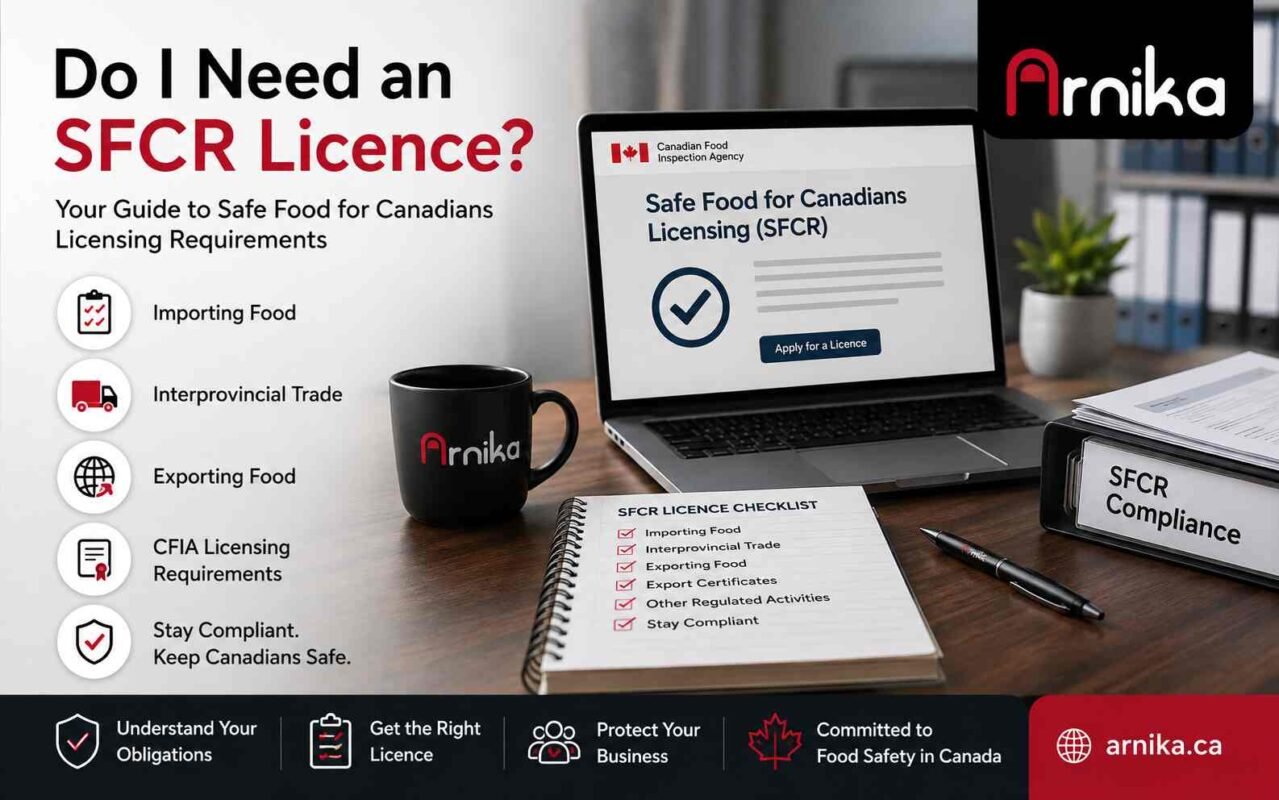
You may need an SFCR licence if your business conducts one or more of the following activities.
You Import Food Into Canada
If you are the person responsible for importing most foods into Canada, you generally need a valid SFC licence for importing food.
For commercial food imports, CFIA requires the licence to be:
- Active
- Issued for the activity “Importing Food”
- Applicable to the commodities being imported
The licence number must also be correctly declared when required for the import transaction.
Example
A Canadian company imports packaged food products from the United States and sells them to Canadian customers.
The company should determine whether it is the importer under the SFCR and, where required, obtain an SFC licence for importing the applicable food commodities.
You Manufacture or Process Food for Interprovincial Trade
An SFCR licence is generally required when a business manufactures, processes, treats, preserves, grades, packages, or labels prescribed food for shipment from one province or territory to another.
The definition of “prepare” under the licensing framework includes activities such as:
- Manufacturing
- Processing
- Treating
- Preserving
- Grading
- Packaging
- Labelling
Certain storage activities can also fall within licensing requirements depending on the circumstances.
Example
A food manufacturer in Ontario produces packaged sauces and sells them to distributors in Quebec and Alberta.
Because the products are being sent across provincial borders, the business should assess whether its activities require an SFC licence.
You Prepare Food for Export
A Canadian business may require an SFC licence when it prepares food for export.
The term prepare can include manufacturing, processing, treating, preserving, grading, packaging, and labelling.
Export requirements can also depend on the requirements of the destination country and whether an export certificate or other export permission is required.
Important distinction
There is a difference between:
Preparing food for export
and
Exporting food.
A business may perform one activity, both activities, or neither. The licensing requirements should therefore be assessed based on the actual activities conducted by the business.
You Export Food and Need an Export Certificate
Exporting food does not automatically mean that every exporter needs an SFC licence for the export activity itself.
CFIA states that an SFC licence is required for exporting food when the exporter needs an export certificate or another export permission from CFIA.
Therefore, exporters should determine:
- What food is being exported?
- Which country is receiving the food?
- Does the destination country require an export certificate?
- Does CFIA issue the required certificate or permission?
- What activities does your Canadian business conduct?
This is particularly important for businesses entering new international markets.
You Slaughter Food Animals for Interprovincial Trade or Export
Specific licensing requirements apply to businesses slaughtering food animals where the resulting meat products are intended for interprovincial trade or export.
These activities can also involve additional CFIA inspection requirements and work-shift arrangements.
Because meat and slaughter operations have specific regulatory requirements, businesses in this sector should assess licensing requirements based on their exact activities and commodities.
You Store and Handle Imported Meat for CFIA Inspection
Certain businesses that store and handle a meat product in its imported condition for CFIA inspection also require an SFC licence.
This is a specific activity under the federal licensing framework and should not be confused with ordinary food warehousing.
When You May Not Need an SFCR Licence
Not every food activity requires an SFCR licence.
For example, a business may not need an SFCR licence when its food activities are limited to intraprovincial trade, depending on the food, activity, and applicable provincial requirements.
CFIA specifically notes that a business generally does not need a federal licence to manufacture, process, treat, preserve, grade, package, or label food that is intended to be sold and consumed only within the same province or territory.
Example
A bakery located in Ontario produces bread and pastries and sells them only to customers and retailers within Ontario.
The business may not require an SFCR licence solely because it manufactures food.
However, that does not mean the business is exempt from all food safety requirements.
Provincial and municipal rules may still apply.
Do Restaurants Need an SFCR Licence?
A restaurant does not automatically need an SFCR licence simply because it prepares food.
If the restaurant prepares and sells food only within its province, the federal SFCR licensing requirement may not apply to that activity.
However, restaurants can still be subject to:
- Provincial food premises requirements
- Municipal public health requirements
- Food handler requirements
- Food safety procedures
- Traceability requirements where applicable
- Labelling requirements where applicable
- Other federal requirements depending on the foods and activities involved
The key question is therefore not simply:
“Are you a restaurant?”
It is:
“What food activities does your business conduct, and where does the food go?”
Do Food Manufacturers Need an SFCR Licence?
Many food manufacturers do, particularly when their products are prepared for:
- Interprovincial trade
- Export
- Certain federally regulated activities
For example, a manufacturer producing food in British Columbia and shipping the finished products to Alberta may have a licensing requirement.
A manufacturer selling only within British Columbia may have a different regulatory situation.
This is why SFCR licensing should be assessed based on actual activities and distribution channels, rather than simply the business category.
Do Food Importers Need an SFCR Licence?
For most commercial food imports covered by the SFCR, the answer is yes.
Before importing, the importer should verify that its SFC licence:
- Is active
- Includes Importing Food
- Covers the applicable food commodities
- Is correctly declared when required
CFIA states that without a valid SFC licence where one is required, an imported food shipment can be denied entry into Canada.
This makes licensing an important part of an importer’s food safety and regulatory compliance system.
Does an SFCR Licence Mean I Am Compliant With Everything?
No.
This is an important distinction.
An SFC licence is not a blanket certification that your entire food business complies with every Canadian food requirement.
Depending on your activities, you may also need to address:
- Preventive controls
- A Preventive Control Plan (PCP), where required
- Traceability
- Labelling
- Packaging
- Food safety procedures
- Record keeping
- Recall procedures
- Complaint handling
- Corrective actions
- Sanitation and hygiene
- Applicable provincial requirements
- Applicable municipal requirements
CFIA specifically notes that businesses that do not require a licence may still have other SFCR requirements that apply to them.
For businesses that need help developing a PCP, see Arnika’s Preventive Control Plan (PCP) Canada guide and HACCP consulting services.
Do I Need a Preventive Control Plan If I Need an SFCR Licence?
Not necessarily in every situation.
This is another area where food businesses often become confused.
Licensing and PCP requirements are related but are not the same requirement.
CFIA’s current food-commodity guidance shows that licensing, preventive controls, PCP, and traceability requirements can differ depending on the activity and commodity.
For example, certain businesses may have a licence but not require a written PCP for a particular activity, while other activities can require both.
There are also specific exceptions to PCP requirements for certain small businesses and food sectors.
Therefore, do not assume:
“I have an SFCR licence, so I automatically need the exact same PCP requirements as every other food business.”
The requirements should be assessed against your actual activities and food commodities.
For more information, see CFIA’s Preventive Control Plan regulatory requirements.
What Information Do I Need to Apply for an SFCR Licence?
When applying for an SFC licence, your business needs to provide information that accurately reflects its operations.
CFIA identifies information such as:
- Licence activities
- Establishment locations, where applicable
- Food commodity categories
- Applicable activities
- Applicable establishments
- Preventive controls
- Written PCP, where required
- Food Safety Supplemental Information (FSSI)
The licence application is completed through My CFIA.
What Is the Food Safety Supplemental Information Questionnaire?
One important current requirement is the Food Safety Supplemental Information (FSSI) questionnaire.
For domestic activities, businesses must complete the FSSI questionnaire for each establishment identified in their SFC licence when applying for, renewing, or amending a licence.
The information helps CFIA assess food safety risks associated with the establishment and its activities.
The questionnaire can include information about:
- Operational activities
- Food commodities
- Processing activities
- Mitigation measures
- Food safety certification systems
- Other establishment-level information
The information is used as part of CFIA’s establishment-based risk assessment process.
Important: The mitigation measures reported in the FSSI questionnaire are not automatically additional regulatory requirements simply because they appear in the questionnaire. CFIA explains that these measures help it assess food safety risks.
How to Apply for an SFCR Licence
CFIA’s current application process can be summarized in five main steps.
Step 1 — Create a My CFIA Account
Create a business profile through My CFIA.
The platform is used for SFC licence applications and other CFIA services.
Step 2 — Determine Your Licence Structure
Your business can have one licence or multiple licences depending on its needs.
Consider:
- Establishments
- Activities
- Food commodities
- Business structure
- Operational locations
- Licensing costs
Step 3 — Complete the Application
Select the appropriate:
- Activities
- Food commodity categories
- Establishments, where applicable
You must also provide the required attestations and complete the applicable FSSI questionnaire for domestic activities.
Step 4 — Verify the Information
Before submitting the application, make sure the information accurately represents your actual business activities.
Incorrect activity or commodity selections can create problems later.
Step 5 — Receive Your Licence
Once the CFIA issues the licence, it will be available through your My CFIA account.
The licence includes an expiry date.
Current CFIA guidance states that an SFC licence expires two years after it is issued or renewed, unless it is cancelled, deactivated, or surrendered earlier.
How Often Does an SFCR Licence Need to Be Renewed?
An SFC licence is currently valid for two years.
CFIA states that the renewal option becomes available in My CFIA 120 days before the licence expiry date.
Businesses should not wait until the licence expires.
If the licence expires, the licence number is no longer valid and the business must apply for a new licence rather than simply renewing the expired licence.
What Happens If My Business Changes?
Your licensing obligations can change when your business changes.
Examples include:
- Adding a new food commodity
- Adding a new activity
- Starting interprovincial distribution
- Starting exports
- Starting imports
- Adding an establishment
- Changing operational practices
- Changing business ownership or structure
CFIA allows businesses to request amendments through My CFIA when applicable.
The SFC licence is also not transferable. A change in ownership or the legal person holding the licence may require a new licence.
SFCR Licence vs Provincial Food Licence
These are not necessarily the same thing.
An SFC licence is a federal licence administered by CFIA under the Safe Food for Canadians framework.
A province, territory, or municipality may also require its own:
- Food premises licence
- Food establishment permit
- Operating permit
- Inspection requirements
- Food handler requirements
- Other local approvals
Having a provincial or municipal food licence does not automatically mean you have an SFC licence.
Likewise, having an SFC licence does not replace applicable provincial or municipal requirements.
Your business should determine which federal, provincial, territorial, and municipal requirements apply to its specific operation.
SFCR Licence vs PCP: What's the Difference?
| Requirement | What it does |
|---|---|
| SFCR Licence | Authorizes specified food activities covered by the federal licensing framework |
| Preventive Controls | Measures used to prevent, eliminate, or reduce food safety hazards |
| PCP | Documents preventive controls and related procedures where a written plan is required |
| Traceability | Helps track food through the supply chain |
| Inspection | CFIA or other authorities verify applicable regulatory requirements |
These requirements work together but should not be treated as interchangeable.
Common SFCR Licensing Mistakes
Food businesses commonly run into problems when they:
Assume every food business needs an SFCR licence
Licensing depends on activities and applicable requirements.
Assume local sales automatically require a federal licence
Intraprovincial activities can fall outside federal licensing requirements, although other rules may still apply.
Forget about imports
Importing food is a major trigger for SFC licensing.
Select the wrong food commodity
The licence should accurately reflect the commodities covered by the activity.
Forget to update the licence after changing operations
New products, activities, establishments, or operational changes can affect licensing requirements.
Confuse a licence with a PCP
An SFC licence and a written Preventive Control Plan are different regulatory requirements.
Assume the licence replaces provincial requirements
Federal licensing does not eliminate applicable provincial or municipal obligations.
SFCR Licence Decision Checklist
Ask the following questions:
Question 1
Do you import food into Canada?
If yes, determine whether an SFC licence is required for your import activity.
Question 2
Do you manufacture, process, package, label, or otherwise prepare food that is sent to another province or territory?
If yes, determine whether the activity is licensable.
Question 3
Do you prepare food for export?
If yes, assess the applicable licensing requirements.
Question 4
Do you export food that requires a CFIA export certificate or other export permission?
If yes, an SFC licence may be required for the export activity.
Question 5
Do you slaughter food animals for interprovincial trade or export?
If yes, specific licensing and inspection requirements apply.
Question 6
Do you store or handle imported meat for CFIA inspection?
If yes, specific licensing requirements may apply.
Question 7
Do you operate only within one province?
If yes, you may not need an SFC licence for that activity, but other federal, provincial, territorial, or municipal requirements may still apply.
When You Should Review Your SFCR Licence
It is a good practice to review your licensing position when:
- You launch a new product
- You start importing
- You begin exporting
- You expand into another province
- You change manufacturing activities
- You add a warehouse or establishment
- You change ownership
- You add new commodities
- You change processing methods
- You renew your licence
- CFIA requests updated information
For domestic establishments, remember that the FSSI questionnaire may also need to be reviewed when licensing information or operational practices change.
How Arnika Can Help With SFCR Licensing and Compliance
Determining whether you need an SFCR licence can become complicated when your business imports, manufactures, processes, stores, distributes, or exports multiple food products.
Arnika provides food safety consulting across Canada to help businesses understand and implement applicable SFCR requirements.
Our support can include:
- SFCR licensing assessment
- Licence activity review
- Food commodity assessment
- Importer compliance support
- Export readiness support
- Interprovincial trade assessment
- Preventive Control Plan development
- HACCP implementation
- GMP implementation
- Traceability systems
- Recall procedures
- Food safety documentation
- CFIA inspection preparation
- Corrective action and compliance support
For broader support, visit Arnika’s Food Safety Consulting Services in Canada.
You can also learn more about CFIA Inspection Preparation if your business is preparing for a CFIA inspection.
Frequently Asked Questions About SFCR Licences
Do all Canadian food businesses need an SFCR licence?
No. SFCR licensing depends on the activities conducted by the business. Importing food and certain activities involving interprovincial trade or export commonly trigger licensing requirements.
Do I need an SFCR licence if I only sell food in my province?
Not necessarily. If your activities are limited to food intended to be sold and consumed within your province or territory, you may not need an SFC licence for those activities. However, other federal, provincial, territorial, or municipal requirements may apply.
Do food importers need an SFCR licence?
For most foods covered by the SFCR, commercial importers require a valid SFC licence for importing food. The licence must be active and cover the applicable activity and commodities.
Do I need an SFCR licence to export food?
It depends on the export activity. An SFC licence is required when exporting food if an export certificate or another CFIA export permission is required. Preparing food for export can also trigger licensing requirements.
Is an SFCR licence the same as a PCP?
No. A licence authorizes specified food activities, while a Preventive Control Plan documents preventive controls and related procedures where a written PCP is required.
How long is an SFCR licence valid?
An SFC licence is currently valid for two years from the date it is issued or renewed, unless it is cancelled, deactivated, or surrendered earlier.
Can I change my SFCR licence?
Yes. Businesses can request amendments through My CFIA when changes to activities, commodities, establishments, or other applicable information require an amendment.
What happens if my SFCR licence expires?
Once an SFC licence expires, the licence number is no longer valid. CFIA states that the business must apply for a new licence rather than renew the expired licence.
Where can I check whether I need an SFCR licence?
CFIA provides a Licensing interactive tool to help businesses determine whether licensing requirements apply.
Final Takeaway
Do I need an SFCR licence?
The answer depends on your food activities, commodities, and how your products move through the Canadian and international supply chain.
You are more likely to need an SFC licence if you:
- Import food into Canada
- Prepare food for interprovincial trade
- Prepare food for export
- Export food requiring a CFIA export certificate or other permission
- Conduct certain meat or slaughter activities
- Conduct other specifically regulated activities
But if your business operates only within one province, an SFC licence may not be required for certain activities.
The important point is that not needing an SFCR licence does not necessarily mean your business has no food safety obligations.
Before starting a new food activity, expanding distribution, importing, exporting, or changing your operation, review the applicable federal and provincial requirements.
For official guidance, CFIA’s SFCR licensing information and licensing tools should be your starting point.
Need Help Determining Your SFCR Requirements?
Arnika helps Canadian food businesses understand, implement, and maintain practical food safety and regulatory systems.
If you are unsure whether your business needs an SFCR licence, whether your current licence covers your activities, or whether you also need a PCP and other preventive controls, our consultants can review your operation and help identify the applicable requirements.
Contact Arnika today for practical food safety and SFCR consulting support across Canada.