
BLOG
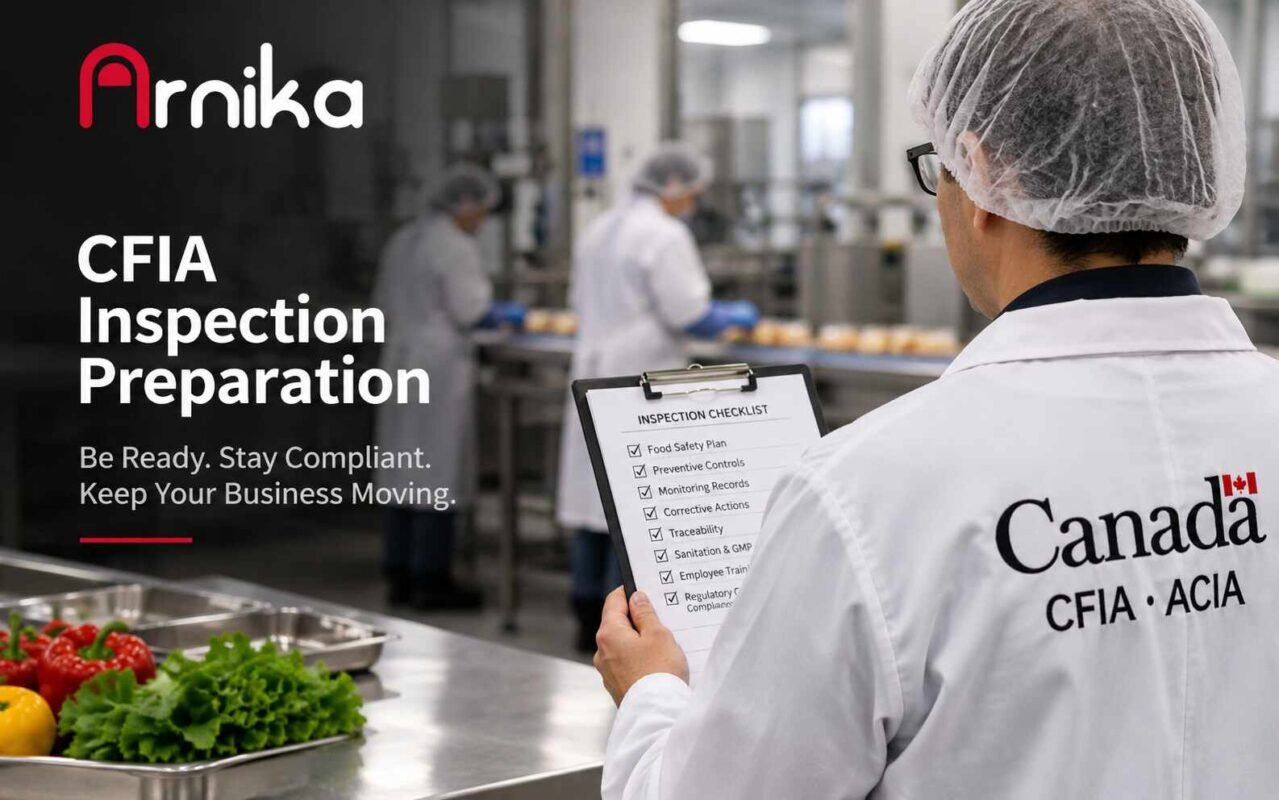
Preparing for a Canadian Food Inspection Agency (CFIA) inspection requires more than having documents on a shelf. Food businesses need to demonstrate that their preventive controls are appropriate, implemented, monitored, verified, and supported by reliable records.
Arnika provides CFIA inspection preparation services for food manufacturers, processors, importers, warehouses, distributors, and other regulated food businesses across Canada.
Our approach focuses on identifying compliance gaps before an inspection, strengthening your Preventive Control Plan (PCP) and supporting programs, reviewing records and procedures, and helping your team understand what inspectors may need to verify.
Whether you have an upcoming CFIA inspection, have received inspection findings, or simply want to assess your readiness, our team can help you prepare with a practical, risk-based approach.
Reviewed by Reza Eslami
CEO & Co-Founder, Arnika
25+ years of experience in food safety, HACCP, SFCR, SQF, GMP, and regulatory compliance.
→ View full profile
What Is a CFIA Inspection?
The Canadian Food Inspection Agency (CFIA) verifies whether regulated food businesses are meeting applicable federal food safety and consumer protection requirements.
For businesses subject to the Safe Food for Canadians Regulations (SFCR), a written Preventive Control Plan may be required. A PCP describes how a business identifies and controls food safety hazards and addresses applicable consumer protection requirements.
CFIA verification activities can include inspection and surveillance. When non-compliance is identified, CFIA may take appropriate compliance and enforcement action.
This means preparation should not focus only on passing an inspection. Your food safety system should actually work in day-to-day operations.
Why Prepare for a CFIA Inspection?
A CFIA inspection can identify weaknesses in your food safety system that may otherwise remain unnoticed.
Preparing in advance allows your organization to identify and correct issues before they become regulatory problems.
A structured inspection-readiness assessment can help you:
- Identify gaps in your Preventive Control Plan
- Review prerequisite programs and preventive controls
- Verify that procedures are actually being followed
- Review monitoring and verification records
- Identify documentation gaps
- Evaluate employee knowledge and training
- Review corrective action procedures
- Strengthen traceability and recall procedures
- Identify sanitation, maintenance, pest-control, or hygiene weaknesses
- Prepare management and employees for inspection activities
- Reduce the risk of unexpected non-compliance findings
CFIA guidance emphasizes that businesses must not only develop a PCP but also implement it, maintain records, and verify that the control measures are effective.
What Does CFIA Inspection Preparation Include?
Every food business is different, so inspection preparation should be tailored to the company’s products, processes, facility, regulatory obligations, and existing food safety system.
Arnika’s CFIA inspection preparation services can include the following areas.
Preventive Control Plan Review
Your Preventive Control Plan is one of the most important areas to review before a CFIA inspection.
CFIA guidance indicates that a written PCP may include hazard analysis, control measures, critical control points and limits where applicable, monitoring, corrective actions, verification procedures, supporting documentation, and evidence that the plan has been implemented.
Arnika can review your PCP to determine whether:
- The plan reflects your current operation
- Products and processes are accurately described
- Hazard analysis is appropriate
- Preventive controls are clearly documented
- CCPs and critical limits are properly addressed where applicable
- Monitoring procedures are defined
- Corrective actions are documented
- Verification procedures are established
- Supporting records are available
- The PCP matches what actually happens on the production floor
Your PCP should describe your real operation, not an idealized version of it.
HACCP and Hazard Analysis Review
A strong hazard analysis is an important part of an effective preventive control system.
Arnika can review your hazard analysis and HACCP-based controls to help determine whether biological, chemical, and physical hazards have been appropriately considered throughout your processes.
This may include reviewing:
- Raw materials and ingredients
- Packaging materials
- Processing steps
- Product flow
- Personnel and traffic flow
- Potential cross-contamination
- Allergen hazards
- Environmental hazards
- Critical control points
- Critical limits
- Monitoring procedures
- Corrective actions
- Verification activities
Our HACCP consulting services can also support businesses that need to develop, update, or strengthen their HACCP-based food safety systems.
Prerequisite Program Review
A CFIA inspection is not limited to your HACCP plan.
Your broader preventive controls and prerequisite programs need to be implemented effectively in the facility.
Depending on your operation, these may include:
- Good Manufacturing Practices (GMP)
- Sanitation
- Personal hygiene
- Pest control
- Allergen control
- Supplier control
- Equipment maintenance
- Water and ice control
- Chemical control
- Glass and brittle plastic control
- Waste management
- Temperature control
- Storage and transportation
- Employee training
- Traceability
- Recall procedures
Our HACCP prerequisite programs page explains how these foundational programs support a broader food safety system.
Arnika can assess whether your programs are documented, implemented, monitored, and supported by appropriate records.
GMP and Facility Readiness
Good Manufacturing Practices provide the foundation for hygienic and controlled food production.
During inspection preparation, we can review areas such as:
- Facility condition
- Personnel hygiene
- Cleaning and sanitation
- Equipment condition
- Production areas
- Storage areas
- Pest-control measures
- Product flow
- Personnel flow
- Cross-contamination risks
- Maintenance
- Temperature control
- Food-contact surfaces
Our GMP consulting and food safety resources can help businesses strengthen the underlying practices that support their preventive control system.
Documentation and Record Review
A procedure is only useful if employees follow it and the business can demonstrate that it is being implemented.
CFIA guidance explains that records provide evidence that a PCP has been implemented and is working effectively. For many PCP records, the SFCR requires records to be retained for two years, with specific longer retention requirements for certain low-acid shelf-stable foods.
Arnika can review records such as:
- Production records
- Temperature records
- Cleaning and sanitation records
- Monitoring records
- CCP records
- Corrective action reports
- Verification records
- Calibration records
- Pest-control records
- Employee training records
- Supplier records
- Receiving records
- Traceability records
- Complaint records
- Recall documentation
- Laboratory and testing results
The goal is to determine whether your records demonstrate what your food safety system says is happening.
Corrective Action and Non-Conformity Review
Food businesses should have a clear process for dealing with deviations and non-compliance.
Corrective action procedures should help the business:
- Identify the problem
- Control affected food or processes
- Determine whether food safety has been affected
- Correct the immediate issue
- Identify the root cause
- Prevent recurrence
- Document the actions taken
- Verify that the corrective action was effective
CFIA guidance specifically identifies corrective action, including determining root cause and preventing recurrence, as an important component of preventive controls.
Arnika can help businesses evaluate their corrective action system and strengthen procedures where necessary.
Our Root Cause Analysis in Food Manufacturing resources provide additional guidance on investigating recurring or significant food safety problems.
Traceability and Recall Readiness
Traceability and recall procedures are important components of food safety preparedness.
Your organization should be able to demonstrate how products, ingredients, suppliers, and customers are identified and tracked as applicable to your operation.
Inspection preparation may include reviewing:
- Lot identification
- Supplier records
- Receiving records
- Production records
- Distribution records
- Customer records
- Traceability exercises
- Recall procedures
- Recall responsibilities
- Complaint handling
- Recall documentation
Businesses can also review our food recall management in Canada resources for additional information.
Employee Training and Interview Readiness
Your employees are an important part of your food safety system.
A well-written PCP cannot compensate for employees who do not understand their responsibilities or follow established procedures.
Arnika can help businesses assess whether employees understand:
- Personal hygiene requirements
- Sanitation procedures
- Food safety hazards
- CCP monitoring
- Corrective actions
- Allergen controls
- Product handling
- Traceability procedures
- Recall responsibilities
- Documentation requirements
Employees should understand what they do, why they do it, and what they should do when something goes wrong.
Mock CFIA Inspection
One of the most practical ways to prepare is to conduct an independent mock CFIA inspection before the actual inspection.
A mock inspection can combine:
- Document review
- PCP assessment
- Facility walkthrough
- Employee discussions
- Record review
- Observation of operational practices
- Identification of potential compliance gaps
- Corrective action recommendations
The objective is not to imitate a CFIA inspector or guarantee an inspection outcome.
Instead, the objective is to provide an independent assessment of your current readiness and identify areas that deserve attention.
What Happens During Arnika's CFIA Inspection Preparation Process?
Our approach can be adapted to the size and complexity of your operation.
Initial Consultation
We begin by understanding your business, products, facility, processes, regulatory situation, and reason for seeking inspection preparation.
Document Review
We review relevant food safety documents, including your PCP, HACCP documentation, prerequisite programs, SOPs, records, and corrective action procedures.
Facility Assessment
Where appropriate, we conduct an on-site assessment of the facility and operational practices.
This allows us to compare documented procedures with actual practices.
Gap Assessment
We identify areas that may require improvement and prioritize findings according to their potential food safety and compliance significance.
Corrective Action Planning
We provide practical recommendations for addressing identified gaps.
Where appropriate, this can include documentation improvements, procedural changes, employee training, verification activities, and operational improvements.
Follow-Up
Depending on the project, Arnika can provide follow-up support to evaluate whether corrective actions have been implemented effectively.
CFIA Inspection Preparation Checklist
Before an inspection, food businesses should consider reviewing the following:
Food Safety System
- Is your PCP current?
- Does it accurately describe your operation?
- Has your hazard analysis been reviewed?
- Are your preventive controls clearly documented?
- Are your procedures being followed?
Facility
- Is the facility maintained and sanitary?
- Are equipment and food-contact surfaces properly maintained?
- Are pest-control measures effective?
- Are personnel and product flows controlled?
- Are storage conditions appropriate?
Records
- Are required records complete?
- Are entries accurate and timely?
- Can records be easily retrieved?
- Do records demonstrate that controls are actually being implemented?
Employees
- Have employees received appropriate training?
- Do employees understand their responsibilities?
- Can employees explain what they do when a deviation occurs?
Corrective Actions
- Are deviations documented?
- Are affected products controlled?
- Are root causes investigated?
- Are corrective actions verified for effectiveness?
Traceability and Recall
- Can products be traced through your system?
- Are recall procedures documented?
- Have you tested your traceability or recall process?
CFIA’s own preventive-control checklist highlights areas including sanitation, pest control, temperature and humidity controls, movement of people and food, employee training and hygiene, complaints, corrective actions, recalls, labelling, and record keeping.
Common CFIA Inspection Preparation Mistakes
Many businesses focus heavily on documentation and overlook implementation.
Common weaknesses include:
Outdated Procedures
The PCP describes an old process, while the facility operates differently.
Incomplete Records
Employees perform the required activities but records are missing, incomplete, or inconsistent.
Weak Verification
The company monitors controls but does not adequately verify that the controls are effective.
CFIA describes verification as a way to confirm that control measures and procedures are consistently implemented and effective.
Employee Knowledge Gaps
Employees may sign training records without being able to explain the procedures they are expected to follow.
Corrective Actions That Treat Symptoms
The immediate problem is fixed, but the underlying cause is not investigated or addressed.
Failure to Update the PCP
CFIA recommends reassessing the PCP when something changes, such as regulations, products, ingredients, equipment, processes, or when problems such as recalls, complaints, laboratory issues, or inspection findings occur.
Who Can Benefit From CFIA Inspection Preparation Services?
Arnika’s services may be appropriate for:
- Food manufacturers
- Food processors
- Food importers
- Food packaging operations
- Warehouses
- Distributors
- Food businesses preparing for federal inspection
- Companies responding to inspection findings
- Businesses developing or updating a PCP
- Companies preparing for a new or expanded operation
- Businesses seeking an independent food safety assessment
The exact requirements depend on the nature of the business, products, activities, and applicable regulations.
CFIA Inspection Preparation vs. CFIA Inspection
It is important to understand the difference.
CFIA inspection is a regulatory activity conducted by the Canadian Food Inspection Agency.
CFIA inspection preparation is an independent service that helps a food business evaluate and improve its readiness before a regulatory inspection.
Arnika does not represent itself as CFIA and cannot guarantee a particular inspection outcome.
Our role is to help businesses understand their food safety systems, identify potential gaps, strengthen controls, and prepare their teams and documentation.
How Arnika Can Help
Arnika provides food safety consulting, training, auditing, inspection, testing, and certification-related services for food businesses across Canada.
For CFIA inspection preparation, our support can include:
- Preventive Control Plan review
- HACCP review
- Prerequisite program assessment
- GMP assessment
- Documentation review
- Record review
- Facility inspection
- Employee training
- Corrective action support
- Root cause analysis
- Traceability and recall readiness
- Mock inspection
- Follow-up verification
Our food safety consulting services can be tailored to the specific needs of your operation.
Why Choose Arnika for CFIA Inspection Preparation?
Effective inspection preparation requires more than a checklist.
It requires an understanding of how regulatory requirements, HACCP, prerequisite programs, GMP, documentation, employee practices, and operational controls work together.
Arnika brings practical food safety experience to help businesses evaluate their systems from both a regulatory and operational perspective.
Our goal is to help you identify problems before they become bigger problems and build food safety systems that work in practice—not just on paper.
Need Help Preparing for a CFIA Inspection?
If your business has an upcoming CFIA inspection, has received inspection findings, or wants an independent assessment of its food safety readiness, Arnika can help.
We can review your Preventive Control Plan, food safety programs, documentation, records, facility practices, and employee responsibilities and help you develop a practical plan to address identified gaps.
Contact Arnika to discuss your CFIA inspection preparation needs.
FAQs About CFIA Inspection Preparation
What is CFIA inspection preparation?
CFIA inspection preparation is an independent assessment and improvement process that helps a food business evaluate its readiness for a CFIA inspection. It may include reviewing the PCP, prerequisite programs, records, facility conditions, employee practices, corrective actions, and traceability systems.
How can I prepare for a CFIA inspection?
Start by reviewing your Preventive Control Plan and confirming that it accurately reflects your current operation. Review your preventive controls, records, sanitation, employee training, corrective actions, traceability, and recall procedures. Most importantly, verify that documented procedures are actually being followed.
CFIA guidance states that businesses with a written PCP need to implement it, maintain evidence of implementation, and verify that their controls are effective.
Does CFIA approve Preventive Control Plans?
No. CFIA states that it does not approve PCPs. Inspectors verify whether businesses have documented evidence that their preventive controls are effective and compliant.
What does CFIA look for during an inspection?
The areas reviewed depend on the business and applicable requirements. They can include preventive controls, sanitation, employee hygiene, facility and equipment conditions, hazard controls, monitoring, records, corrective actions, traceability, labelling, and other regulatory requirements.
What documents should I have ready for a CFIA inspection?
The documents required depend on your operation. They may include your PCP, hazard analysis, SOPs, prerequisite programs, monitoring records, verification records, corrective action records, training records, sanitation records, traceability records, supplier documentation, and other supporting records.
How long should PCP records be kept?
CFIA guidance states that SFCR requires PCP records to generally be retained for two years, with a three-year requirement for records related to thermal processing of low-acid food in hermetically sealed containers.
Can Arnika conduct a mock CFIA inspection?
Yes. Arnika can provide an independent inspection-readiness assessment that may include document review, facility assessment, record review, employee discussions, and identification of potential gaps.
A mock assessment is not a CFIA inspection and cannot guarantee the outcome of an actual regulatory inspection.
What happens if CFIA finds non-compliance?
The response depends on the nature and significance of the finding. A business may need to take corrective action and demonstrate that the underlying issue has been addressed. CFIA may take appropriate compliance or enforcement action when non-compliance is identified.
Can Arnika help after a CFIA inspection?
Yes. Depending on the situation, Arnika can help review findings, investigate root causes, develop corrective actions, update food safety documentation, provide training, and support follow-up activities.
Is CFIA inspection preparation the same as a food safety audit?
No. An inspection is a regulatory verification activity, while an independent assessment or mock inspection is a preparation and improvement service. The scope and purpose should be clearly defined before the engagement.