

BLOG
For many food businesses, a visit from the Canadian Food Inspection Agency (CFIA) can feel stressful. Whether you manufacture, process, import, export, or distribute food, a CFIA inspection is designed to verify that your operation complies with the Safe Food for Canadians Regulations (SFCR) and that your food safety system effectively protects consumers.
The good news is that inspections should never be a surprise if your food safety system is well implemented. Businesses that maintain accurate records, follow documented procedures, and continuously improve their operations are generally well prepared for regulatory inspections.
This guide explains what happens during a CFIA inspection, what inspectors typically review, and how you can prepare your facility using a practical CFIA inspection checklist.
Reviewed by Reza Eslami, CEO & Co-Founder of Arnika
Food Safety Consultant with 25+ years of experience in HACCP, GMP, SFCR, SQF, BRCGS, FSSC 22000, and regulatory compliance for Canadian food businesses.
👉 Read Reza’s full profile
What Is a CFIA Inspection?
A CFIA inspection is an official assessment conducted by the Canadian Food Inspection Agency to determine whether a food business complies with applicable Canadian food laws and regulations.
Depending on your operation, inspectors may evaluate:
- Food safety programs
- Preventive Control Plans (PCPs)
- Sanitation procedures
- Employee hygiene practices
- Traceability systems
- Product labelling
- Equipment maintenance
- Pest control
- Supplier approval programs
- Food safety records
The objective is not only to identify non-compliance but also to verify that preventive controls are consistently implemented.
Why Do CFIA Inspections Matter?
A successful inspection helps demonstrate that your organization is committed to producing safe food and complying with Canadian regulations.
Benefits of maintaining inspection readiness include:
- Protecting consumers from food safety risks
- Reducing the likelihood of recalls
- Demonstrating due diligence
- Maintaining customer confidence
- Supporting certification programs such as SQF, BRCGS, and FSSC 22000
- Avoiding enforcement actions and unnecessary business interruptions
Inspection readiness should be viewed as an ongoing process rather than a one-time event.
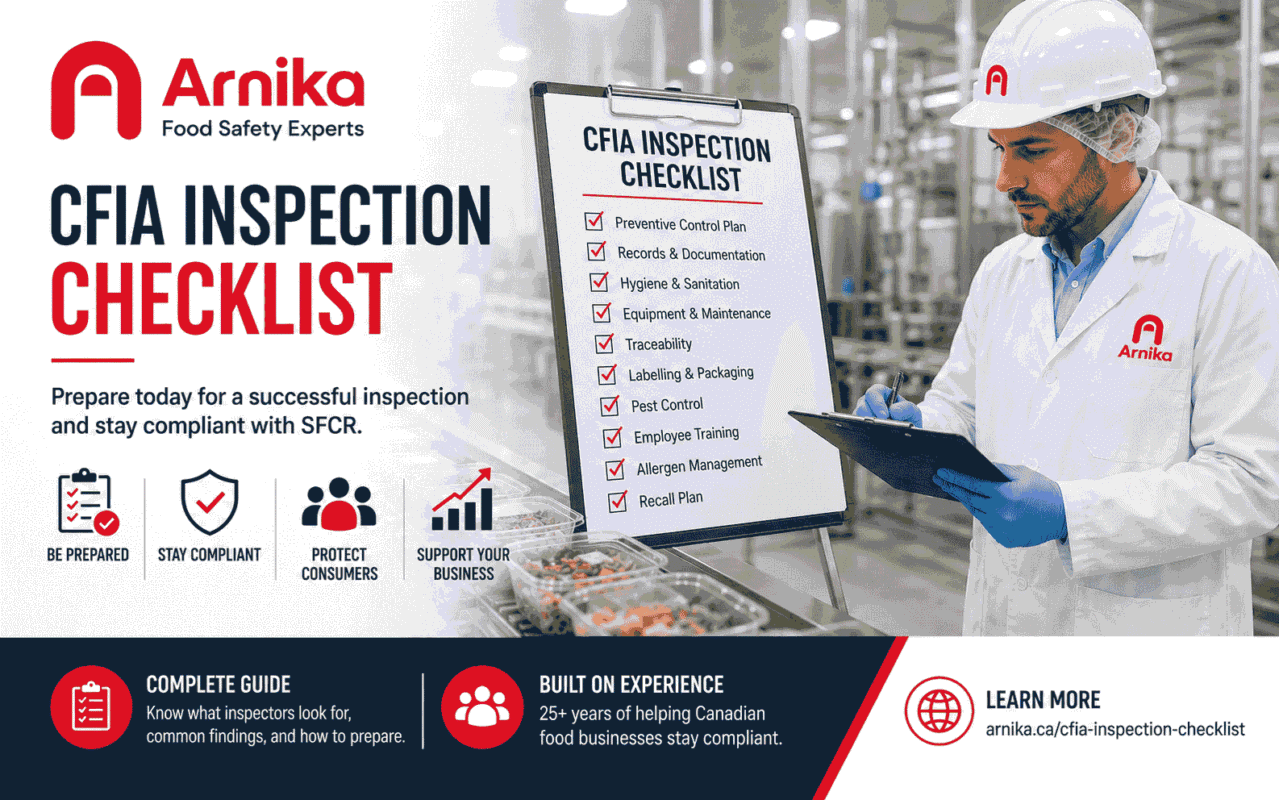
CFIA Inspection Checklist
Before an inspection, review the following areas carefully.
Documentation
✔ Preventive Control Plan (PCP) is current
✔ Standard Operating Procedures (SOPs)
✔ Sanitation records
✔ Training records
✔ Corrective action records (CAPA)
✔ Calibration records
✔ Supplier approval documentation
✔ Recall procedures & Traceability records
✔ Customer Complaint records
Facility Conditions
Inspectors commonly review:
- Building maintenance
- Floors, walls, and ceilings
- Lighting
- Drainage
- Ventilation
- Waste management
- Employee welfare facilities
A clean and well-maintained facility demonstrates strong operational control.
Employee Practices
Ensure employees consistently follow food safety procedures.
Inspectors may observe:
- Handwashing practices
- Protective clothing
- Hair restraints
- Glove usage
- Illness reporting procedures
- Cross-contamination prevention
Training records should support observed practices.
Equipment
Equipment should be:
- Clean
- Properly maintained
- Calibrated where necessary
- Suitable for food contact
- Free of damage
Poorly maintained equipment increases contamination risks.
Cleaning and Sanitation
Review your sanitation program.
Confirm that:
- Cleaning schedules are followed.
- Chemicals are correctly labelled.
- Verification activities are completed.
- Records are maintained.
- Cleaning tools are properly stored.
Pest Control
Inspectors often review:
- Pest control reports
- Bait station maps
- Corrective actions
- Evidence of pest activity
- Building integrity
An effective pest management program is essential for compliance.
Traceability
Businesses should be able to quickly identify:
- Incoming ingredients
- Production batches
- Finished products
- Customers
- Suppliers
Strong traceability supports rapid product recalls when necessary.
Product Labelling
Inspectors may verify:
- Ingredient lists
- Allergen declarations
- Nutrition information
- Product identity
- Lot codes
- Date markings
Labelling errors are among the most common compliance issues.
Common Findings During CFIA Inspections
Some of the most common observations include:
- Incomplete documentation
- Outdated Preventive Control Plans
- Missing employee training records
- Poor sanitation verification
- Weak traceability systems
- Equipment maintenance deficiencies
- Incomplete corrective actions
- Labelling inaccuracies
Many of these issues are preventable through routine internal audits.
How to Prepare Before the Inspector Arrives
Preparation should begin long before the inspection date.
Recommended actions include:
- Conduct an internal audit.
- Review your Preventive Control Plan.
- Verify employee training.
- Organize inspection records.
- Correct outstanding deficiencies.
- Walk through the facility from the inspector’s perspective.
- Ensure management personnel are available.
The goal is not simply to pass an inspection but to demonstrate that food safety is embedded in daily operations.
How Arnika Helps Food Businesses Prepare for CFIA Inspections
Preparing for a CFIA inspection can be challenging, particularly for growing businesses or organizations facing new regulatory requirements.
Arnika works with food manufacturers, processors, importers, distributors, retailers, and food service businesses across Canada to strengthen inspection readiness.
Our services include:
- CFIA pre-inspection assessments
- Preventive Control Plan development and review
- HACCP implementation
- GMP assessments
- Internal audits
- Food safety training
- Corrective action planning
- Ongoing compliance support
Our objective is to help businesses build practical food safety systems that support both regulatory compliance and operational excellence.
Conclusion
CFIA inspections should never be viewed as isolated events. Businesses that maintain strong preventive controls, accurate documentation, trained employees, and effective food safety programs are far better positioned to demonstrate compliance.
By preparing continuously rather than reactively, organizations can reduce regulatory risk, strengthen consumer confidence, and improve overall operational performance.
CFIA inspection Checklist FAQs
What is a CFIA inspection?
A CFIA inspection evaluates whether a food business complies with Canadian food safety regulations, including the Safe Food for Canadians Regulations (SFCR).
What documents should be available during a CFIA inspection?
Businesses should have a current Preventive Control Plan, sanitation records, training records, traceability documents, supplier records, corrective actions, and recall procedures readily available.
Does every food business receive CFIA inspections?
Inspection frequency depends on factors such as commodity, risk level, compliance history, and regulatory requirements.
How can businesses prepare for a CFIA inspection?
Conduct internal audits, review documentation, train employees, verify preventive controls, and correct deficiencies before an inspection.
Can Arnika help prepare for a CFIA inspection?
Yes. Arnika provides CFIA pre-inspection assessments, food safety consulting, HACCP implementation, Preventive Control Plan development, training, and internal auditing services.
Prepare for Your Next CFIA Inspection with Confidence
Whether you’re expecting your first inspection or looking to strengthen your existing food safety system, Arnika can help.
Our experienced consultants provide practical support with CFIA inspection readiness, Preventive Control Plans, HACCP, GMP, SFCR compliance, internal audits, and food safety training tailored to your business.
👉 Contact Arnika today to schedule a CFIA pre-inspection assessment and identify opportunities to strengthen your compliance before inspectors arrive.