

BLOG
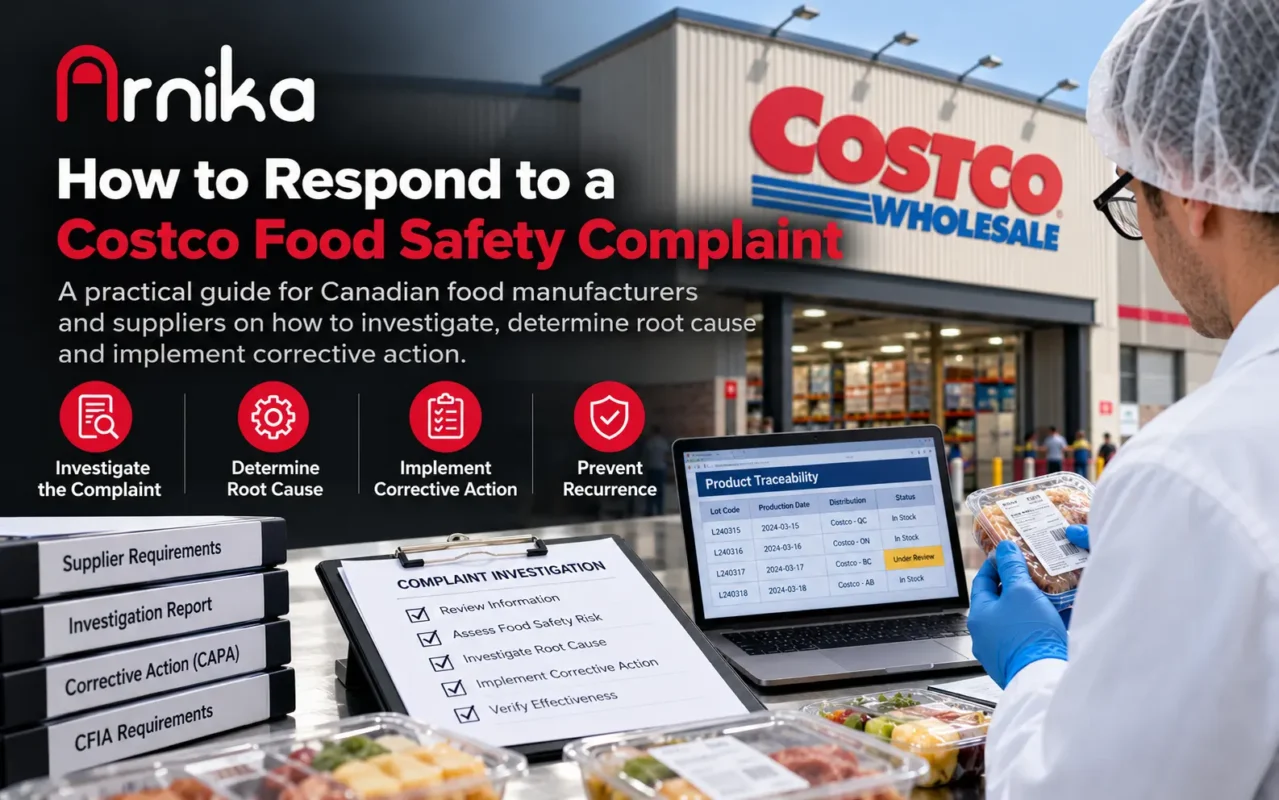
Receiving a Costco food safety complaint can be stressful for a food manufacturer, processor, importer, or supplier. A complaint involving a foreign material, allergen, contamination, spoilage, incorrect labelling, packaging issue, or illness allegation should be treated seriously and investigated systematically.
The goal is not simply to provide Costco with a quick response.
The goal is to determine what happened, whether other products may be affected, what caused the problem, what immediate controls are required, and how recurrence will be prevented.
For Canadian food businesses, complaint investigations should also fit within applicable food safety, preventive control, traceability, recall, and regulatory requirements.
The CFIA specifically expects regulated businesses to have procedures for receiving, investigating, and responding to food complaints and to document the complaint, investigation results, and actions taken.
Reviewed by Reza Eslami, CEO & Co-Founder of Arnika, with more than 25 years of experience in food safety, quality, HACCP, GMP, SFCR and certification readiness.
What Should You Do When Costco Reports a Food Safety Complaint?
The first step is to take control of the investigation without jumping to conclusions.
Do not immediately assume the complaint is caused by your facility. At the same time, do not dismiss the complaint because you believe the product was manufactured correctly.
Start by collecting all available information.
Important information may include:
- Product name
- Brand
- Costco item number, if applicable
- Lot code
- Production date
- Best-before date
- UPC
- Quantity involved
- Warehouse or distribution location
- Date of complaint
- Nature of the complaint
- Photographs or videos
- Returned product or sample
- Customer information, where appropriately available
- Whether illness, injury, or allergic reaction was reported
- Other complaints involving the same product or lot
Costco may also have specific supplier, quality, communication, or corrective-action requirements under your commercial agreement or supplier procedures. Follow the applicable Costco requirements and your established complaint-response procedure.
Costco publicly identifies food and sundry supplier contacts for its Canadian Eastern and Western regions, but the appropriate communication channel for an active complaint should be determined from your supplier relationship and Costco’s instructions.
Acknowledge the Complaint Quickly
Your first response should be professional, factual, and controlled.
Avoid statements such as:
“This could not have happened at our facility.”
or:
“Our product is safe, so the complaint must be incorrect.”
Instead, acknowledge the complaint and confirm that an investigation has been initiated.
A simple response could be:
We have received the complaint and initiated an investigation. We are reviewing the affected product, production records, traceability information, environmental and process controls, and relevant testing results. We will provide an update once the investigation has progressed and appropriate corrective actions have been identified.
The initial communication should focus on facts and actions, not speculation.
Determine the Potential Food Safety Risk
Not every complaint represents the same level of risk.
For example, a cosmetic quality issue is different from:
- An undeclared allergen
- Potential pathogen contamination
- Foreign material
- Chemical contamination
- Evidence of tampering
- Foodborne illness
- Incorrect product or label
- Temperature abuse
- Spoilage that could indicate a process-control failure
The potential severity, likelihood, distribution, affected population, and reported illness or injury should influence the urgency of the investigation.
CFIA’s food incident process considers factors including the hazard, severity and likelihood of harm, distribution, target population, reported illness or injury, and product shelf life.
If there is reason to believe that a food may pose a risk to human health, do not wait for the commercial complaint process to resolve before addressing regulatory responsibilities.
Put the Affected Product Under Control (Hold)
If the investigation indicates that potentially affected product may still be under your control, immediately determine whether it should be:
- Held
- Segregated
- Stopped from shipment
- Removed from inventory
- Placed on quality hold
- Prevented from further distribution
You should also determine whether other lots could be affected.
For example, if a foreign material complaint is associated with one production lot, investigate whether the same equipment, ingredient, packaging material, shift, or process was used on other lots.
Your traceability system should allow you to determine where the product came from and where it went.
CFIA’s inspection guidance specifically expects traceability and control systems to support stopping further distribution and retrieving implicated products when necessary.
Conduct a Documented Investigation
A Costco complaint should not be investigated only through email discussions.
Build a documented investigation.
Depending on the complaint, review:
Production Records
- Production date and time
- Batch records
- Line records
- Processing parameters
- Monitoring records
- Deviations
- Equipment information
Ingredients
- Ingredient lot numbers
- Supplier information
- Certificates of analysis where applicable
- Receiving records
- Ingredient specifications
- Previous supplier complaints
Packaging and Labels
- Packaging lot
- Label version
- Line clearance records
- Packaging specifications
- Allergen declarations
- Coding information
Food Safety Controls
- HACCP plan
- Preventive control measures
- CCP monitoring
- GMP records
- Sanitation records
- Environmental monitoring where applicable
- Metal detection or X-ray records where applicable
- Verification records
Your HACCP program and Preventive Control Plan should be important sources of evidence during the investigation.
Perform Root Cause Analysis
Finding the immediate cause is not necessarily the same as finding the root cause.
For example:
Complaint: Plastic fragment found in finished product.
Immediate cause: Plastic fragment entered the product during production.
But the investigation should continue:
- Where did the plastic come from?
- Did equipment break?
- Was a component damaged?
- Was the equipment inspected?
- Was the inspection frequency adequate?
- Was preventive maintenance completed?
- Did an employee identify the damaged component?
- Was the hazard identified in the HACCP hazard analysis?
- Were existing preventive controls effective?
A useful root cause analysis should identify why the system allowed the problem to occur.
Avoid writing “employee error” as the root cause without investigating why the system permitted the error.
Determine Whether Other Products Are Affected
One of the most important questions is:
Is this an isolated incident or a broader problem?
Review:
- Other production lots
- Other production dates
- Other SKUs
- Other Costco shipments
- Common ingredients
- Common suppliers
- Common equipment
- Common production lines
- Similar complaints
- Testing results
- Environmental or sanitation findings
Traceback and traceforward activities help determine where a food originated and where affected product was distributed.
This step can significantly change the scope of the response.
Decide Whether Regulatory Notification or Recall Action Is Required
A Costco complaint can become more than a customer-service issue if the investigation identifies a potential food safety risk.
Depending on the circumstances, you may need to consider:
- Regulatory notification
- Product hold
- Withdrawal
- Recall
- Customer notification
- Additional testing
- Increased monitoring
- Corrective action
- Preventive action
CFIA states that food businesses are responsible for taking appropriate action when they become aware that food may pose a risk, including conducting a recall where appropriate.
Do not make the mistake of waiting until the investigation is “perfect” before taking necessary risk-control measures.
Control the risk first. Complete the investigation as evidence becomes available.
Prepare a Strong Corrective Action Response
If Costco requests a corrective action plan, avoid providing a response that simply says:
“Employees were retrained.”
Training may be part of the solution, but it is rarely sufficient if the underlying system problem has not been addressed.
A stronger corrective action response should explain:
Problem
What happened?
Immediate Correction
What was done to control the affected product?
Root Cause
Why did the problem occur?
Corrective Action
What was changed to address the cause?
Preventive Action
What will prevent recurrence?
Verification
How will you confirm that the corrective action actually worked?
For example:
Root cause: Inadequate inspection of a packaging component.
Corrective action: Revised the inspection procedure and frequency.
Preventive action: Added documented verification and supervisor review.
Effectiveness verification: Review inspection records and complaint trends for a defined period.
This demonstrates a functioning food safety management system rather than simply a short-term reaction.
Communicate Professionally With Costco
When responding to Costco, keep communication:
- Factual
- Timely
- Professional
- Evidence-based
- Consistent with your investigation
- Clear about actions taken
Do not provide unsupported conclusions.
If the investigation is still underway, say so.
If the root cause has not been confirmed, do not label a suspected cause as a confirmed cause.
If testing is pending, clearly identify what testing is being conducted and what question it is intended to answer.
Update Your Food Safety System
A complaint should become a learning opportunity for the food safety system.
After completing the investigation, determine whether changes are required to:
- HACCP hazard analysis
- Preventive controls
- GMP procedures
- Sanitation procedures
- Supplier controls
- Employee training
- Equipment maintenance
- Inspection procedures
- Sampling/testing
- Traceability
- Complaint procedures
- Recall procedures
- Verification activities
CFIA’s preventive-control checklist specifically recommends reviewing and updating the preventive control plan when issues arise, including a customer complaint, recall, or unsatisfactory laboratory result.
Costco Food Safety Complaint Response Checklist
Before closing the investigation, confirm that you have:
☐ Documented the original complaint
☐ Identified the affected product and lot
☐ Assessed the potential food safety risk
☐ Placed potentially affected product under control
☐ Reviewed production records
☐ Reviewed ingredient and supplier records
☐ Reviewed packaging and labelling records
☐ Checked traceability
☐ Reviewed previous complaints
☐ Conducted root cause analysis
☐ Determined whether other products are affected
☐ Evaluated regulatory notification/recall requirements
☐ Implemented corrective actions
☐ Established preventive actions where necessary
☐ Verified corrective-action effectiveness
☐ Communicated findings appropriately
☐ Updated procedures or the food safety system where necessary
CFIA’s current inspection guidance also expects complaint records to include the complaint details, investigation results, and actions taken, with records retained for at least two years after the actions are completed.
What Not to Do After a Costco Complaint
Avoid these common mistakes:
- Dismissing the complaint too early
A complaint may reveal a previously unidentified hazard. - Blaming an employee immediately
“Employee error” may be a symptom rather than the root cause. - Testing the product without investigating the process
A negative test result does not automatically prove that the production system was effective. - Retraining everyone without identifying the cause
Training should address an identified competency or procedural gap. - Ignoring other lots
Always determine whether the same condition could have affected additional product. - Closing the complaint without effectiveness verification
Corrective action should be checked to determine whether it actually solved the problem.
How Arnika Can Help With Food Safety Complaint Investigations
A serious retailer complaint can expose weaknesses in a company’s food safety system, documentation, traceability, corrective action, or verification processes.
Arnika provides food safety consulting support for Canadian food manufacturers, processors, importers, and suppliers, including:
- Food safety complaint investigations
- Root cause analysis
- Corrective and preventive actions
- HACCP review
- Preventive Control Plan review
- GMP assessment
- Traceability and recall support
- Food safety audits
- CFIA inspection preparation
- Food safety training
- GFSI certification readiness
Our food safety consulting services are designed to help businesses investigate problems, strengthen their systems, and prepare for customer and regulatory scrutiny.
Frequently Asked Questions
What should I do first when Costco reports a food safety complaint?
Acknowledge the complaint, collect the available product and lot information, assess the potential risk, place potentially affected product under control where appropriate, and begin a documented investigation.
Does every Costco food complaint require a recall?
No. A complaint does not automatically mean a recall is required. The appropriate action depends on the investigation and risk assessment. If the investigation indicates that food may pose a risk to human health, applicable regulatory notification and recall requirements must be considered.
Should I notify CFIA about a Costco complaint?
Not every complaint necessarily requires CFIA notification. However, if your investigation indicates that a food may pose a risk of injury to human health, applicable CFIA notification requirements should be addressed promptly.
What should a Costco corrective action plan include?
A strong response should identify the problem, immediate containment, root cause, corrective action, preventive measures where appropriate, and how effectiveness will be verified.
How long should food complaint records be kept?
For businesses subject to the applicable SFCR complaint requirements, CFIA‘s inspection guidance states that complaint investigation records are kept for at least two years after the actions taken as a result of the investigation are completed.
Final Thoughts
A Costco food safety complaint should be treated as a food safety investigation—not simply a customer-service issue.
The strongest response is structured, evidence-based, and focused on risk control.
Receive the complaint → assess the risk → control affected product → investigate → determine root cause → evaluate scope → take corrective action → verify effectiveness → update the food safety system.
For Canadian food suppliers, having a strong complaint investigation and corrective-action process can help protect consumers, maintain customer confidence, and strengthen readiness for regulatory and customer audits.
Arnika helps Canadian food businesses with food safety consulting, HACCP, GMP, complaint investigations, corrective actions, audits, certification readiness, and CFIA inspection preparation.