

Food Recall Investigation: A Canadian Food Manufacturer Case Study
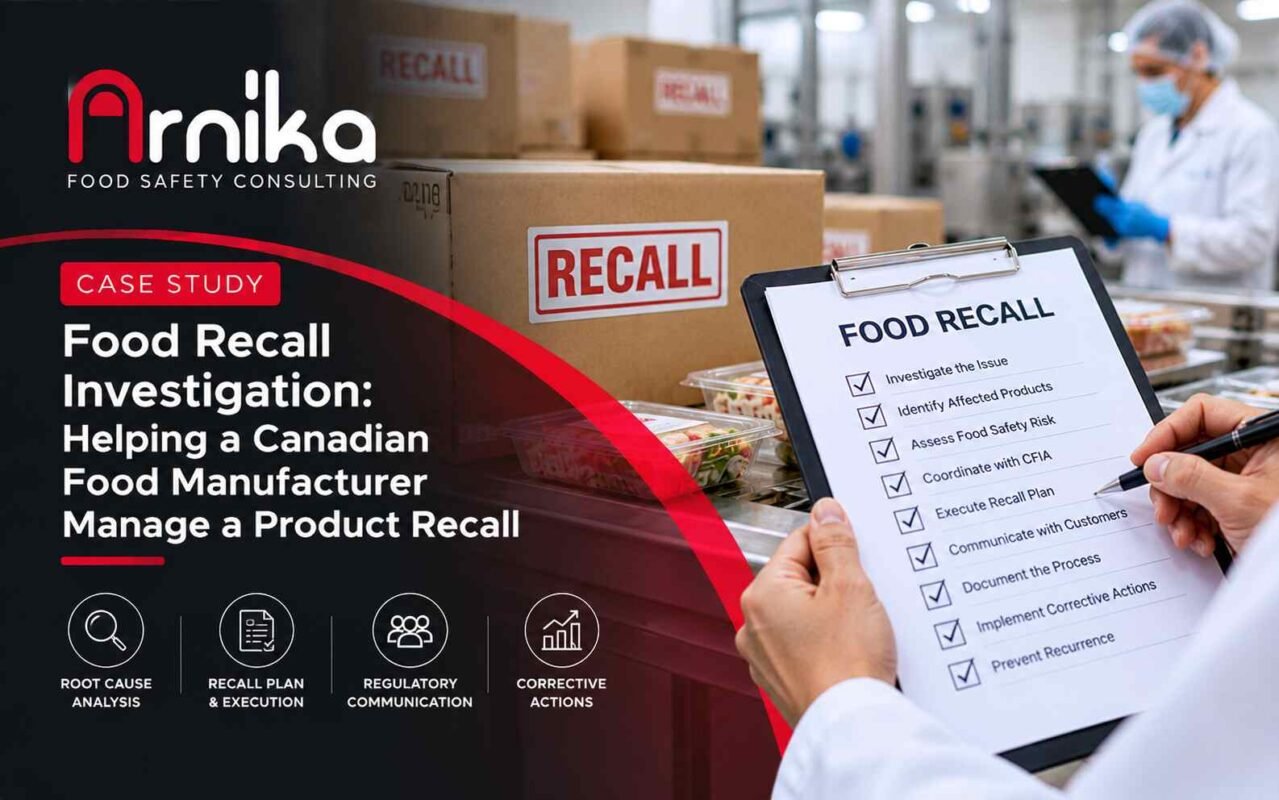
A potential food safety incident can put a food manufacturer under immediate pressure. The business must understand what happened, determine which products may be affected, control product where necessary, and decide what further action is appropriate. Those decisions should be based on evidence and a risk assessment—not assumptions.
This anonymized case study describes Arnika’s support to a Canadian food manufacturer facing a potential food safety incident. Client-identifying information has been removed or generalized to protect confidentiality. The available case information supports a description of the investigation approach and its outputs; it does not establish a specific contaminant, product category, confirmed root cause, recall decision, or quantified result. Those details are therefore not asserted here.
The Situation
The manufacturer contacted Arnika after becoming aware of a potential food safety issue involving one of its products. The organization needed a structured way to establish the facts, understand the possible scope, review the relevant production and food safety controls, and identify appropriate corrective action.
The immediate questions included whether the issue might extend beyond a single lot or production date, whether other products or operations could be involved, what the available records showed, and whether additional customer or regulatory action might be required. The first priority was to establish what was known and what remained uncertain.
Arnika’s Investigation Approach
1. Establishing the facts and preserving evidence
The investigation began with a review of the information available to the manufacturer. Depending on relevance to the incident, this included product and lot identification, production dates and records, complaint information, laboratory results, processing and sanitation records, supplier information, equipment and maintenance records, distribution details, and previous related complaints or corrective actions. The purpose was to distinguish verified facts from assumptions and establish a reliable timeline.
2. Assessing product control and traceability
Where product may be affected, the business needs to consider appropriate controls while the facts are being established. These may include placing product on hold, segregating and identifying inventory, preventing further distribution, preserving relevant samples and records, and confirming quantities and locations. For a broader overview of recall planning and response in Canada, see Food Recall Management in Canada.
Traceback and traceforward information is central to defining the potential scope. Traceback considers the origin of the product and relevant inputs, such as ingredients, packaging, suppliers, production batches and processing dates. Traceforward identifies where potentially affected finished product went, including customers, distributors, retailers or other recipients. The records help the business understand the possible boundaries of the issue.
3. Reviewing production and preventive controls
The documented process flow was considered alongside the actual manufacturing activities. Relevant stages may include receiving, storage, ingredient handling, preparation, processing, treatment, cooling, packaging, labelling, finished-product storage and distribution. The review considers where a hazard could have been introduced, could have survived, or could have spread.
The investigation also examined relevant preventive controls, which may include sanitation, allergen management, supplier approval, process and temperature controls, equipment maintenance, personnel practices, monitoring and verification. The question is not only whether a procedure exists, but whether the control was suitable, implemented as intended, monitored and verified.
4. Reviewing records and assessing root cause
Records provide evidence of what happened in practice. Relevant documents may include production and monitoring records, sanitation and pre-operational inspection records, calibration and maintenance records, receiving and supplier records, product-release documentation, employee training, previous complaints and corrective-action records. Reviewing records is also central to regulatory readiness. See Arnika’s guide to CFIA Inspection Preparation for further guidance on reviewing the PCP, procedures and supporting records.
The review supports a timeline and helps identify gaps, deviations or patterns that require further investigation. Root cause assessment goes beyond identifying an immediate failure. It considers why the system allowed the problem to occur and whether contributing factors may relate to equipment, materials, methods, people, training, supervision, maintenance, process design or management oversight. A proposed cause should be supported by evidence; it should not be presented as confirmed when the available information does not establish it. For a more detailed explanation of the methodology, read Root Cause Analysis in Food Manufacturing.
5. Defining the scope and corrective-action priorities
The evidence is used to assess whether the issue appears limited or whether the investigation should extend to other lots, dates, shifts, lines, products, suppliers or similar historical events. The potential scope should be reviewed against production, inventory and distribution information.
Corrective actions should address the identified problem and its underlying causes. Depending on the findings, actions may include revising procedures, strengthening monitoring or verification, providing additional training, repairing or modifying equipment, requesting supplier corrective action, or improving sanitation or process controls. Actions should be assigned, documented and followed by a check of their effectiveness.
Outcome and Food Safety System Improvement
The investigation provided the manufacturer with a structured view of the information available, the questions requiring resolution, the potential scope of the issue, the relevant production and preventive controls, and priorities for corrective action. It also provided a basis for considering whether the Preventive Control Plan (PCP) and related procedures required reassessment. Businesses reviewing their PCP after an incident may also find Arnika’s CFIA Inspection Preparation services relevant.
The source material for this case study does not document a specific confirmed root cause, recall outcome, or measured performance improvement. The case is therefore presented as an example of the investigation process and the practical areas reviewed, rather than as a claim that a particular hazard was eliminated or a recall was avoided.
Key Lessons for Food Manufacturers
- Start with evidence. A complaint or test result is a signal to investigate; it is not, by itself, proof of a particular cause.
- Know where product came from and where it went. Accurate lot, production and distribution records help define the potential scope and support timely decisions.
- Check whether controls work in practice. Written procedures are not enough. Monitoring, verification and records should demonstrate that preventive controls are implemented effectively.
- Address causes and verify actions. Correcting an immediate problem may not prevent recurrence. Corrective actions should address contributing factors and be checked for effectiveness.
How Arnika Supports Food Safety Investigations
Arnika provides food safety consulting support to food manufacturers, importers and distributors dealing with food safety complaints, potential contamination, foreign material concerns, process deviations, laboratory findings, traceability issues and preventive-control failures. Support may include reviewing available evidence and records, assessing production processes and preventive controls, facilitating root cause analysis, developing corrective-action priorities, and identifying where a PCP or related procedures may need to be reassessed. Learn more about Arnika’s food safety consulting services.
If your business is responding to a food safety incident or needs help strengthening its investigation and corrective-action process, contact Arnika to discuss the scope of support required.
Frequently Asked Questions
What is a food recall investigation?
It is a structured assessment of a potential food safety issue. It may involve reviewing the complaint or test result, assessing the hazard and product scope, tracing product through the supply chain, reviewing controls, and determining appropriate actions.
Does every food safety complaint require a recall?
No. A complaint does not automatically mean a recall is required. The response depends on the nature of the issue, the potential hazard, the evidence, the products and distribution involved, and applicable regulatory requirements. Businesses should assess the situation promptly and meet their applicable notification and control obligations.
Why are traceback and traceforward important?
They help establish where potentially affected food and relevant inputs originated and where finished product was distributed. This information supports an evidence-based assessment of the potential scope.
Why is root cause analysis important?
It helps determine why an issue occurred, rather than only describing the immediate failure. Understanding contributing factors helps a business select corrective actions that are more likely to prevent recurrence.
Should a Preventive Control Plan be reviewed after an incident?
An incident may indicate that a preventive control plan or related procedure needs reassessment. The business should evaluate the facts and applicable requirements and update its PCP where necessary.