
Preventive Control Plan Case Study: Helping a Canadian Bakery Build a Strong Food Safety System
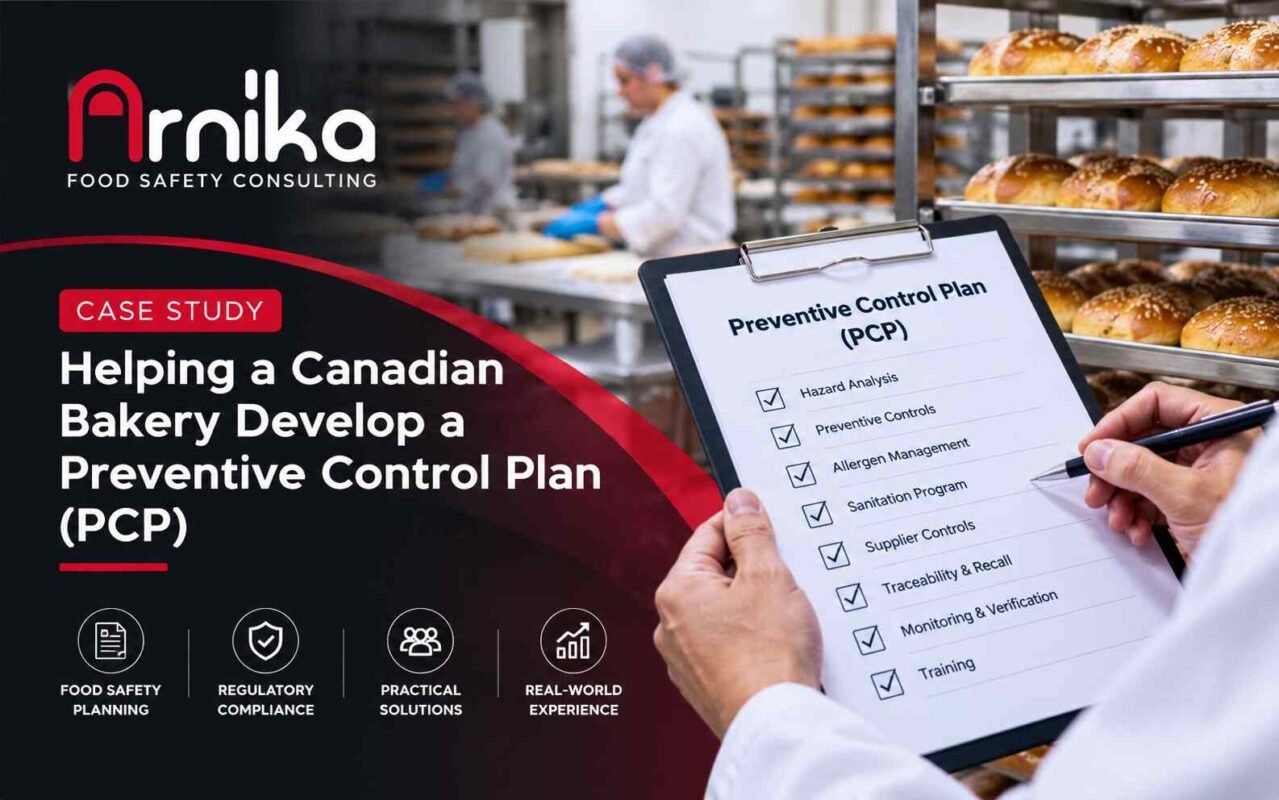
A Preventive Control Plan (PCP) is more than a collection of documents. It should explain how a food business identifies and controls reasonably foreseeable food safety hazards, and how those controls are monitored, verified and corrected.
This case study describes how Arnika supported an anonymized Canadian bakery in developing and strengthening its food safety system. Client-identifying information has been removed or generalized to protect confidentiality. The objective was not simply to prepare a document for a binder, but to organize the bakery’s food safety practices into a practical system that employees could implement and management could maintain.
The Situation
The bakery already performed a number of food safety activities, but those practices were not sufficiently organized into one integrated and documented system. The business needed a more structured approach covering ingredient receiving and storage, production and baking, cooling, packaging, allergen management, sanitation, employee hygiene, supplier controls, traceability, recall procedures, corrective actions, training and verification.
The challenge was therefore broader than writing a PCP. The plan needed to reflect what actually happened in the bakery and connect daily activities with clear responsibilities, records and follow-up.
Understanding the Operation
Before developing the plan, Arnika reviewed the bakery’s operation and process flow, from ingredient receiving through storage, preparation, processing, baking, cooling, packaging, finished-product storage and distribution. Employee movement, equipment, sanitation, allergen handling and storage conditions were also considered.
This operational understanding provided the basis for identifying reasonably foreseeable biological, chemical and physical hazards. Depending on the products and processes, the assessment considered potential microbial hazards and cross-contamination, allergens and cleaning-chemical residues, and physical hazards such as metal, glass, plastic or equipment fragments. The relevant controls must be selected for the actual products and processes, rather than copied from a generic template.
Developing the Preventive Control Plan
The PCP was structured around the bakery’s actual activities and the hazards identified during the assessment. Existing procedures, employee practices, cleaning activities, ingredient controls, production practices, equipment, records, training, supplier information and previous corrective actions were reviewed. This helped distinguish between what the business intended to do and what was happening in practice.
The plan incorporated foundational Prerequisite Programs covering areas such as personal hygiene, cleaning and sanitation, pest control, equipment maintenance, water and ice, waste, chemical control, supplier controls, allergens, storage, transportation and employee training. These programs provide the basic conditions needed for safe food production.
The hazard analysis was developed using HACCP principles and connected to the bakery’s process flow. It considered what hazards could occur, where they could occur, their significance, which controls were appropriate, and how controls should be monitored and verified.
Key Food Safety Controls Addressed
Allergen management
The assessment considered the bakery’s allergenic ingredients and the potential for cross-contact, including ingredient identification and storage, segregation, production scheduling, equipment and utensil controls, cleaning, label verification, employee awareness and recordkeeping. The objective was to address both allergen cross-contact and the risk of undeclared allergens.
Sanitation and Good Manufacturing Practices
The food safety system included sanitation and Good Manufacturing Practices (GMP) such as cleaning schedules and methods, sanitizing, equipment cleaning, employee hygiene, handwashing, protective clothing, facility cleanliness, waste handling, pest prevention and equipment condition. Procedures needed to be clear enough to follow and supported by appropriate records and verification.
Supplier, receiving and storage controls
Supplier and incoming-material controls considered approved suppliers, specifications, supporting documentation, receiving inspections, packaging integrity, lot identification, temperature requirements where applicable, allergen information and follow-up when a supplier issue occurs. Storage controls addressed raw-material and allergen segregation, finished-product storage, product identification, stock rotation, chemical segregation, packaging protection and pest prevention.
Production, cooling, packaging and labelling
The process review considered ingredient preparation, mixing, processing, baking, cooling, handling and packaging. Where a process step was relied upon to control a hazard, the applicable monitoring, corrective-action and verification requirements needed to be defined. Packaging and label checks included product identity, allergen declarations, lot and date coding, packaging integrity and line clearance.
Traceability and recall readiness
The bakery’s traceability approach needed to connect ingredients with finished products and distribution. Relevant information included suppliers, ingredients, lot numbers, production dates, finished products, quantities and customers. The recall procedure considered product identification and hold, customer identification, product reconciliation, communication, corrective actions, documentation and effectiveness checks.
For more detail on recall planning and response in Canada, see Food Recall Management in Canada.
Training, Records and Verification
Employee training was considered in relation to each person’s responsibilities, including hygiene, sanitation, allergen controls, receiving, production, monitoring, corrective actions, traceability and recall procedures. A production employee may need different instruction from a supervisor or food safety coordinator.
The PCP was supported by records relevant to the controls in place. These could include receiving, temperature, sanitation, monitoring, corrective-action, training, supplier, traceability, calibration, maintenance and verification records. Verification activities may include record review, observation, internal audits, equipment checks, calibration, testing where appropriate, corrective-action review and sanitation-effectiveness checks.
When a deviation occurs, the business should address the immediate issue, assess affected product, investigate the cause, determine corrective action and verify effectiveness. Arnika’s guide to Root Cause Analysis in Food Manufacturing explains this investigation approach in more detail.
The Result
The project gave the bakery a more structured food safety system connecting hazard identification, preventive controls, monitoring, records, verification and corrective actions. Rather than treating food safety as a collection of separate activities, the PCP provided a framework linking day-to-day operations with the bakery’s food safety responsibilities.
The source case material does not provide quantified performance results or identify a specific regulatory inspection outcome. The result is therefore described in terms of the documented structure and scope of the food safety system, not as a claim of certification, inspection approval or a measured reduction in incidents.
Key Lessons from the Case
- A PCP should reflect the real operation. A generic template cannot replace an assessment of the actual facility, products, processes and employees.
- Documentation alone is not enough. Procedures need to be implemented consistently and supported by useful records.
- Employees are part of the control system. Training should match employees’ responsibilities and help them understand what to do when a control fails.
- Allergen management goes beyond labelling. Controls should consider ingredient handling, segregation, shared equipment, cleaning, cross-contact and label accuracy.
- Verification keeps the system current. A PCP should be reviewed as products, suppliers, equipment, processes and other operating conditions change.
PCP Development Is an Ongoing Process
A food business changes over time: new products may be introduced, suppliers may change, equipment may be replaced and production processes may be modified. A Preventive Control Plan should therefore be maintained and reassessed when significant changes occur or when verification results, complaints, incidents or other information indicate that improvements may be needed.
For businesses preparing their documentation and records for a regulatory visit, see CFIA Inspection Preparation.
How Arnika Helps Food Businesses Develop PCPs
Arnika supports Canadian food businesses with food safety assessments, hazard analysis, HACCP and PCP development, Prerequisite Programs, GMP, sanitation procedures, allergen controls, supplier controls, traceability, recall procedures, employee training, verification programs, corrective actions and CFIA inspection preparation.
Learn more about Arnika’s food safety consulting services and support for developing, implementing and maintaining food safety systems appropriate to your operation.
Frequently Asked Questions
What is a Preventive Control Plan?
A Preventive Control Plan is a documented system describing how a food business identifies and controls reasonably foreseeable food safety hazards and how it demonstrates that its preventive controls are implemented and effective.
Does every bakery in Canada need a PCP?
The requirements depend on the activities of the business and the applicable Canadian regulatory requirements. A bakery should determine which Safe Food for Canadians Regulations requirements apply to its specific operation.
What should a bakery’s PCP address?
Depending on its products and processes, a bakery’s PCP may address ingredients, receiving, storage, production, baking, cooling, packaging, allergens, sanitation, employee hygiene, traceability, recall, suppliers, equipment, monitoring and verification.
Is a PCP the same as HACCP?
No. HACCP is a systematic approach to identifying and controlling food safety hazards. A PCP can incorporate HACCP principles together with broader preventive controls, Prerequisite Programs, procedures, monitoring, verification and documentation.
Why are Prerequisite Programs important for a bakery?
Prerequisite Programs establish basic environmental and operational conditions needed to produce safe food. They may include sanitation, personal hygiene, pest control, equipment maintenance, allergen management and supplier controls.
How often should a PCP be reviewed?
A PCP should be maintained and reassessed when significant changes, incidents, complaints, verification results or other information indicate that changes may be necessary.
Need Help Developing a Preventive Control Plan?
A practical PCP should be built around the real operation—not simply completed as a paperwork exercise. Contact Arnika to discuss support with PCP development, HACCP, Prerequisite Programs, GMP, training, verification and food safety compliance across Canada.