

BLOG
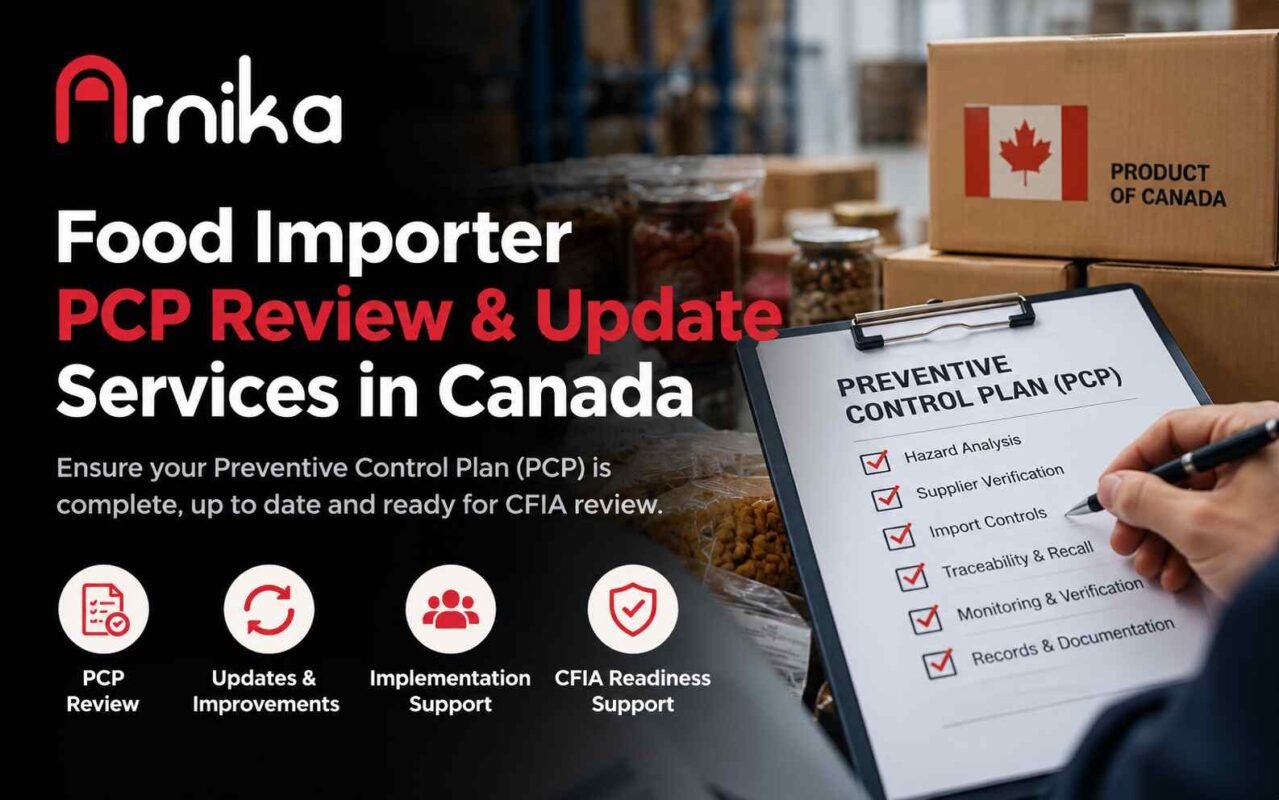
Already importing food into Canada? If your business already has a Preventive Control Plan (PCP), you may not need to start from scratch. However, your existing plan should reflect your current products, suppliers, import activities, food safety risks, and actual business practices.
Many Canadian food importers have a PCP prepared when they first applied for their Safe Food for Canadians (SFC) licence. Over time, products change, new suppliers are introduced, documentation becomes outdated, and required records may not be consistently maintained.
At Arnika – Food Safety Consulting Canada, we help food importers develop, review, update, and implement practical food safety documentation aligned with their business activities and applicable Canadian requirements.
Whether you need a new PCP, a review of an existing plan, assistance maintaining your documentation, or preparation for a CFIA interview or inspection, we can help you identify the gaps and determine the next steps.
If you are looking for a general explanation of importer requirements, start with our guide: PCP for Food Importers Canada: CFIA & SFCR Requirements. This service-focused page explains when a review or update may be useful and how consulting support can help.
When Should a Food Importer Review an Existing PCP?
Having a written PCP is an important part of food safety compliance when your business is required to maintain one. However, having a document on file does not necessarily mean that the plan reflects your current operation or that the required controls are being implemented effectively.
Consider reviewing your PCP if any of the following situations apply.
1. Your PCP Has Not Been Reviewed for Several Years
Your business may have changed since the plan was originally prepared. An older PCP may no longer accurately describe your imported products, supplier arrangements, verification activities, or current procedures.
A review can help determine whether the document remains appropriate and which sections require updating.
2. You Have Added New Products or Suppliers
Adding a new food category, ingredient, foreign supplier, or country of origin may introduce different hazards or regulatory considerations.
Your PCP and supporting procedures should be reviewed to determine whether the new products and suppliers are adequately covered. Supplier approval and verification activities should also reflect the risks associated with the food being imported.
3. Your Required Records Are Incomplete or Outdated
An effective food safety system depends on both appropriate procedures and evidence that those procedures are implemented.
Your business may have a PCP but lack current supplier assessments, verification records, traceability information, complaint records, or documented follow-up actions.
A gap assessment can identify missing or incomplete documentation and help establish a practical plan for addressing the gaps.
4. You Are Preparing for a CFIA Interview, Inspection, or Follow-Up
CFIA may contact food businesses for different compliance-related activities. Depending on the circumstances, your business may need to explain its food safety controls, provide supporting records, respond to findings, or demonstrate how its PCP is implemented.
Arnika can help you review your documentation, organize relevant records, identify potential weaknesses, and prepare to explain your procedures and responsibilities.
5. Your SFC Licence Is Approaching Expiry
A licence renewal is an opportunity to review your business information and confirm that your food safety arrangements remain appropriate.
The SFC licence and PCP are related but separate matters. Renewing a licence does not automatically mean that you must rewrite your PCP. However, you should review the plan and supporting records when appropriate and address any changes or deficiencies.
Common Gaps in Existing Food Importer PCPs
A plan can look complete on paper while failing to reflect the way the business actually operates. A structured review can help identify gaps such as the following:
1. The plan no longer reflects the products or suppliers
The hazard analysis and supplier verification procedures should consider the foods being imported and the relevant hazards associated with the foods and the foreign supplier’s processes. New products or suppliers may require a reassessment of the existing controls and supporting evidence.
2. Supplier verification is not sufficiently defined
The PCP should describe the food safety assurances and verification approach applicable to the importer’s circumstances. A reviewer may check whether supplier documents, product specifications, audit information, certificates of analysis or other evidence are appropriate, current and reviewed according to a defined procedure. The suitable evidence and frequency depend on the product and risk.
3. Procedures are vague or difficult to follow
Procedures should make responsibilities and actions clear. Where relevant, they should explain what is done, how it is done, when it is done, who is responsible and which records are retained. A procedure that is too general may be difficult for staff to apply consistently.
4. Records do not demonstrate implementation
A written PCP should be supported by evidence that the plan is being implemented. Depending on the operation, relevant records may include supplier assessments, receiving checks, storage or temperature records, verification activities, complaint investigations, corrective actions, traceability information and recall-related documentation. Recordkeeping requirements vary by activity and record type.
5. Complaint, corrective action and recall processes need attention
Importers should have workable procedures for handling complaints, investigating potential food safety issues, taking corrective action and responding to recall situations. The team should understand its responsibilities and know how to locate the relevant records quickly.
6. The plan has not been reassessed after a problem or change
A supplier change, a new product, a complaint trend, a recall, an unsatisfactory laboratory result or an identified control failure may indicate that the PCP needs to be reassessed. Updating a document without investigating the reason for the change may leave the underlying issue unresolved.
PCP Review vs. PCP Development: Which Service Do You Need?
Not every food importer needs a completely new PCP. The appropriate service depends on the quality of the existing documentation, the scope of the business, and the gaps identified.
Option 1: Review Your Existing PCP
This option may be suitable if your business already has a written PCP and needs to understand whether it remains appropriate.
Arnika reviews the relevant documentation, identifies gaps, and recommends improvements. Depending on the agreed scope, the work may include reviewing supplier approval procedures, verification activities, supporting SOPs, forms, and records.
Option 2: Update and Improve Your PCP
If the existing plan is generally suitable but contains outdated or incomplete sections, targeted revisions may be sufficient.
We can help update the relevant procedures and supporting documents to reflect your products, suppliers, current activities, and applicable requirements.
Option 3: Develop a New PCP
If your current PCP is missing, unsuitable, or too incomplete to serve as a reliable foundation, developing a new business-specific plan may be more appropriate.
Arnika can help establish the necessary documentation based on your operation, including hazard analysis, preventive controls, supplier-related procedures, verification activities, and applicable supporting programs.
For a broader overview of PCP requirements across food businesses, see our Preventive Control Plan Canada: Complete Guide for Food Businesses.
How Arnika Helps Food Importers Maintain Compliance
Our objective is not simply to deliver a document. We help importers understand what their food safety system requires and how to maintain it in everyday business operations.
PCP Review and Gap Assessment
We assess your existing PCP and supporting documentation against applicable requirements and your actual import activities. You receive a clearer understanding of what is adequate, what needs improvement, and which issues should be addressed first.
PCP Development and Updates
We develop or revise documentation based on your products, suppliers, food safety risks, and business practices. The scope may include hazard analysis, preventive control procedures, verification activities, and supporting documents.
Foreign Supplier Approval and Verification
Supplier documentation is an important part of managing food safety risks when importing food. We can help establish or improve supplier approval criteria, organize supporting documentation, define verification activities, and develop procedures for reviewing supplier information as appropriate to your operation.
SOPs, Forms, and Record-Keeping Systems
We help make your food safety documentation practical to use. Depending on your needs, this may include supplier assessment forms, verification records, traceability procedures, complaint logs, recall procedures, and other applicable records. The goal is to help your team understand what information to collect, when to collect it, and how to maintain records that demonstrate implementation.
CFIA Interview, Inspection, and Follow-Up Preparation
If CFIA has requested information or your business is preparing for an applicable interview or inspection, we can help you review the relevant PCP sections, organize supporting documentation, identify potential gaps, and prepare to explain your food safety controls. If you have received a compliance concern or request for corrective action, we can also help review the issue and develop an appropriate response within the agreed scope. Our support is intended to improve preparedness and understanding. It cannot guarantee a particular CFIA decision or inspection outcome.
Practical Implementation and Ongoing Support
A food safety plan needs to work for the people responsible for implementing it. We explain procedures, help identify responsibilities, clarify record-keeping expectations, and provide guidance on maintaining the system as your business changes. Support can be tailored to your needs, whether you require a defined review project or assistance with specific compliance questions.
Preparing for a CFIA Inspection, Interview or Follow-Up
When a CFIA compliance activity is expected, importers should be ready to explain how their controls work in practice and provide relevant documents or records when requested. A readiness review may examine whether:
- The PCP reflects the current importing operation and the foods being imported.
- Supplier verification procedures are defined and supported by appropriate evidence.
- The people responsible for food safety understand their duties.
- Required records are complete, readable, accessible in Canada and can be retrieved promptly.
- Complaint, traceability and recall procedures are documented and understood.
- Known gaps, deviations or changes have been assessed and addressed.
Preparation should be based on the actual scope of the CFIA activity and the records applicable to the business. Not every importer will have the same documents or follow the same compliance pathway.
Food Importer SFC Licence Renewal: What Should You Check?
Under the Safe Food for Canadians Regulations (SFCR), an SFC licence generally expires two years after it is issued or renewed. The renewal option becomes available through My CFIA 120 days before the licence expiry date. The renewal request must be processed before expiry; an expired licence number is no longer valid and cannot simply be renewed.
You can verify the applicable process through the CFIA’s official food licensing guidance: https://inspection.canada.ca/en/food-licences/licensing
As your licence approaches expiry, consider the following steps.
- Check your licence expiry date. Confirm the date shown on your licence and plan ahead.
- Review your licence information. Check whether the licence continues to reflect your current business activities and imported food commodities.
- Review your PCP, where applicable. Confirm that it reflects your current products, suppliers, hazards, and food safety controls.
- Check supporting records. Review supplier documentation, verification activities, traceability, complaints, recalls, and other applicable records.
- Identify changes or gaps. Determine whether any procedures, records, or supplier-related controls require updating.
- Prepare for possible CFIA follow-up. Depending on the circumstances, CFIA may request additional information or conduct an interview or inspection.
Important: Licence renewal and PCP review are not the same process. A licence renewal does not automatically require a complete PCP rewrite or a new interview in every case. The appropriate preparation depends on your circumstances and any specific CFIA request.
If your licence is approaching expiry and you are uncertain whether your existing documentation remains suitable, Arnika can help assess your PCP and supporting records before you proceed.
What to Expect When Working With Arnika
We aim to make food safety consulting straightforward and practical.
Step 1: Understand Your Business
We begin by understanding the types of food you import, your suppliers, your existing PCP, and the specific assistance you need.
Step 2: Define the Scope of Work
We determine whether you need a document review, a gap assessment, targeted updates, a new PCP, or interview and inspection preparation.
Step 3: Review or Develop Your Documentation
We work on the agreed documentation and identify areas that require clarification, improvement, or additional supporting information.
Step 4: Explain the Required Actions
We help you understand the findings, the records you need to maintain, and the practical steps required to implement the agreed improvements.
Step 5: Provide Follow-Up Support as Needed
If you need additional guidance as you implement the procedures or respond to specific compliance questions, further support can be arranged within an agreed scope.
The scope, deliverables, timeline, and professional fees depend on the complexity of your operation and the work required. We provide a quotation before proceeding with larger projects.
Frequently Asked Questions About Food Importer PCP Review
Do I need to rewrite my PCP every two years when I renew my SFC licence?
Not automatically. SFC licence renewal and PCP review are separate matters. You should maintain and update your PCP as appropriate to your operation and applicable requirements, rather than assume that every licence renewal requires a complete rewrite.
Can Arnika review a PCP prepared by another consultant?
Yes. We can assess an existing PCP and its supporting documentation, identify gaps, and recommend appropriate improvements. The review can help determine whether targeted updates are sufficient or whether more extensive redevelopment is needed.
Can you help if we have not maintained our PCP records?
Yes. We can review the available documentation, identify missing or incomplete records, and help establish a practical corrective action plan. Records should accurately reflect what was done; missing historical records should not be recreated as if the activities had occurred.
Can you help us prepare for a CFIA interview?
Yes. Depending on the purpose of the interview and your circumstances, we can review relevant documentation, identify potential gaps, organize supporting records, and help you prepare to explain your food safety controls.
Do you only work with food importers in Montreal?
No. Arnika provides food safety consulting support to businesses across Canada, with remote and on-site services depending on the project requirements.
How much does a PCP review cost?
The fee depends on the size and complexity of your business, the quality of the existing PCP, the number of products and suppliers, and the scope of the review. After understanding your needs, we can propose an appropriate scope and professional fee.
Need Help With Your Food Importer PCP?
Whether you need to develop a new Preventive Control Plan, review an existing one, update outdated documentation, improve supplier verification, or CFIA inspection preparation or interview , Arnika can help.
You do not necessarily need to start from scratch. The first step is to understand what you already have, what your business currently does, and what needs to be improved.
- Already have a PCP? Request a review and gap assessment.
- Need a new PCP? Request a proposal for PCP development.
- Preparing for CFIA follow-up or licence renewal? Tell us about your situation so we can help define the appropriate next steps.
Contact Arnika to discuss your food safety consulting needs: https://arnika.ca/contact-us/
Arnika – Food Safety Consulting Canada provides practical support for PCP development, review, implementation, supplier verification, documentation, and regulatory readiness.
Related Resources
- PCP for Food Importers Canada: CFIA & SFCR Requirements
- Preventive Control Plan Canada: Complete Guide for Food Businesses
- HACCP Consulting Canada
Official CFIA References
- Guide for food importers: prepare your preventive control plan
- Importing food to Canada: a step-by-step guide
- Regulatory requirements: Licensing of food businesses
- Preventive controls and preventive control plans
Regulatory note: This article provides general information, not legal advice or a determination of the requirements for a specific business. Applicable obligations depend on the business’s activities, products and circumstances. Confirm current requirements with CFIA and other relevant authorities.