
BLOG
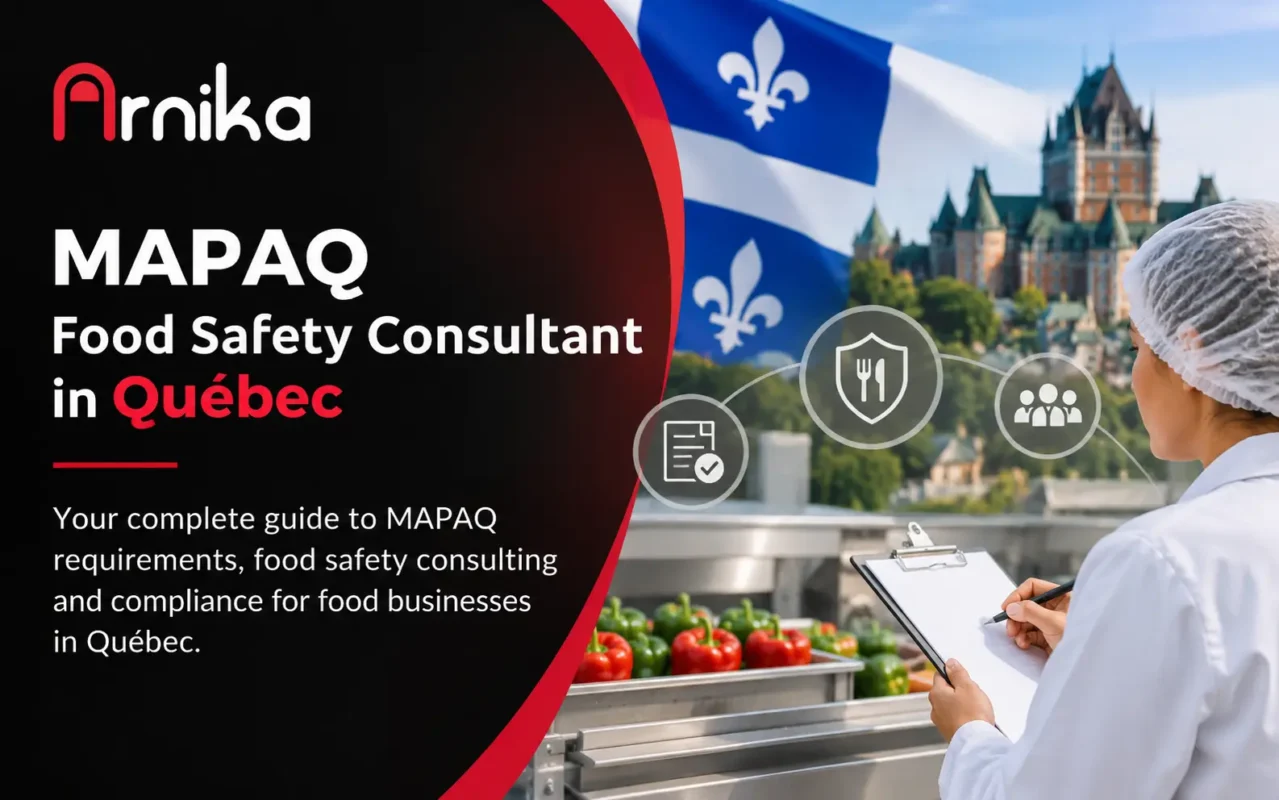
Operating a food business in Québec requires more than producing safe and high-quality food. Food establishments must understand and comply with applicable Québec food safety, hygiene, sanitation, permitting, and operational requirements.
Arnika provides MAPAQ food safety consulting services in Québec to help food businesses understand their obligations, prepare their food safety systems, address compliance gaps, and improve their readiness for regulatory inspections.
Whether you are opening a new food business, expanding an existing facility, preparing for a MAPAQ inspection, developing HACCP and prerequisite programs, or addressing food safety deficiencies, our team can provide practical consulting support tailored to your operation.
Important: MAPAQ requirements can vary according to the type of food activity, establishment, products, and business model. Businesses should confirm their specific regulatory obligations with the Québec government/MAPAQ.
Reviewed by Reza Eslami, CEO & Co-Founder of Arnika, with more than 25 years of experience in food safety, quality, HACCP, GMP, SFCR and certification readiness.
What Is MAPAQ?
MAPAQ is the Québec Ministry of Agriculture, Fisheries and Food (Ministère de l’Agriculture, des Pêcheries et de l’Alimentation du Québec).
MAPAQ is responsible for important aspects of food safety and the oversight of food establishments in Québec.
Québec’s food businesses operate under provincial legislation and regulations concerning food safety, hygiene, sanitation, food handling, and related requirements.
For businesses starting or operating a food establishment, understanding the requirements that apply to the specific activity is an important part of establishing a compliant food safety system.
The Québec government provides specific information about food permits, hygiene and sanitation training, food establishment requirements, and other obligations.
What Does a MAPAQ Food Safety Consultant Do?
A MAPAQ food safety consultant helps food businesses understand and implement appropriate food safety and sanitation controls for their operations.
Depending on the business, consulting support may include:
- MAPAQ regulatory-readiness assessment
- Food establishment compliance review
- Permit-related guidance
- Food safety system development
- HACCP development
- Prerequisite Programs
- GMP implementation
- Sanitation programs
- Employee hygiene and training
- Allergen control
- Traceability
- Recall procedures
- Corrective actions
- Inspection preparation
- Documentation and record review
- Facility and process assessment
The objective is not simply to prepare documents.
The objective is to help ensure that your actual operation, employees, procedures, records, and food safety controls work together.
Who Needs MAPAQ Food Safety Consulting?
MAPAQ consulting can be valuable for a wide range of food businesses in Québec, including:
- Food manufacturers
- Food processors
- Restaurants
- Caterers
- Food retailers
- Bakeries
- Meat and poultry businesses
- Food wholesalers
- Food distributors
- Food startups
- Commercial kitchens
- Food businesses operating from new facilities
- Businesses expanding or changing their activities
The exact permit and regulatory requirements depend on the nature of the food activity.
For example, Québec currently provides different permit categories for activities such as food preparation, restaurant operations, retail food sales, special events, and other food activities.
MAPAQ Food Safety Consulting Services
MAPAQ Compliance Assessment
Before opening a new food business or preparing for an inspection, it can be useful to conduct a structured compliance assessment.
Arnika can review areas such as:
- Facility conditions
- Food handling practices
- Personal hygiene
- Cleaning and sanitation
- Equipment
- Storage
- Temperature controls
- Pest control
- Cross-contamination prevention
- Allergen management
- Documentation
- Employee training
- Corrective actions
The objective is to identify potential weaknesses before they become regulatory or food safety problems.
MAPAQ Permit and Regulatory Guidance
Food businesses may need a Québec food permit depending on their activities.
The Québec government states that businesses requiring a food permit must receive the permit before beginning the applicable activities. Permit requirements and fees depend on the type of activity.
Arnika can help businesses understand the food safety considerations associated with their proposed operations and identify areas that should be addressed before starting production.
However, the actual permit application and final regulatory determination remain with the Québec authorities.
Food Establishment Startup Consulting
Starting a food business in Québec?
Food safety should be considered before the facility is built, renovated, or opened.
Arnika can help review:
- Product types
- Processing activities
- Facility layout
- Product flow
- Personnel flow
- Equipment
- Storage
- Sanitation
- Temperature control
- Cross-contamination risks
- Allergen controls
- Cleaning requirements
For businesses starting a new operation, our Food Manufacturing Startup Consulting service can provide broader support from the planning stage through food safety system implementation.
HACCP Development and Implementation
A strong HACCP system helps businesses identify and control food safety hazards associated with their products and processes.
Arnika can support:
- Product descriptions
- Intended use
- Process flow diagrams
- Hazard analysis
- Preventive controls
- Critical Control Points
- Critical limits
- Monitoring
- Corrective actions
- Verification
- HACCP documentation
Our HACCP consulting services can be tailored to the specific products and processes used by your business.
HACCP should not simply be treated as a document.
It should reflect what actually happens in your facility.
Prerequisite Programs
HACCP works best when the foundational conditions surrounding production are properly controlled.
Arnika can help develop and implement prerequisite programs covering areas such as:
- GMP
- Personal hygiene
- Sanitation
- Pest control
- Allergen control
- Supplier control
- Equipment maintenance
- Water quality
- Waste management
- Chemical control
- Temperature control
- Traceability
- Recall
- Employee training
Our HACCP Prerequisite Programs pillar provides a detailed explanation of how these programs support food safety systems.
GMP Implementation
Good Manufacturing Practices provide the operational foundation for hygienic food production.
A GMP program may address:
- Employee hygiene
- Facility maintenance
- Equipment
- Cleaning
- Sanitation
- Production practices
- Storage
- Pest control
- Cross-contamination
- Documentation
- Training
Arnika can help food businesses develop practical GMP procedures that fit their actual operation.
Learn more through our GMP Canada guide.
Hygiene and Sanitation Training
Employee knowledge is an important part of food safety.
Québec has specific requirements concerning food hygiene and sanitation training. The Québec government identifies training requirements for the person responsible for hygiene and sanitation controls as well as certain employees involved directly with food or cleaning food-contact equipment.
MAPAQ’s training framework includes different types of hygiene and sanitation training, including training for food-establishment managers and food handlers.
Arnika can support food businesses with broader food safety training covering:
- Personal hygiene
- GMP
- HACCP
- Sanitation
- Allergen control
- Food handling
- Preventive controls
- Documentation
- Corrective actions
See our Food Safety Training services.
Food Safety Documentation
Food businesses need practical procedures and records that demonstrate how food safety controls are implemented.
Depending on the operation, documentation may include:
- SOPs
- SSOPs
- HACCP plans
- Sanitation procedures
- Temperature records
- Receiving records
- Cleaning records
- Pest-control records
- Training records
- Corrective-action records
- Verification records
- Traceability records
- Recall procedures
Arnika can help businesses organize and strengthen their food safety documentation so it reflects their actual operations.
MAPAQ Inspection Preparation
A regulatory inspection should not be treated as something to prepare for only after an inspector arrives.
A proactive inspection-readiness assessment can identify potential problems involving:
- Facility conditions
- Hygiene
- Sanitation
- Food handling
- Temperature control
- Employee practices
- Equipment
- Documentation
- Corrective actions
- Food safety procedures
Québec’s inspection system can result in corrective measures when significant deficiencies or food safety risks are identified. In serious situations, measures can include restrictions or cessation of activities and, in certain circumstances, suspension or cancellation of a permit.
Arnika can conduct a structured mock inspection to help identify potential gaps before an official inspection.
Corrective Action Support
What happens if an inspection identifies deficiencies?
The next step should be a structured corrective-action process.
Arnika can help businesses:
- Understand the finding
- Identify the underlying cause
- Determine immediate corrections
- Develop corrective actions
- Establish preventive measures
- Assign responsibilities
- Establish timelines
- Verify effectiveness
Corrective action should address more than the immediate problem.
The objective is to reduce the likelihood of the problem happening again.
Temperature Control
Temperature control is an important food safety consideration for many Québec food businesses.
Québec guidance identifies potentially hazardous foods as foods that can support the growth of harmful bacteria and emphasizes appropriate temperature control. For example, current Québec guidance identifies 4°C or below and 60°C or above as temperature controls for potentially hazardous foods in the applicable context.
Arnika can help businesses establish appropriate:
- Receiving controls
- Storage controls
- Cooking controls
- Cooling controls
- Hot-holding controls
- Cold-holding controls
- Monitoring records
- Corrective actions
Specific controls should be determined according to the product, process, and applicable requirements.
Allergen Control
Allergen management should be integrated into the food safety system.
Arnika can help establish controls for:
- Allergen identification
- Ingredient receiving
- Storage
- Production scheduling
- Segregation
- Cleaning
- Changeovers
- Labelling
- Employee training
- Verification
Effective allergen management helps reduce the risk of unintended allergen cross-contact.
Traceability and Recall
Food businesses should be prepared to identify and control affected products when a food safety issue occurs.
Arnika can help establish:
- Lot identification
- Receiving records
- Production records
- Distribution records
- Traceability procedures
- Recall procedures
- Mock recalls
- Corrective actions
Our Food Recall Management in Canada guide provides additional information about food recall preparedness.
Food Safety Consulting for New Québec Businesses
If you are opening a new food business in Québec, we recommend considering food safety requirements before opening day.
The Québec government itself provides startup guidance covering applicable laws and regulations, hygiene and sanitation, cleaning, cooking, potentially hazardous foods, and recall procedures.
Arnika can help you build a practical food safety system around your actual operation.
This may include:
Planning → Facility → Processes → HACCP → PRPs → GMP → Training → Documentation → Verification
MAPAQ Food Safety Consulting Process
Step 1: Initial Consultation
We learn about:
- Your business
- Products
- Processes
- Facility
- Employees
- Current food safety system
- Regulatory concerns
- Customer requirements
Step 2: Gap Assessment
We identify potential weaknesses in:
- Food handling
- Hygiene
- Sanitation
- HACCP
- GMP
- Prerequisite Programs
- Documentation
- Training
- Traceability
- Corrective actions
Step 3: Corrective Action Plan
We prioritize identified gaps according to their importance and operational impact.
Step 4: System Development or Improvement
Depending on the project, we help develop or improve:
- HACCP
- PRPs
- GMP
- SOPs
- SSOPs
- Training
- Traceability
- Recall systems
- Monitoring procedures
Step 5: Employee Training
Employees need to understand not only what they must do but why it matters.
Training can be tailored to their responsibilities.
Step 6: Verification and Inspection Readiness
Before an official inspection or customer audit, we can evaluate whether your food safety system is actually being implemented.
MAPAQ vs CFIA: What Is the Difference?
This is an important question for Québec food businesses.
MAPAQ is the Québec provincial ministry responsible for important provincial food safety oversight and requirements.
CFIA is the federal Canadian Food Inspection Agency.
The requirements that apply to a business depend on its activities, products, trade, and jurisdiction.
For example, a Québec business may have provincial MAPAQ requirements while also being subject to federal requirements where applicable.
Businesses involved in federally regulated activities or interprovincial/export trade may need to consider the Safe Food for Canadians Regulations (SFCR) and applicable CFIA requirements.
For businesses operating under both provincial and federal requirements, the food safety system should be designed to address the applicable requirements rather than assuming one automatically replaces the other.
Common MAPAQ Compliance Mistakes
Waiting Until an Inspection
Food safety compliance should be managed continuously rather than immediately before an inspection.
Incomplete Sanitation Procedures
A cleaning schedule alone does not necessarily demonstrate that sanitation controls are effective.
Poor Employee Hygiene
Employees can become a significant source of contamination when hygiene procedures are not properly implemented.
Missing or Incomplete Records
Without appropriate records, it can be difficult to demonstrate that required controls are being consistently implemented.
Ignoring Temperature Controls
Temperature deviations can create significant food safety risks for applicable products.
Generic HACCP Plans
A HACCP plan should reflect the actual products, processes, hazards, and controls in the facility.
Treating Corrective Actions as a One-Time Fix
The goal should be to address the underlying cause and prevent recurrence.
Why Choose Arnika for MAPAQ Food Safety Consulting?
Arnika provides food safety consulting services to food businesses across Canada, including Québec.
Our expertise covers:
- HACCP
- GMP
- SFCR
- Prerequisite Programs
- Food safety systems
- Auditing
- Inspection preparation
- Training
- Certification readiness
- Food safety documentation
Our Food Safety Consulting team can help businesses develop practical systems that fit their products, processes, employees, and facilities.
We focus on implementation, not simply paperwork.
Build Your Québec Food Safety System With Confidence
Food safety compliance is an ongoing responsibility.
Whether you are opening a new food business, preparing for a MAPAQ inspection, responding to deficiencies, or strengthening an existing food safety system, having the right controls in place can help protect consumers, employees, and your business.
Need help with MAPAQ food safety compliance in Québec?
Contact Arnika’s Food Safety Consulting Team to discuss your operation and determine what type of support may be appropriate.
MAPAQ Food Safety Consultant FAQs
What does a MAPAQ food safety consultant do?
A MAPAQ food safety consultant helps food businesses in Québec understand and implement appropriate food safety, hygiene, sanitation, documentation, and operational controls. Consulting may also include inspection preparation, HACCP, GMP, prerequisite programs, training, and corrective actions.
Does every food business in Québec need a MAPAQ permit?
Not necessarily. Permit requirements depend on the type of food activity and business. Québec provides specific tools and permit categories to help businesses determine whether a permit is required.
Do food businesses need hygiene and sanitation training?
Many food businesses have specific training obligations under Québec requirements. The applicable requirements depend on the establishment and the roles of employees. Québec currently identifies training requirements for the person responsible for hygiene and sanitation as well as certain food handlers and employees involved with food-contact equipment.
Can Arnika help prepare for a MAPAQ inspection?
Yes. Arnika can conduct a food safety and inspection-readiness assessment covering facility practices, hygiene, sanitation, documentation, employee practices, food safety systems, and corrective actions.
Can Arnika develop a HACCP plan for a Québec food business?
Yes. Arnika can develop or improve HACCP systems based on the company’s products, processes, hazards, and controls.
Learn more about our HACCP consulting services.
Can Arnika help with GMP and prerequisite programs?
Yes. GMP and prerequisite programs can be developed as part of a broader food safety management system.
Does MAPAQ certification exist?
It is better to distinguish between MAPAQ regulatory requirements and food-handler/manager training attestations rather than referring generally to a “MAPAQ certification.” Québec regulates food establishment activities and training requirements, while specific certificates or certifications may come from other organizations or certification schemes.
Can Arnika help a new restaurant or food business in Québec?
Yes. Arnika can help new businesses understand food safety considerations, develop procedures, establish prerequisite programs, train employees, and prepare for regulatory requirements.
What happens if a Québec food establishment has serious food safety problems?
Depending on the circumstances and level of risk, Québec authorities may require corrective measures and, in serious situations, may restrict or stop certain activities or suspend/cancel a permit.
Does MAPAQ apply to food manufacturers?
MAPAQ requirements can apply to food businesses according to their activities. The exact regulatory framework and permit requirements depend on what the business produces and does.
Can Arnika help with both MAPAQ and CFIA requirements?
Yes. Where both provincial and federal requirements apply, Arnika can help businesses understand and organize the applicable food safety controls. The specific legal requirements should always be confirmed with the relevant authority.