

BLOG
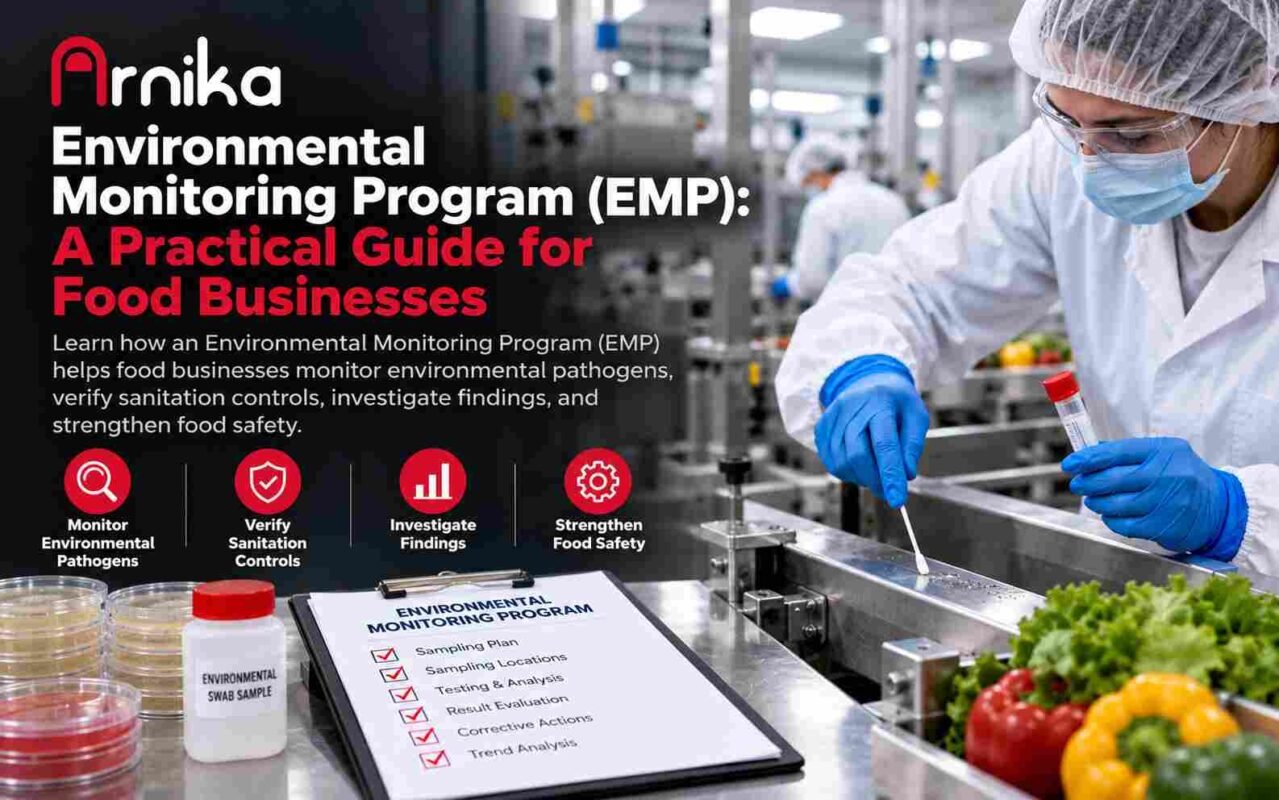
An Environmental Monitoring Program (EMP) is a structured program used by food businesses to monitor the processing environment for microorganisms or other indicators that may affect food safety.
An EMP can be particularly important for food manufacturers producing ready-to-eat (RTE) foods, where environmental contamination can present a significant food safety risk.
In Canada, the Canadian Food Inspection Agency (CFIA) provides specific guidance on environmental sampling for Listeria in RTE food operations. The program can help businesses evaluate the effectiveness of controls, identify potential contamination sources, and determine appropriate follow-up actions.
An effective EMP is not simply a schedule for taking swabs.
It should be part of the company’s overall food safety system.
Reviewed by Reza Eslami, CEO & Co-Founder of Arnika and Food Safety & Regulatory Compliance Consultant.
What Is an Environmental Monitoring Program?
An Environmental Monitoring Program is a documented system that defines:
- What will be sampled
- Where samples will be collected
- Which microorganisms or indicators will be tested
- How samples will be collected
- When sampling will occur
- How frequently sampling will occur
- Which laboratory or analytical method will be used
- How results will be evaluated
- What actions will be taken when a result is positive
- How results will be trended and reviewed
The purpose is to provide evidence about the condition of the processing environment and the effectiveness of relevant sanitation and preventive controls.
CFIA’s guidance specifically describes environmental sampling as a tool for monitoring Listeria in food-processing environments, including both food-contact and non-food-contact surfaces.
Why Is an EMP Important?
Food processing environments can contain areas where microorganisms may survive or become established.
Potential sources include:
- Equipment
- Drains
- Floors
- Conveyors
- Wheels and casters
- Structural surfaces
- Hard-to-clean areas
- Water or moisture
- Processing equipment
- Food-contact surfaces
This is particularly important for Listeria because Listeria monocytogenes can survive in processing environments and grow at refrigeration temperatures.
CFIA notes that L. monocytogenes is well adapted to cold, moist environments commonly found in food-processing establishments.
An EMP can therefore help a business identify environmental problems before they become a product contamination problem.
Environmental Monitoring and Listeria
For many RTE food operations, Listeria is one of the most important organisms considered in an EMP.
CFIA recommends that environmental programs for applicable RTE operations consider Listeria spp., rather than testing only for Listeria monocytogenes. Testing for Listeria species can provide an indication of whether environmental controls are working effectively.
However, an EMP should not automatically use the same organism, sampling locations, or frequency for every food business.
The program should be risk-based and appropriate to the product and process.
What Areas Should Be Sampled?
A well-designed EMP generally considers different zones within the processing environment.
For example:
Food-Contact Surfaces
These are surfaces that directly contact exposed food.
Examples include:
- Conveyor belts
- Processing equipment
- Cutting equipment
- Tables
- Utensils
- Fillers
Non-Food-Contact Surfaces
These do not directly contact food but may provide potential sources or pathways for contamination.
Examples include:
- Floors
- Drains
- Wheels
- Equipment frames
- Structural surfaces
- Cleaning tools
- Areas around processing equipment
CFIA’s RTE guidance recommends considering both food-contact and non-food-contact surfaces and using process-flow information to identify potential cross-contamination pathways.
How Often Should Environmental Samples Be Collected?
There is no single sampling frequency that is appropriate for every food business.
Sampling frequency should reflect factors such as:
- Product risk
- Whether the food is ready-to-eat
- Whether the product supports growth of L. monocytogenes
- Processing conditions
- Sanitation history
- Previous environmental findings
- Facility design
- Processing environment
- Existing preventive controls
CFIA provides specific recommended testing frequencies for certain RTE food categories and risk levels, so businesses should use the applicable CFIA guidance rather than applying an arbitrary “weekly” or “monthly” rule to every operation.
When Should Environmental Sampling Take Place?
Timing matters.
If samples are always collected immediately after cleaning and sanitation, the results may not provide the same information as samples collected during production.
CFIA’s guidance identifies sampling during production, including several hours into production, as an important consideration for applicable RTE operations.
The EMP should therefore clearly define when samples are collected and why that timing was selected.
What Should an EMP Procedure Include?
A practical Environmental Monitoring Program should document:
1. Scope
Identify the products, areas, lines, and processes covered by the program.
2. Target Organisms
Define the microorganisms or indicators being monitored.
3. Sampling Locations
Identify specific sampling locations and maintain an updated sampling map.
4. Sampling Frequency
Define how frequently each location or zone is sampled.
5. Sampling Method
Describe the equipment, materials, collection method, handling, and transportation requirements.
6. Laboratory Testing
Identify the applicable analytical method and laboratory arrangements.
7. Acceptance Criteria
Define how results will be interpreted.
8. Corrective Actions
Establish what happens when an unacceptable result is obtained.
9. Trend Analysis
Review results over time to identify recurring or increasing problems.
10. Verification
Periodically confirm that the EMP itself remains appropriate and effective.
CFIA’s guidance identifies target organisms, sampling sites, sampling procedures, frequency, and follow-up actions as important elements of an environmental sampling program.
What Happens When You Get a Positive Result?
A positive environmental result should trigger a documented response based on the organism, location, product risk, and applicable procedures.
Possible actions may include:
- Confirming the result where appropriate
- Increasing environmental sampling
- Reviewing sanitation activities
- Conducting intensified cleaning and sanitation
- Investigating potential harborage sites
- Reviewing employee and equipment movement
- Assessing potential cross-contamination
- Reviewing recent production
- Evaluating potentially affected product
- Conducting additional testing where appropriate
- Performing root cause analysis
- Implementing corrective actions
- Increasing monitoring until control is demonstrated
CFIA’s current operational procedure for Listeria detection follows a structured approach involving preliminary assessment, investigation, risk assessment, mitigation, follow-up, and closure.
The important point is:
Do not simply resample and move on.
A recurring positive result may indicate an underlying sanitation, hygienic design, traffic-flow, equipment, or environmental-control problem.
EMP and HACCP: How Do They Work Together?
An Environmental Monitoring Program can support a broader HACCP-based food safety system, but it is not itself a HACCP plan.
Think of the relationship as:
Prerequisite Programs → Sanitation & GMP → HACCP/Preventive Controls → Environmental Monitoring → Verification → Corrective Action
Environmental monitoring can provide evidence that certain preventive controls are working effectively.
For example, repeated environmental findings may indicate that sanitation controls, equipment design, traffic patterns, or other preventive controls need to be reassessed.
You can learn more about the relationship between HACCP and prerequisite programs in Arnika’s Prerequisite Programs for HACCP guide and our HACCP resource.
EMP vs Product Testing
Environmental monitoring and finished-product testing are not interchangeable.
Product testing tells you something about the samples tested.
Environmental monitoring can help identify potential contamination sources within the processing environment.
For environmental pathogens such as Listeria, this distinction is particularly important because finding and eliminating environmental harborage sites can be an important part of preventing contamination of RTE food. CFIA specifically identifies environmental sampling as a way to determine the presence of Listeria in processing areas and equipment and to help assess control effectiveness.
A food business should therefore avoid relying exclusively on finished-product testing to demonstrate that the processing environment is under control.
Common EMP Mistakes
Using the Same Sampling Plan Forever
Your sampling locations should be reviewed based on results, process changes, and emerging risks.
Sampling Only Easy-to-Reach Areas
Easy sampling locations may not be the locations most likely to reveal environmental problems.
Sampling Only Food-Contact Surfaces
Non-food-contact areas can provide valuable information about potential sources and pathways of contamination.
Treating Every Positive Result the Same
The response should consider the organism, location, product, process, and risk.
Not Trending Results
Individual results matter, but trends can reveal recurring problems that individual results may not make obvious.
Treating the EMP as a Laboratory Exercise
The value of an EMP comes from connecting sampling results to sanitation, investigation, corrective action, and preventive controls.
How Arnika Can Help
Arnika helps Canadian food businesses develop and strengthen practical food safety systems, including environmental monitoring and related preventive controls.
Our support can include:
- Environmental Monitoring Program development
- Risk-based sampling plans
- Sampling-site assessment
- Listeria control program review
- Sanitation program assessment
- HACCP and PCP review
- Root cause analysis
- Corrective action development
- Food safety audits
- Employee training
- CFIA inspection preparation
Our food safety consulting services can help businesses evaluate whether their environmental monitoring and preventive control systems are appropriate for their products and processes.
Environmental Monitoring Program FAQs
Is an Environmental Monitoring Program required for every food business?
No single EMP applies universally to every food business. Requirements and expectations depend on the product, process, hazards, regulatory framework, and customer or certification requirements. CFIA has specific environmental sampling guidance for applicable RTE food operations.
What is the main organism monitored in an EMP?
For many RTE operations, Listeria spp. is an important target. The appropriate target organisms should be determined based on the hazards and risks associated with the specific operation.
Is environmental monitoring part of HACCP?
Environmental monitoring can support HACCP and preventive-control systems by providing evidence about environmental control, but an EMP is not the same thing as a HACCP plan.
How often should environmental swabs be taken?
Sampling frequency should be risk-based. There is no universal frequency suitable for every facility. CFIA provides specific guidance for certain RTE food categories and risk levels.
What should I do if I find Listeria in an environmental sample?
Follow your documented response procedure, assess the result and potential risk, investigate the source, implement appropriate corrective actions, and verify that the controls are effective. The appropriate response depends on where the organism was detected, the product and process, and the circumstances of the finding.
Conclusion
An Environmental Monitoring Program (EMP) is more than a schedule for collecting environmental swabs.
A well-designed EMP helps a food business understand its processing environment, evaluate sanitation and preventive controls, identify potential contamination sources, respond to environmental findings, and use trend information to improve its food safety system.
For Canadian food businesses, particularly those producing applicable RTE foods, environmental monitoring can be an important part of a broader preventive-control and food safety program.
The goal is not simply to collect samples.
The goal is to use environmental monitoring results to detect problems early, investigate their causes, control risks, and prevent recurrence.