

HACCP Compliance Case Study: Strengthening a Canadian Food Manufacturer’s Food Safety System
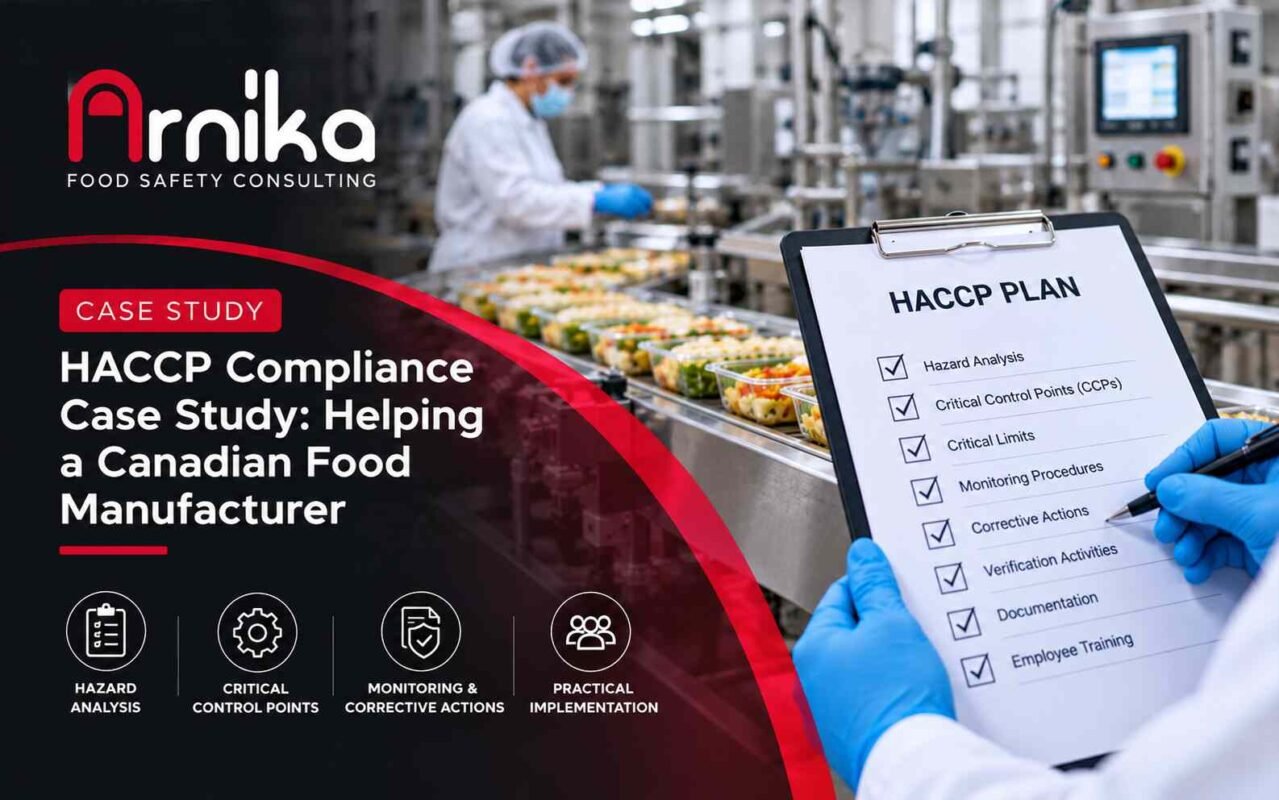
A HACCP plan is only effective when it reflects the actual operation and is consistently implemented. A manufacturer may have procedures and records in place, but the system still needs to be checked against what happens on the production floor.
This case study describes how Arnika supported an anonymized Canadian food manufacturer in reviewing and strengthening its HACCP system. The objective was not simply to revise a document, but to create a more practical framework for identifying hazards, applying controls, monitoring results and verifying that the system was working.
Client-identifying information has been removed or generalized to protect confidentiality.
The Situation
The manufacturer had an established food safety system and wanted a more structured assessment of its HACCP compliance. The review focused on whether the documented system accurately represented the operation and adequately addressed the relevant hazards and controls.
The scope included the production process, product and process information, hazard analysis, prerequisite programs (PRPs), Critical Control Points (CCPs), critical limits, monitoring, corrective actions, verification, validation, records and employee training.
A central question guided the assessment: did the HACCP system control the food safety hazards associated with the products and processes, and could the manufacturer demonstrate that those controls were being implemented?
How Arnika Approached the Assessment
1. Understanding the operation and process flow
The review began with the actual movement of materials through the facility, from receiving and storage through preparation, processing, packaging, finished-product storage and distribution. Ingredients, equipment, employees, rework, sanitation and production conditions were considered. The documented process flow needed to match what was really happening; otherwise, the hazard analysis could overlook relevant steps or hazards.
2. Reviewing the HACCP plan and prerequisite programs
Existing product descriptions, intended use, process flow diagrams, hazard analysis, control measures, CCPs, critical limits, monitoring, corrective actions, verification and records were reviewed against the operation.
The review also considered foundational programs such as personal hygiene, cleaning and sanitation, pest control, equipment maintenance, supplier controls, allergen management, chemical control, waste management and storage. These Prerequisite Programs support the HACCP system; they do not replace hazard-specific controls. Related GMP practices were also considered.
3. Assessing hazards and critical control points
The hazard analysis considered biological, chemical and physical hazards in the context of the products and process steps. Examples included pathogenic microorganisms and microbial growth; allergens, cleaning chemicals and undeclared ingredients; and metal, glass, plastic or equipment fragments. The purpose was to identify reasonably foreseeable hazards requiring control, rather than produce a generic list.
The assessment then considered where CCPs were appropriate. CCPs and their critical limits must be based on the specific hazard and process—not copied from another facility’s plan. Depending on the operation, measurable limits may relate to time, temperature, pH, water activity or physical detection parameters. Any applicable limits require an appropriate technical or scientific basis.
4. Reviewing monitoring and corrective actions
For each applicable control, the review considered what should be monitored, how it should be measured, who is responsible, the required frequency, where results are recorded and what happens when a limit is not met. Monitoring instructions need to be clear and practical enough for employees to follow consistently.
Corrective-action procedures were considered in terms of process correction, product hold and evaluation, disposition, documentation, investigation and prevention of recurrence. Addressing the underlying cause is important when deviations recur. Arnika’s guide to root cause analysis in food manufacturing provides further information.
5. Checking verification, validation and records
The assessment distinguished validation from verification. Validation asks whether a control measure is capable of controlling the identified hazard; verification checks whether the system is being implemented and continues to work as intended.
Activities considered included record review, direct observation, internal audits, calibration, testing, monitoring review, corrective-action review and trend analysis. Records reviewed included CCP monitoring, sanitation, production, receiving, calibration, training, maintenance, corrective actions and traceability. Missing or incomplete entries, unresolved deviations and weak follow-up can make it difficult to demonstrate that the system is functioning.
6. Considering people and supporting controls
Employee responsibilities were considered across production, CCP monitoring, sanitation, allergen control, receiving, corrective actions, recordkeeping and verification. Employees need to understand both what they must do and why the control matters. Where allergenic ingredients were involved, the review considered ingredient identification, storage, production scheduling, cross-contact prevention, cleaning, label verification and corrective actions.
Traceability and recall readiness were also considered as part of the wider food safety system, linking ingredients to production, finished products and customers. See Arnika’s guidance on
food recall management in Canada for more information.
7. Prioritizing corrective actions and improvement
Identified gaps were organized according to their potential effect on food safety, HACCP effectiveness, regulatory compliance, monitoring, verification, documentation and employee implementation. The corrective-action approach connected each issue to its cause, action, responsible person, completion and verification.
The manufacturer was encouraged to treat HACCP as a living system. New products, ingredients, suppliers, equipment, process changes, incidents, complaints or recurring deviations may indicate that reassessment is needed.
The Outcome
The project gave the manufacturer a clearer and more structured HACCP framework and a better understanding of where its existing system needed improvement. The key improvement was a stronger connection between hazard analysis, preventive controls, CCPs, critical limits, monitoring, corrective actions and verification.
The source project information does not report a specific certification result, regulatory inspection outcome or quantified performance improvement. The case study therefore focuses on the assessment approach and the practical framework established, rather than claiming an unreported result.
Key Lessons
- A HACCP plan must reflect the actual products, process and facility—not an assumed or outdated process.
- Effective PRPs and GMPs provide the foundation for HACCP controls.
- CCPs should be determined from the hazards and process; not every process step is a CCP.
- Monitoring and corrective-action instructions must be clear, practical and documented.
- Validation and verification serve different purposes and both matter.
- Training, reliable records and periodic reassessment help keep the system effective.
How Arnika Can Help
Arnika supports Canadian food manufacturers with HACCP development and review, gap assessments, hazard analysis, CCP determination, critical-limit review, monitoring and corrective-action procedures, verification, validation support, PRPs, GMP programs, employee training, internal audits and certification preparation.
If your organization is developing, reviewing or strengthening its HACCP system, learn more about Arnika’s food safety consulting services or food safety training.
Frequently Asked Questions
What is HACCP compliance?
HACCP compliance involves implementing a system that identifies and controls relevant food safety hazards, supported by monitoring, corrective actions, verification and appropriate records.
What are the seven HACCP principles?
The traditional seven principles are: conduct a hazard analysis; determine CCPs; establish critical limits; establish monitoring procedures; establish corrective actions; establish verification procedures; and establish recordkeeping and documentation procedures.
What is the difference between a CCP and a prerequisite program?
Prerequisite Programs establish foundational conditions for safe food production, such as hygiene, sanitation, pest control and maintenance. A CCP is a process step where control is essential to manage a specific food safety hazard.
What is the difference between validation and verification?
Validation asks whether a control measure is capable of controlling a hazard. Verification checks whether the system is being implemented and continues to work as intended.
When should a HACCP plan be reassessed?
Reassessment may be needed when products, ingredients, suppliers, equipment, processes or facilities change, or when incidents, complaints, recurring deviations or verification results indicate that the system may need updating.
Can Arnika help develop or improve a HACCP system?
Yes. Arnika supports Canadian food businesses with HACCP development, gap assessments, hazard analysis, PRPs, monitoring and corrective-action procedures, verification, training and certification preparation.