

SQF Certification Case Study: Helping a Canadian Food Manufacturer Prepare for Certification
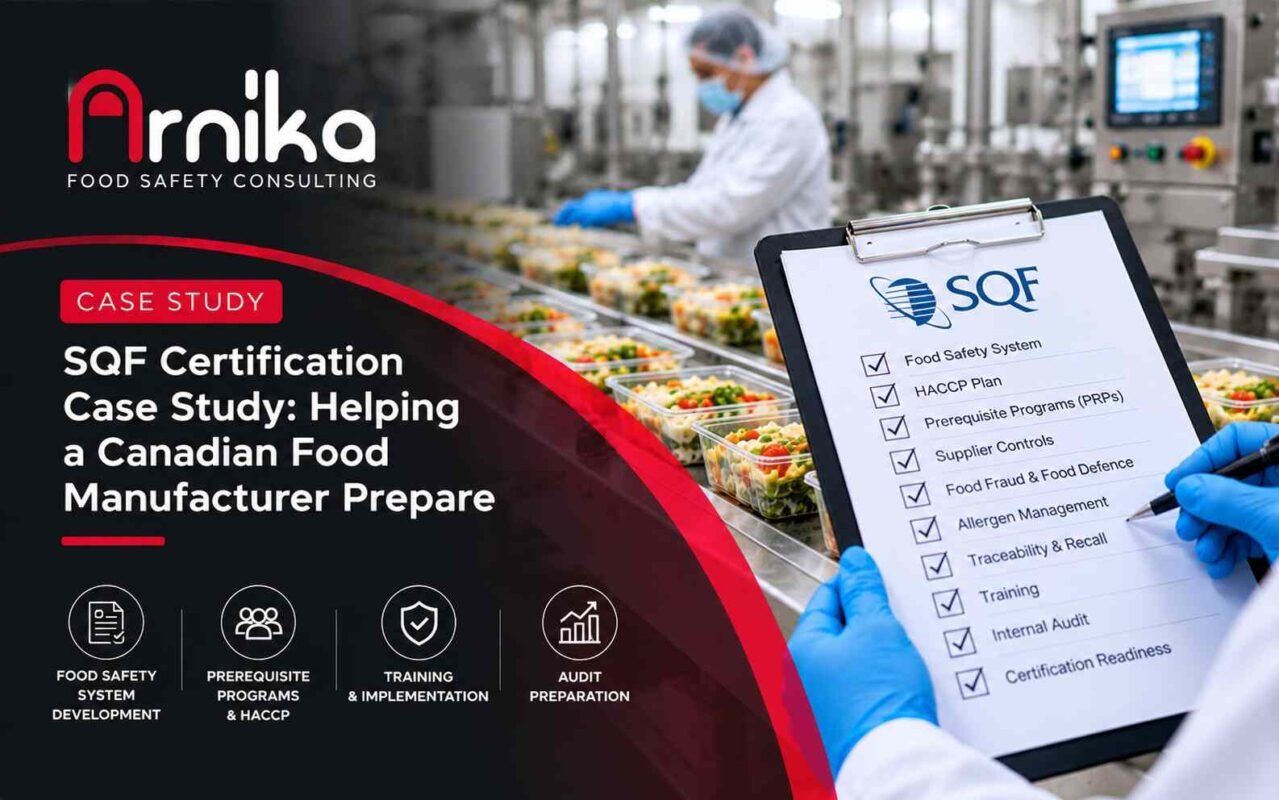
Preparing for SQF certification involves much more than completing documents before an auditor arrives. An organization needs to develop, implement, maintain and demonstrate a food safety system that meets the requirements applicable to its products, processes and certification scope.
This case study describes how Arnika supported an anonymized Canadian food manufacturer preparing for SQF certification. Client-identifying information has been removed or generalized. The objective was to help the manufacturer move from having separate food safety programs to a more integrated system that could be implemented and assessed.
The Situation
The manufacturer was preparing to enter the SQF certification process. Management recognized the potential business value of certification, including customer confidence and access to customers seeking GFSI-benchmarked certification. However, the company needed to determine whether its existing food safety system was sufficiently developed and implemented.
Key questions included which requirements applied to the site, what documentation and programs needed improvement, whether HACCP and prerequisite programs were adequate, whether employees understood their responsibilities, and whether records demonstrated effective implementation.
How Arnika Approached the Project
1. Defining the certification scope and reviewing the existing system
The preparation began by considering the products, processes, raw materials, packaging, storage, distribution activities and applicable food sector category within the intended certification scope. Defining the scope accurately is important because the applicable requirements are linked to what the site actually does.
The existing food safety system was then reviewed, including HACCP, prerequisite programs, GMP, sanitation, allergen management, pest control, supplier controls, traceability, recall, food defence, food fraud, training, internal auditing, corrective actions, document control and records.
2. Conducting an SQF gap assessment
The gap assessment compared the current system with the applicable SQF requirements and considered both documentation and implementation. A written procedure may still represent a gap if employees do not follow it, records are incomplete, verification is missing, corrective actions are ineffective or the procedure does not reflect the actual operation.
The purpose was to establish a practical starting point and identify the areas that needed to be addressed before the certification audit.
3. Reviewing HACCP, prerequisite programs and GMP
The HACCP review considered product descriptions, intended use, process flow diagrams, hazard analysis, preventive controls, CCPs, critical limits, monitoring, corrective actions, verification, validation and records.
The assessment also considered foundational programs such as sanitation, personal hygiene, pest control, preventive maintenance, allergen management, chemical control, supplier approval, receiving, storage, waste management and employee training. Arnika’s resources on HACCP, Prerequisite Programs and GMP provide further information about these components.
4. Establishing responsibilities and strengthening documentation
The project considered ownership of the SQF system and the responsibilities needed to maintain it. These included coordinating food safety activities, maintaining documentation, monitoring implementation, organizing internal audits, following corrective actions and supporting management review. The source emphasizes that the organization itself must own the system; it cannot become the responsibility of a consultant alone.
Policies, procedures, work instructions, forms, specifications, HACCP documentation, prerequisite programs, monitoring records, verification records and corrective-action records were reviewed for usefulness, clarity, consistency and completeness. The objective was not to create paperwork for its own sake, but to ensure that documents could be followed and verified.
5. Preparing employees and reviewing supply-chain controls
Employee knowledge was considered in relation to GMP, hygiene, food safety hazards, HACCP responsibilities, allergens, sanitation, monitoring, corrective actions, recordkeeping and reporting problems. Training was connected to job responsibilities so employees could explain what they do, why it matters, what they monitor and what to do when a result is unacceptable.
Traceability and recall readiness were also reviewed, including ingredient and finished-product identification, lot coding, supplier and customer information, traceability exercises and recall procedures. Supplier approval and verification were considered alongside food fraud and food defence controls, based on the applicable scope and requirements.
6. Reviewing internal audits, management review and corrective actions
The internal audit process was considered in terms of scope, frequency, auditor competency, findings, corrective actions and follow-up. Management review inputs could include audit findings, corrective actions, complaints, food safety incidents, verification results, program performance and changes affecting the system.
For significant findings, the corrective-action approach connected the finding with immediate correction, root cause, corrective action and verification. Arnika’s guide to root cause analysis in food manufacturing explains this approach in greater detail.
7. Conducting a pre-assessment and production-floor review
A pre-assessment or mock audit was used as a readiness check before the certification audit. It challenged both documentation and implementation through questions such as: Can the site show the procedure and the corresponding record? How does it know the procedure is followed? What happens when monitoring results are unacceptable? Can employees explain their responsibilities?
The practical walkthrough considered employee behaviour, hygiene, product handling, equipment condition, sanitation, material flow, storage, allergen controls, record completion and operational practices. The central question was whether the production floor matched the food safety system on paper.
The final readiness review considered current procedures, completed records, corrective actions, training, internal audits, verification, HACCP and PRP implementation, facility conditions and employee practices.
The Outcome
The manufacturer moved toward a more integrated SQF system, with a clearer understanding of how GMP, prerequisite programs, HACCP, employees, records, verification and continuous improvement fit together. The preparation focused on demonstrating implementation rather than simply completing documents.
The source material does not confirm that the manufacturer completed the certification audit or achieved SQF certification. This case study therefore describes the preparation work and reported readiness improvements without claiming a certification result.
Key Lessons
- Define the certification scope before building or revising the system.
- Assess the actual operation as well as the documents.
- HACCP needs effective prerequisite programs and GMP controls to support it.
- Employees and management must understand and own their responsibilities.
- Internal audits should identify genuine weaknesses while there is time to address them.
- A pre-assessment can help test whether procedures, records and practices align.
- Records and verification provide evidence that the system is implemented.
SQF Certification Is an Ongoing Commitment
Certification should not be treated as the finish line or an annual emergency. The source describes ongoing internal audits, management review, problem investigation, employee training, verification, procedure updates, complaint review and continuous improvement as important parts of maintaining the system.
The certification scope and applicable SQF Code requirements should be confirmed for each site. Requirements can depend on the products, processes and food sector category involved.
How Arnika Can Help
Arnika supports Canadian food manufacturers with SQF gap assessments, SQF system development, HACCP, prerequisite programs, GMP implementation, internal audits, mock audits, corrective-action support, employee training and certification preparation.
Learn more about Arnika’s certification services, food safety consulting and food safety training.
Frequently Asked Questions
What is SQF certification?
SQF is a food safety and quality certification program used by food businesses to demonstrate that their systems meet applicable SQF requirements.
How do you prepare for SQF certification?
Preparation generally includes defining the scope, understanding the applicable SQF Code, assessing the current system, addressing gaps, implementing programs, training employees, conducting internal audits and completing a readiness review before the certification audit.
What is an SQF gap assessment?
It compares the organization’s current food safety system and its implementation against applicable SQF requirements to identify areas needing improvement.
Is an SQF pre-assessment required?
The source describes pre-assessment as optional. It can be used as a readiness check to identify gaps before the certification audit.
Does SQF include HACCP?
The source describes the SQF food safety program as using a risk-based approach incorporating HACCP principles to identify and manage food safety hazards.
Who conducts an SQF certification audit?
The source states that SQF audits are conducted by SQFI-licensed certification bodies using qualified SQF auditors.
How long does SQF certification preparation take?
There is no universal timeline. It depends on the organization’s size, operations and level of preparation.
Can Arnika help a Canadian manufacturer prepare for SQF?
Yes. Arnika can support SQF gap assessments, food safety system development, HACCP, prerequisite programs, GMP, internal audits, mock audits, training, corrective actions and certification preparation.