
BLOG
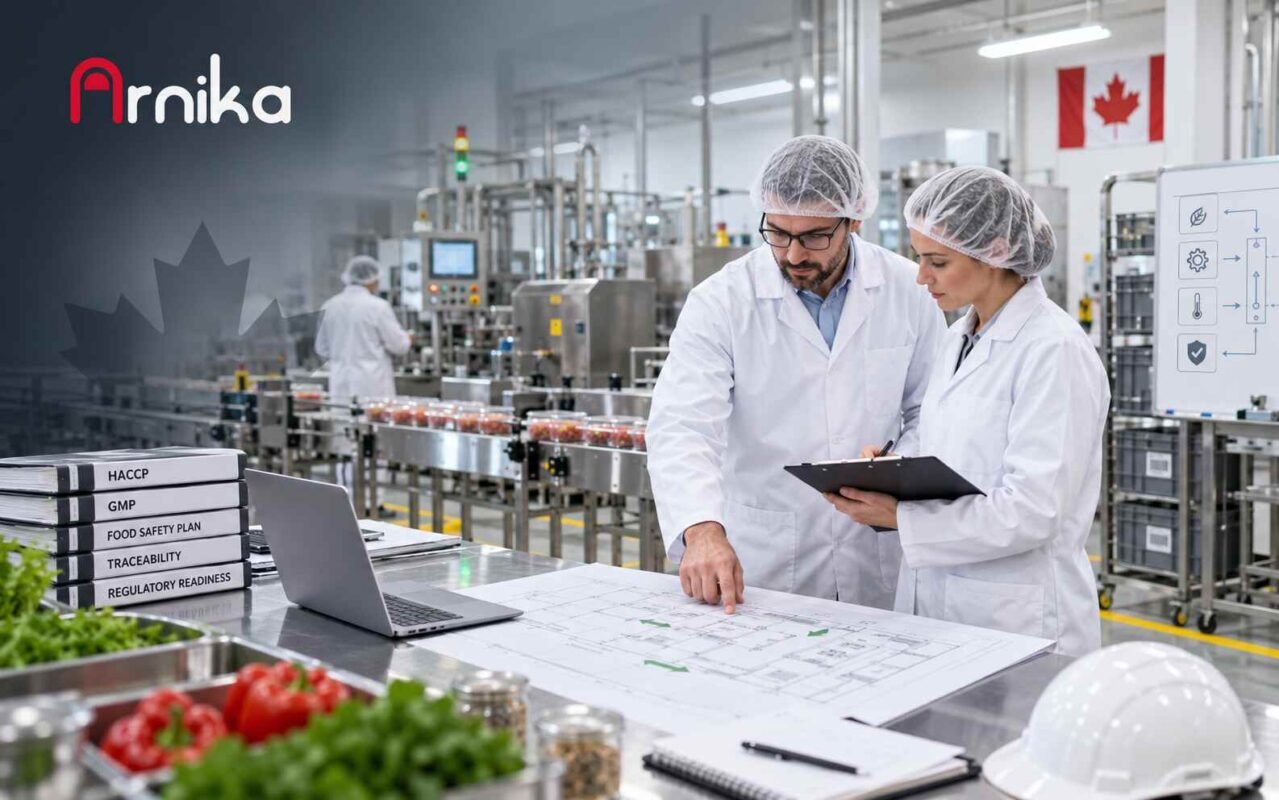
Starting a food manufacturing business requires much more than developing a good product.
Before production begins, entrepreneurs and food companies need to consider facility design, process flow, equipment, sanitation, food safety hazards, HACCP, prerequisite programs, regulatory requirements, employee training, documentation, traceability, and preventive controls.
Arnika provides food manufacturing startup consulting services in Canada to help new and expanding food businesses build their operations with food safety and regulatory requirements in mind from the beginning.
Whether you are developing a new food processing facility, expanding an existing operation, launching a new product line, or preparing to begin commercial production, we can help you identify food safety and compliance requirements before costly problems arise.
Why Food Manufacturing Startups Need Specialized Consulting
Launching a food manufacturing facility involves decisions that can have long-term consequences.
A facility may look suitable from a production perspective but create food safety challenges because of:
- Poor product flow
- Inadequate separation between raw and finished products
- Insufficient sanitation access
- Inappropriate equipment placement
- Cross-contamination risks
- Inadequate storage capacity
- Poor personnel flow
- Inadequate allergen controls
- Difficult-to-clean surfaces
- Insufficient documentation systems
- Inadequate preventive controls
CFIA’s preventive-control requirements address areas including hazard identification, sanitation, pest control, equipment, facility conditions, storage, employee competency and hygiene, complaints, corrective actions, and recalls.
The best time to address these issues is before construction, equipment installation, and production begin.
What Is Food Manufacturing Startup Consulting?
Food manufacturing startup consulting is professional support provided during the planning, development, construction, commissioning, or early operation of a food manufacturing business.
The objective is to help ensure that the facility and its food safety system are designed around the actual products and processes being produced.
Depending on your project, Arnika can support areas such as:
- Food safety regulatory requirements
- SFCR requirements
- Preventive Control Plans
- HACCP
- Prerequisite Programs
- GMP
- Facility and process-flow review
- Sanitation
- Equipment and hygienic design considerations
- Allergen control
- Supplier controls
- Traceability
- Recall preparedness
- Employee training
- Documentation
- Internal audits
- Certification readiness
When Should You Hire a Food Manufacturing Consultant?
Ideally, food safety consulting should begin before major facility and process decisions are finalized.
Arnika can become involved at different stages of a project.
Before Facility Design
This is often the most valuable stage for consulting.
Before construction or major renovation, we can help review:
- Product types
- Ingredients
- Processing steps
- Production volumes
- Product flow
- Personnel flow
- Raw-material receiving
- Storage requirements
- Processing areas
- Packaging areas
- Finished-product storage
- Waste flow
- Cleaning and sanitation requirements
Early review can help identify potential food safety problems before they become expensive construction or operational changes.
During Facility Design and Construction
As the facility develops, food safety considerations should remain connected to the actual operation.
CFIA’s preventive-control guidance includes expectations concerning facility design, maintenance, sanitation, equipment, adequate space, lighting, ventilation, water, waste, and controls that help prevent contamination.
Depending on the project, Arnika can help review:
- Facility layout
- Production-area separation
- Personnel movement
- Product movement
- Equipment positioning
- Storage areas
- Sanitation access
- Cleaning requirements
- Pest-control considerations
- Drainage and water considerations
- Temperature-controlled areas
- Allergen segregation
- Raw and finished product separation
Food Manufacturing Startup Consulting Services
Food Safety Regulatory Assessment
Before developing your operation, it is important to understand which regulatory requirements apply to your business.
The Safe Food for Canadians Regulations (SFCR) apply to food businesses according to their activities and trade context. For example, federal requirements can apply to businesses manufacturing, processing, treating, preserving, grading, packaging, or labelling food for interprovincial trade or export.
Arnika can help you identify the food safety and regulatory requirements relevant to your project.
This may include:
- SFCR
- CFIA requirements
- Preventive controls
- PCP requirements
- Licensing considerations
- Traceability
- Food safety documentation
- Applicable customer requirements
- GFSI certification expectations
Preventive Control Plan Development
A Preventive Control Plan (PCP) describes how a food business controls food safety hazards and meets applicable requirements.
CFIA’s guidance describes a PCP as including elements such as hazard analysis, control measures, critical control points where applicable, critical limits, monitoring, corrective actions, verification, and evidence that the plan has been implemented.
Arnika can help develop a PCP that reflects your actual:
- Products
- Ingredients
- Processes
- Equipment
- Facility
- Personnel
- Food safety hazards
- Monitoring activities
- Verification activities
Our HACCP consulting services can also support the hazard-analysis component of your food safety system.
HACCP Development
HACCP should be built around your actual products and processes rather than treated as a generic document.
Arnika can support:
- Product descriptions
- Intended use
- Process flow diagrams
- Hazard analysis
- Hazard evaluation
- Preventive controls
- Critical Control Points (CCPs)
- Critical limits
- Monitoring procedures
- Corrective actions
- Verification procedures
- HACCP documentation
For businesses that are planning to pursue GFSI certification later, establishing a strong HACCP foundation early can also make future system development more efficient.
Prerequisite Programs
A strong food safety system requires foundational programs that control the conditions surrounding production.
Your startup may require programs covering:
- GMP
- Sanitation
- Personal hygiene
- Pest control
- Allergen control
- Supplier approval
- Chemical control
- Equipment maintenance
- Water quality
- Waste management
- Glass and brittle plastic
- Temperature control
- Transportation
- Traceability
- Recall
- Employee training
Our HACCP Prerequisite Programs pillar explains how these foundational programs support a broader food safety system.
GMP Development
Good Manufacturing Practices help establish the hygienic and operational foundation of a food manufacturing facility.
Arnika can help establish GMP expectations for:
- Personnel hygiene
- Facility conditions
- Equipment
- Sanitation
- Production practices
- Storage
- Pest control
- Cross-contamination prevention
- Documentation
- Employee responsibilities
See our GMP Canada guide for more information about Good Manufacturing Practices in Canadian food operations.
Facility Layout and Process Flow Review
Facility design can significantly affect food safety.
Before finalizing a layout, it is important to understand how:
People → Raw Materials → Processing → Packaging → Finished Products → Shipping
will move through the facility.
CFIA guidance specifically considers the design, construction, maintenance, size, layout, equipment, sanitation and movement within food establishments as part of preventive controls.
Arnika can review proposed layouts from a food safety perspective and identify potential concerns involving:
- Cross-contamination
- Raw/finished product separation
- Personnel flow
- Material flow
- Allergen flow
- Waste flow
- Sanitation
- Equipment access
- Storage
- Cleaning
- Maintenance
Equipment and Hygienic Design Considerations
Equipment selection should consider not only production capacity but also food safety and sanitation.
Depending on the process, considerations may include:
- Cleanability
- Accessibility
- Food-contact surfaces
- Material compatibility
- Equipment placement
- Drainage
- Maintenance access
- Cross-contamination risks
- Temperature control
- Calibration
- Cleaning and sanitation
CFIA’s preventive-control requirements include expectations that equipment used for food operations be appropriate for the activity and function as intended.
Allergen Control
Allergen management should be considered before production begins, particularly where a facility will manufacture multiple products.
An effective allergen-control program may address:
- Allergen identification
- Ingredient receiving
- Storage
- Segregation
- Production scheduling
- Equipment
- Cleaning
- Changeovers
- Labelling
- Employee training
- Verification
Designing allergen controls into the process from the beginning can be considerably easier than trying to retrofit them after production starts.
Supplier Approval and Ingredient Controls
Your food safety system begins before ingredients enter the facility.
Arnika can help establish supplier-control procedures covering:
- Supplier approval
- Ingredient specifications
- Packaging specifications
- Certificates and documentation
- Receiving controls
- Ingredient inspection
- Allergen information
- Supplier performance
- Corrective actions
The goal is to establish appropriate controls for raw materials and packaging before they enter your production process.
Traceability and Recall System
A new food business should establish traceability procedures before commercial production begins.
Your system should allow the business to understand where ingredients and materials came from and, where applicable, where finished products were distributed.
Arnika can help establish:
- Lot coding
- Receiving records
- Production records
- Ingredient traceability
- Finished-product traceability
- Distribution records
- Complaint procedures
- Recall procedures
- Recall testing
Our Food Recall Management in Canada resource provides additional information about recall preparedness.
Employee Training
A food safety system is only effective when employees understand and follow it.
Arnika can provide or support training related to:
- HACCP
- GMP
- Personal hygiene
- Sanitation
- Allergen control
- Preventive controls
- Documentation
- Corrective actions
- Traceability
- Food safety culture
Our food safety training services can be tailored to the needs of your operation.
Documentation and Record-Keeping
A startup should establish its documentation system before production becomes complicated.
Depending on the operation, documentation may include:
- SOPs
- SSOPs
- HACCP documentation
- PCP
- Monitoring records
- Sanitation records
- Training records
- Supplier records
- Receiving records
- Corrective action records
- Verification records
- Traceability records
- Recall records
- Calibration records
CFIA guidance emphasizes that records provide evidence that preventive controls have been implemented and are effective.
CFIA Licensing and Regulatory Readiness
Whether your operation requires a federal Safe Food for Canadians licence depends on your food, activities, and trade situation.
CFIA provides a licensing process through My CFIA and requires applicants who need a licence to attest to applicable SFCR requirements, including preventive controls and a written PCP when required.
Arnika can help businesses understand the food safety requirements that should be addressed as part of their regulatory-readiness process.
Important: Regulatory requirements can vary according to the nature of the food business. We recommend confirming licensing obligations directly with CFIA for your specific activity.
GFSI Certification Preparation
Some food manufacturers plan to supply major retailers or international customers from the beginning.
If your business expects to pursue a GFSI-recognized certification scheme, it can be advantageous to consider those requirements during initial system design.
Arnika can help businesses prepare for schemes such as:
- SQF
- BRCGS
- FSSC 22000
Our GFSI certification pillar provides an overview of GFSI and recognized certification schemes.
Planning for certification early can reduce the need to redesign your food safety system later.
Food Manufacturing Startup Consulting Process
Step 1: Understand Your Business
We begin by understanding:
- Your products
- Ingredients
- Processes
- Production volumes
- Facility
- Target market
- Distribution model
- Regulatory requirements
- Customer requirements
Step 2: Identify Regulatory and Food Safety Requirements
We determine which requirements may apply to the project, including relevant SFCR preventive controls, PCP considerations, traceability, licensing, and customer or certification requirements.
Step 3: Review the Facility and Process
We examine how the proposed facility, equipment, people, materials, and processes will interact.
The objective is to identify potential food safety risks before they become operational problems.
Step 4: Develop the Food Safety System
Depending on your project, this may include:
- HACCP
- PCP
- PRPs
- GMP
- SOPs
- SSOPs
- Allergen controls
- Supplier controls
- Traceability
- Recall procedures
- Monitoring programs
Step 5: Train Your Team
Employees receive the training necessary to understand their responsibilities within the food safety system.
Step 6: Verify Readiness
Before production or regulatory inspection, we can assess whether the system has actually been implemented.
This may include:
- Document review
- Facility assessment
- Record review
- Employee interviews
- Mock inspection
- Corrective action review
Building a Food Safety System Before You Build the Facility
One of the biggest advantages of startup consulting is the ability to identify food safety problems before they become expensive.
Consider a facility where:
- Raw materials cross finished-product areas
- Employees must walk through production zones unnecessarily
- Equipment cannot be properly cleaned
- Allergens cannot be adequately segregated
- Sanitation access is inadequate
- Storage space is insufficient
- Waste crosses clean areas
- Product flow creates unnecessary contamination risks
Correcting these issues after construction can require expensive modifications.
Considering them during planning can make the facility safer, more efficient, and easier to operate.
Common Mistakes in Food Manufacturing Startups
Starting With Production Instead of Food Safety
A common mistake is designing production first and trying to add food safety later.
Food safety should influence the facility, process, equipment, and operating procedures from the beginning.
Treating HACCP as Just a Document
HACCP should reflect the actual hazards and processes in your facility.
A generic HACCP plan will not necessarily control the risks of your specific operation.
Ignoring Personnel and Product Flow
Poor movement patterns can create unnecessary opportunities for cross-contamination.
Waiting Until an Inspection Is Scheduled
Regulatory readiness should be built into the operation rather than treated as a last-minute project.
Our CFIA Inspection Preparation services can help established businesses assess their readiness before an inspection.
Designing Without Future Certification in Mind
If major customers will eventually require SQF, BRCGS, or FSSC 22000, those expectations should be considered early.
Underestimating Documentation
A food safety system requires evidence that procedures are being followed.
Who Can Benefit From Food Manufacturing Startup Consulting?
Arnika’s startup consulting services may benefit:
- New food manufacturers
- Food processing startups
- Food entrepreneurs
- New food factories
- Existing businesses adding a production facility
- Companies launching new product lines
- Food importers expanding into manufacturing
- Private-label manufacturers
- Businesses preparing for retail customers
- Companies planning GFSI certification
- Investors developing food manufacturing facilities
Why Choose Arnika?
Food manufacturing startups need to balance food safety, regulatory compliance, production, quality, cost, and operational practicality.
Arnika brings these areas together through food safety consulting, training, auditing, inspection, testing, and certification support.
Our food safety consulting services can be tailored to the stage and needs of your project.
We focus on practical systems that can be implemented by your team—not simply documents created for compliance purposes.
Start Your Food Manufacturing Project With Food Safety in Mind
Starting a food manufacturing facility is a significant investment.
The decisions made during the planning and design stages can affect food safety, efficiency, compliance, certification readiness, and operating costs for years.
Getting professional food safety input early can help identify potential problems before construction, equipment installation, and production make those problems more difficult and expensive to correct.
Planning a new food manufacturing facility or expanding an existing operation?
Contact Arnika’s Food Safety Consulting Team to discuss your project and determine what type of support may be appropriate.