

BLOG
Finding a piece of metal, plastic, glass, wood, stone, or another unexpected material in food is a serious food safety concern.
For food manufacturers, a foreign material complaint should never be treated simply as a customer-service issue. It may indicate a failure in equipment maintenance, processing controls, sanitation, employee practices, packaging, supplier controls, or other parts of the food safety system.
A proper Foreign Material Investigation helps determine what happened, whether other products may be affected, what caused the incident, and what corrective actions are necessary to prevent recurrence.
In Canada, food businesses should have procedures for handling complaints, corrective actions, and recalls as part of their overall food safety controls. The Canadian Food Inspection Agency (CFIA) also identifies foreign materials as physical hazards that food businesses should control through appropriate preventive measures.
This guide explains a practical approach to investigating foreign material incidents in food manufacturing.
Reviewed by Reza Eslami
CEO & Co-Founder, Arnika
25+ years of experience in food safety, HACCP, SFCR, SQF, GMP, and regulatory compliance.
→ View full profile
What Is a Foreign Material Investigation?
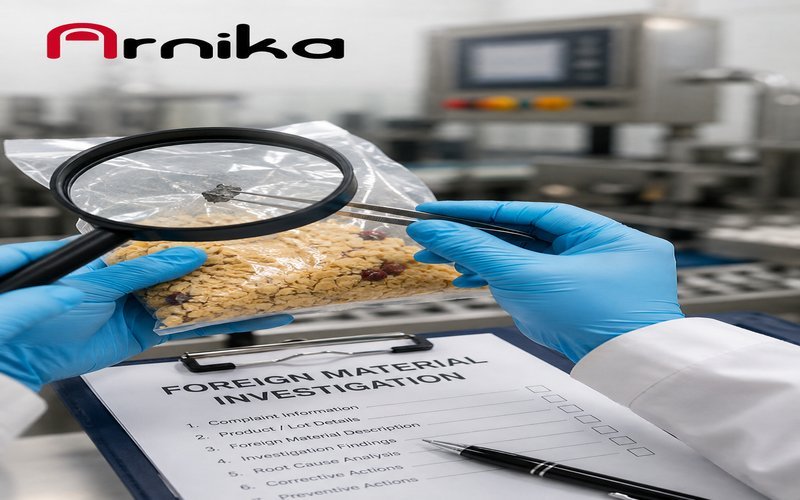
A Foreign Material Investigation is a systematic investigation performed after a foreign object is discovered in food or reported through a customer or consumer complaint.
The objective is not simply to determine what the object is.
A complete investigation should answer questions such as:
- What is the foreign material?
- Where could it have entered the product?
- Which product, lot, batch, or production period is affected?
- Could other products be affected?
- Was the material introduced during processing, packaging, storage, transportation, or another stage?
- What control failed?
- What is the root cause?
- What corrective and preventive actions are required?
The investigation should be documented and supported by evidence.
Common Types of Foreign Material in Food
Foreign material can vary considerably depending on the food product and manufacturing process.
Examples include:
Metal
Metal fragments may originate from:
- Processing equipment
- Cutting blades
- Screens and sieves
- Mixers
- Conveyors
- Fasteners
- Worn machinery components
Plastic
Plastic may originate from:
- Packaging materials
- Equipment components
- Scrapers
- Containers
- Tools
- Broken or damaged plastic parts
Glass
Glass contamination can result from:
- Broken containers
- Light fixtures
- Gauges
- Windows
- Measuring equipment
- Other brittle materials
Wood
Wood fragments may come from:
- Pallets
- Wooden tools
- Damaged structures
- Shipping materials
Other Physical Materials
Other examples can include stones, rubber, fabric, insects, personal items, or other materials that should not be present in the finished product.
The appropriate investigation depends on the material, product, process, and potential hazard.
Why Foreign Material Complaints Require Serious Investigation
A single complaint does not necessarily mean that an entire production run is unsafe.
However, it can be an important signal that a preventive control may not be working as intended.
For example, a metal fragment found in a finished product could indicate:
- Equipment deterioration
- Inadequate preventive maintenance
- A damaged screen or blade
- Failure of a metal detector
- Incorrect detector settings
- Inadequate inspection procedures
- Poor employee practices
This is why investigating the root cause is more valuable than simply removing the affected product.
CFIA guidance emphasizes identifying and isolating affected food, evaluating its safety, determining the root cause of deviations, documenting corrective actions, and preventing recurrence
Food Complaint Investigation: Step-by-Step
A structured Food Complaint Investigation can help prevent a complaint from becoming a larger food safety problem.
Record the Complaint
Begin by documenting all available information.
Important information may include:
- Date of complaint
- Customer information
- Product name
- Product code
- Lot or batch number
- Best-before date
- Quantity involved
- Description of the foreign material
- Photographs
- Location where the material was found
- Whether the product was consumed
- Any reported injury or illness
Preserve the original complaint information and any physical evidence whenever possible.
Secure the Evidence
If the foreign material and affected product are available, preserve them appropriately.
Do not unnecessarily alter, clean, discard, or manipulate the evidence before the investigation is complete.
Photographs, samples, packaging, lot information, and production records can all become important evidence.
Identify the Foreign Material
Determine what the material appears to be.
Depending on the situation, identification may involve:
- Visual examination
- Magnification
- Material comparison
- Laboratory analysis
- Metal identification
- Examination of equipment components
The objective is to determine whether the material can reasonably be connected to something used in the facility or supply chain.
Establish Product and Lot Traceability
Determine exactly which products could potentially be affected.
Review:
- Production dates
- Batch records
- Lot codes
- Production lines
- Ingredients
- Packaging materials
- Equipment used
- Distribution information
This step is particularly important when determining whether the incident is isolated or potentially systemic.
Root Cause Analysis Food Safety: Finding the Real Cause
Simply stating that “a metal piece was found in the product” is not a root cause.
The investigation needs to determine why the metal entered the product and why existing controls did not prevent or detect it.
Useful techniques can include:
The 5 Whys
Ask “why” repeatedly until the investigation moves beyond the immediate event.
For example:
Problem: Metal was found in finished product.
Why?
A metal fragment entered the product.
Why?
A processing component was damaged.
Why?
The component experienced excessive wear.
Why?
Preventive maintenance did not identify the deterioration.
Why?
The maintenance inspection frequency was inadequate for that equipment.
The exact root cause will depend on the evidence. The purpose of the 5 Whys is to move beyond symptoms and identify the underlying system failure.
Fishbone/Ishikawa Analysis
For more complicated incidents, consider categories such as:
- People
- Equipment
- Materials
- Methods
- Environment
- Measurement
This can help investigation teams consider multiple potential sources rather than immediately assuming employee error.
Corrective Action After a Foreign Material Incident
Once the cause has been identified, corrective actions should address both the immediate problem and the underlying cause.
Possible actions include:
- Isolating affected product
- Inspecting equipment
- Repairing or replacing damaged components
- Adjusting preventive maintenance schedules
- Reviewing foreign material controls
- Testing detection equipment
- Reviewing employee training
- Improving inspection frequency
- Revising procedures
- Increasing verification activities
- Evaluating other potentially affected products
CFIA guidance states that corrective actions should address the affected food, determine the root cause, prevent recurrence, and document the actions taken.
Foreign Material Control in a Preventive Control Plan
Foreign material control should not begin after a complaint occurs.
It should be part of the food business’s preventive food safety system.
CFIA guidance identifies foreign materials as physical hazards and provides examples of preventive controls involving equipment maintenance, glass and brittle-material controls, visual inspection, and detection/removal systems such as filters, sieves, magnets, metal detectors and X-ray equipment, where applicable.
Your controls should be appropriate to your:
- Products
- Processes
- Equipment
- Facility
- Packaging
- Suppliers
- Production environment
A Preventive Control Plan (PCP) should also be reviewed when something goes wrong, including a customer complaint, recall, or other food safety problem
When Does a Foreign Material Complaint Become a Recall Issue?
Not every foreign material complaint automatically requires a recall.
The food business must evaluate the specific circumstances and determine whether the food poses a risk and whether additional product may be affected.
Important questions include:
- Is the material hazardous?
- Could the same problem exist in other lots?
- Was affected product distributed?
- Can you identify and control the affected product?
- Does the incident indicate a broader failure in the food safety system?
- Is there a potential risk of injury?
If the investigation indicates that potentially unsafe food has left the business’s control, the company’s recall procedures may need to be activated. The CFIA Inspection Checklist and guidance specifically link affected food that has left the operator’s control with recall procedures.
When Should You Hire a Food Safety Consultant?
A professional Food Complaint Investigation can be especially valuable when:
- The source of the foreign material is unknown
- Multiple complaints have been received
- The incident involves potentially hazardous material
- The affected product has already been distributed
- A recall may be necessary
- The root cause cannot be identified internally
- Corrective actions need independent verification
- The incident may affect your HACCP or PCP
- You are preparing for a regulatory or third-party audit
An experienced food safety consultant can help organize the investigation, review records, identify potential root causes, evaluate corrective actions, and strengthen the preventive controls that failed.
How Arnika Can Help
A foreign material incident can be stressful, particularly when the source is unclear or the potentially affected product has already entered distribution.
Arnika provides practical food safety consulting support for Canadian food businesses, including complaint investigations, foreign material investigations, root cause analysis, corrective action, HACCP and PCP support, audit readiness, and food safety system improvement.
Our approach focuses not only on addressing the immediate incident, but also on understanding why it happened and how to prevent it from happening again.
Need help investigating a foreign material complaint? Contact Arnika to discuss your situation with a food safety consultant.
Frequently Asked Questions
What is a Foreign Material Investigation?
A Foreign Material Investigation is a documented process used to determine how an unwanted physical material entered food, what products may be affected, the root cause, and what corrective actions are necessary.
What is a Food Complaint Investigation?
A Food Complaint Investigation evaluates a customer or consumer complaint to determine whether a food safety, quality, regulatory, or process issue requires corrective action.
What is Root Cause Analysis in Food Safety?
Root Cause Analysis is a structured method for determining the underlying reason a food safety problem occurred rather than addressing only the immediate symptom.
Should every foreign material complaint be investigated?
Yes. The level of investigation should be appropriate to the nature and potential risk of the complaint. A documented assessment helps determine whether further action is required.
Can a foreign material complaint lead to a recall?
Potentially. If an investigation indicates that food may present a risk and the affected product has been distributed, the business may need to follow its Food Recall Management procedures and applicable regulatory requirements.
Can Arnika help with a foreign material investigation?
Yes. Arnika can support Canadian food businesses with foreign material investigations, complaint investigations, root cause analysis, corrective actions, HACCP/PCP review, and food safety system improvement.
References
The following Canadian Food Inspection Agency (CFIA) resources provide additional information related to food safety investigations, food complaints, foreign material, and food recalls:
- CFIA – Food Safety Investigations
Food safety investigations may examine the nature and extent of a food safety issue and help determine appropriate actions.
Food Safety Investigations – CFIA - CFIA – How We Decide to Recall a Food
Information about how CFIA assesses food safety issues and determines whether a food product should be recalled.
How We Decide to Recall a Food – CFIA - CFIA – Where to Report a Food Complaint or Concern
Guidance on reporting food safety complaints and concerns, including foreign objects and other potential hazards in food.
Where to Report a Food Complaint or Concern – CFIA - CFIA – Recall Procedure: A Guide for Food Businesses
Guidance for food businesses on managing and conducting food recalls in Canada.
Recall Procedure – A Guide for Food Businesses – CFIA
About Author
Reza Eslami is CEO & Co-Founder of Arnika, a Canadian food safety consulting company. With more than 25 years of experience in food safety and quality, he supports food businesses with HACCP, SFCR, GMP, preventive controls, auditing, certification preparation, training, and regulatory compliance.