

BLOG
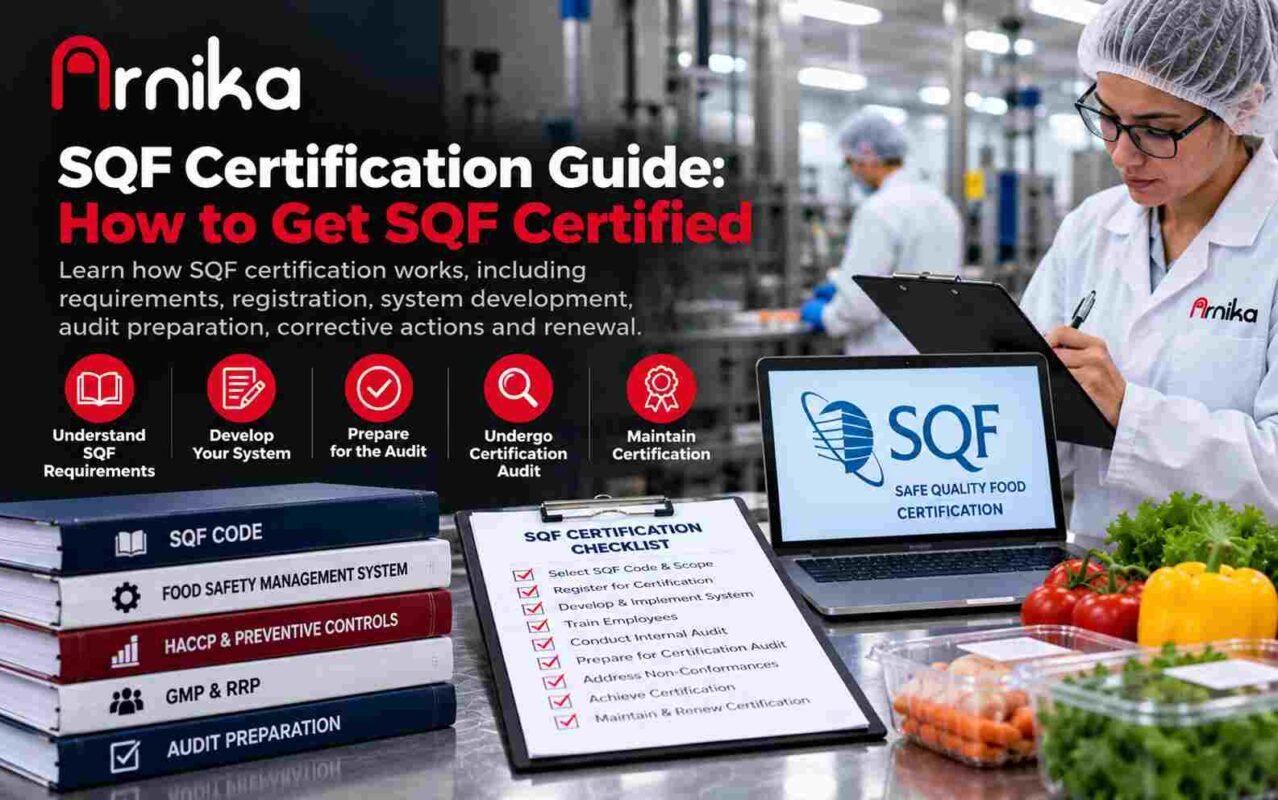
SQF certification is a globally recognized food safety and quality certification program used by food businesses to demonstrate that their systems meet the requirements of the applicable Safe Quality Food (SQF) Code.
For Canadian food manufacturers and other food businesses, SQF certification can be an important customer requirement, particularly when supplying retailers, food service companies, distributors, or large food brands.
The certification process involves more than preparing documents for an audit.
A business needs to select the appropriate SQF Code and certification scope, develop and implement its food safety system, train responsible personnel, complete internal activities, undergo an audit by an SQFI-licensed certification body, address applicable non-conformances, and maintain the system after certification.
This SQF certification guide explains the process and what Canadian food businesses should consider when preparing.
Reviewed by Reza Eslami, CEO & Co-Founder of Arnika and Food Safety & Regulatory Compliance Consultant.
What Is SQF Certification?
SQF stands for Safe Quality Food.
The SQF program provides food safety and quality codes designed for different sectors of the food supply chain.
SQF uses a risk-based food safety approach that incorporates HACCP principles and provides requirements for developing and maintaining a food safety management system.
SQF certification is not issued simply because a company has a HACCP plan or GMP program.
The business must demonstrate that its documented system is implemented and effective against the applicable SQF requirements.
Who Uses SQF Certification?
SQF certification can apply to many types of food businesses, including organizations involved in:
- Food manufacturing
- Food processing
- Packaging
- Storage and distribution
- Primary production
- Food ingredient production
- Other food-sector activities covered by the applicable SQF Code
The appropriate Code and certification scope depend on the activities, products and processes of the site.
SQFI provides a Code Selector to help businesses determine the appropriate requirements and scope.
For Canadian manufacturers, the first step should therefore be understanding exactly what products and processes will be included in the certification scope.
Why Do Food Businesses Seek SQF Certification?
Businesses may pursue SQF certification because of:
- Customer requirements
- Retailer requirements
- Supplier approval requirements
- Market access
- Food safety expectations
- Quality-system improvement
- Risk management
- Supply-chain requirements
SQFI describes its certification program as supporting food businesses in meeting food safety and quality requirements of buyers and supplying local and global food markets.
Certification should therefore be viewed as both an external requirement and an opportunity to strengthen the company’s food safety system.
SQF Certification Process
SQFI summarizes the certification journey into five broad steps:
- Learn about the Code
- Register for SQF certification
- Prepare for the audit
- Schedule and conduct the audit
- Renew certification
Let’s look at what each step involves.
Choose the Appropriate SQF Code and Scope
Before developing your system, determine which SQF Code applies to your operation.
Your certification scope should identify the relevant:
- Food sector category
- Products
- Processes
- Activities
- Site or sites covered
The scope is important because it determines which requirements will be assessed during the audit. SQFI states that the scope needs to be agreed upon between the site and certification body before the initial certification audit.
A poorly defined scope can create problems later.
Start with the actual operation rather than trying to make the scope broader than necessary.
Designate an SQF Practitioner
Depending on the SQF program selected, the site may need to designate an appropriately qualified SQF Practitioner.
The practitioner is responsible for overseeing activities associated with developing, implementing, reviewing and maintaining the SQF system.
SQFI notes that some programs may also require a substitute practitioner to ensure appropriate coverage when the primary practitioner is unavailable.
The practitioner should have sufficient authority, knowledge and resources to manage the system effectively.
Develop the SQF System
The next step is to document the system.
Depending on the applicable Code and operation, this can include:
- Food safety policies
- Procedures
- Work instructions
- Specifications
- HACCP plan
- Prerequisite programs
- Sanitation procedures
- Allergen controls
- Supplier controls
- Traceability
- Recall procedures
- Food defence
- Food fraud controls
- Training
- Internal audits
- Corrective actions
- Verification activities
- Records
SQFI describes the preparation process as first documenting the policies, procedures, work instructions and specifications required by the applicable SQF Code.
But documentation is only the beginning.
Implement the SQF System
A common mistake is assuming that having procedures means the site is ready for certification.
It doesn’t.
SQF requires the system to be implemented.
Employees need to follow procedures.
Records need to demonstrate that activities are actually being performed.
For example, having a sanitation procedure is different from demonstrating:
- Sanitation was performed
- Employees were trained
- Results were checked
- Deviations were addressed
- Corrective actions were completed
- Effectiveness was verified
SQFI specifically distinguishes between documenting the system and implementing it through actual practices and records.
Conduct Internal Audits and Verification
Before the certification audit, the site should evaluate its own system.
An internal assessment can identify gaps in:
- Documentation
- Records
- Employee practices
- Sanitation
- HACCP implementation
- Allergen controls
- Traceability
- Corrective actions
- Supplier controls
- Management-system requirements
The objective is not simply to produce a high internal score.
It is to identify problems before the certification audit.
This is where an independent Food Safety Audit can provide additional value.
Register With SQFI
The site must register for SQF certification through the SQF Assessment Database.
SQFI’s current certification process requires sites to register and provide the information necessary for their certification process.
Registration should be completed with enough time to prepare the system and arrange the certification audit.
Select an SQF Certification Body
SQF audits are conducted by SQFI-licensed certification bodies.
The certification body selects an appropriately qualified auditor based on the site’s industry scope.
The certification body—not SQFI directly—conducts the audit and issues the SQF certificate when the certification decision is made.
When selecting a certification body, consider:
- Relevant industry experience
- Auditor availability
- Audit scheduling
- Certification scope
- Fees
- Travel requirements
- Communication
- Certification-body experience with your type of operation
SQFI provides a directory of licensed certification bodies.
Prepare for the SQF Audit
Good audit preparation should go beyond reviewing documents.
Walk through the facility and ask:
If the auditor asks for evidence, can we provide it?
Review:
Food Safety System
- HACCP
- Hazard analysis
- Prerequisite programs
- Monitoring
- Verification
- Corrective actions
Facility
- Sanitation
- Equipment
- Maintenance
- Pest control
- Personnel practices
- Storage
Records
- Receiving
- Production
- Cleaning
- Monitoring
- Training
- Calibration
- Verification
- Corrective actions
Employees
Employees should understand their responsibilities and be able to explain relevant procedures.
SQFI auditors assess documentation and implementation through records, interviews and observations of operational and cleaning activities.
Conduct the SQF Audit
The certification audit evaluates whether the site’s system meets the applicable SQF requirements.
Auditors may review:
- Documentation
- Records
- Employee knowledge
- Production activities
- Cleaning activities
- Facility conditions
- Food safety controls
- Quality controls
- Implementation of procedures
The audit is therefore not simply a document review.
The auditor needs evidence that the system works in practice.
Address Non-Conformances
If non-conformances are identified, the site must address them through appropriate corrective action.
This generally means:
Finding → Root Cause → Corrective Action → Evidence → Verification
SQFI explains that corrective-action evidence is uploaded for certification-body/auditor review when non-conformances are identified.
Avoid treating corrective action as simply fixing the immediate problem.
For recurring problems, determine why the problem occurred and what needs to change to prevent recurrence.
For more information, see Arnika’s Root Cause Analysis in Food Manufacturing guide.
Certification Decision
After the audit and review of applicable corrective actions, the certification body makes the certification decision.
If certification is granted, the certification body issues the SQF certificate.
SQFI states that SQF certification is valid for one year.
This is important because certification is not a one-time achievement.
The site must continue maintaining its SQF system and complete the required certification cycle to remain certified.
SQF Certification Cost
There is no single price for SQF certification.
The total cost can depend on factors such as:
- Facility size
- Number of employees
- Products
- Processes
- Certification scope
- Audit duration
- Certification body fees
- Travel
- Training
- Consulting
- Laboratory testing
- System development
- Corrective actions
- Internal audits
A manufacturer starting from an established food safety system may require considerably less preparation than a facility building its system from the ground up.
For that reason, businesses should obtain a quotation based on their actual scope rather than relying on a generic SQF certification cost estimate.
How Long Does SQF Certification Take?
There is no single timeline that applies to every business.
The preparation period depends on:
- Existing food safety systems
- Facility condition
- Documentation
- Employee competency
- HACCP maturity
- Number of products
- Process complexity
- Existing certification experience
- Internal resources
A company with strong GMP, HACCP and prerequisite programs may be much closer to certification readiness than a company starting from scratch.
The key is to allow enough time for implementation, not just document preparation.
SQF Certification vs HACCP
SQF certification and HACCP are not the same thing.
HACCP is a systematic approach to identifying and controlling food safety hazards.
SQF is a certification program with defined requirements for a food safety and/or quality management system.
SQF uses a risk-based approach incorporating HACCP principles.
A company may therefore have HACCP in place before beginning its SQF certification project.
You can learn more from Arnika’s HACCP Guide and HACCP Plan Template Guide.
SQF and GMP
GMP provides important foundational controls for food manufacturing.
These can include:
- Sanitation
- Personnel hygiene
- Facility maintenance
- Pest control
- Equipment
- Storage
- Receiving
- Production controls
SQF goes beyond individual GMP practices by establishing broader system requirements.
For a Canadian manufacturer preparing for SQF, strengthening the underlying GMP system can therefore be an important part of preparation.
SQF and Prerequisite Programs
Prerequisite programs are another important foundation.
They can include controls for:
- Sanitation
- Pest control
- Personnel
- Equipment
- Water
- Receiving
- Storage
- Maintenance
- Waste
- Allergen management
Your Prerequisite Programs for HACCP page provides a deeper explanation of these foundational programs.
SQF Edition 10: What Canadian Businesses Should Know
SQFI published SQF Code Edition 10 in March 2026.
However, SQFI states that Edition 10 is undergoing the GFSI benchmarking process and that the expected mandatory implementation date is January 2, 2027, subject to that process. Audits before the mandatory implementation date remain under Edition 9.
This means businesses preparing for SQF should not simply assume that Edition 10 is already mandatory.
Your certification body or SQFI should be consulted when determining which edition applies to your specific audit date.
For companies planning certification in 2027, however, preparing for the transition early can be sensible.
SQF Certification Checklist
Before the certification audit, ask:
☐ Correct SQF Code selected
☐ Certification scope defined
☐ SQF Practitioner designated where required
☐ Food safety system documented
☐ HACCP system established
☐ Prerequisite programs implemented
☐ GMP controls implemented
☐ Allergen controls implemented
☐ Supplier controls established
☐ Traceability tested
☐ Recall system tested
☐ Food defence reviewed
☐ Food fraud controls reviewed where applicable
☐ Employees trained
☐ Internal audits completed
☐ Corrective actions addressed
☐ Verification completed
☐ Records available
☐ Certification body selected
☐ Audit scheduled
Common SQF Certification Mistakes
1. Writing Procedures but Not Implementing Them
Auditors look for evidence that the system actually operates.
2. Starting Too Close to the Audit
A rushed implementation makes it difficult to generate meaningful records and demonstrate effectiveness.
3. Ignoring Employees
Employees need to understand the procedures relevant to their jobs.
4. Weak Corrective Actions
Fixing the immediate issue without addressing the root cause can lead to recurring problems.
5. Poor Traceability
A manufacturer should be able to demonstrate that its traceability system actually works.
6. Treating SQF as Only a Food Safety Document Project
SQF certification involves the facility, people, processes, records and management system, not just a manual.
How Arnika Can Help With SQF Certification
Arnika supports Canadian food manufacturers preparing for SQF certification through practical consulting services, including:
- SQF gap assessments
- SQF system development
- HACCP development and review
- GMP improvement
- Prerequisite programs
- Food safety training
- Internal audit preparation
- Mock audit support
- Corrective action
- Root cause analysis
- Traceability and recall systems
- Employee audit preparation
- Certification readiness
Our GFSI Certification Support can help businesses prepare for certification to applicable GFSI-recognized certification programs, including SQF.
Arnika can also provide Food Safety Auditing Services to identify gaps before the certification audit.
Frequently Asked Questions
What is SQF certification?
SQF certification is certification to an applicable Safe Quality Food Code through an SQFI-licensed certification body.
How do I get SQF certified?
The basic process is to select the appropriate Code and scope, register, develop and implement the SQF system, select a certification body, complete the audit, address applicable non-conformances and receive the certification decision.
How long is SQF certification valid?
SQF certification is valid for one year, with annual certification/renewal activities required to maintain certification.
Who issues the SQF certificate?
An SQF-licensed certification body conducts the audit and issues the SQF certificate following the certification decision.
Is HACCP required for SQF?
SQF uses a risk-based food safety approach incorporating HACCP principles. The specific requirements depend on the applicable SQF Code and certification scope.
Is SQF certification required by Canadian law?
SQF certification is not a universal Canadian legal requirement for all food businesses. A customer, retailer, market or contractual requirement may require certification, while Canadian regulatory requirements such as the SFCR apply separately where applicable.
Can a consultant issue SQF certification?
No. A consultant can help a business prepare its system, conduct gap assessments or provide training, but the certification audit and certification decision are performed through an SQFI-licensed certification body.
Conclusion
SQF certification is more than preparing a food safety manual for an auditor.
A successful SQF system needs to be:
Documented → Implemented → Monitored → Verified → Continuously Improved
For Canadian food manufacturers, strong GMP, prerequisite programs, HACCP, allergen controls, supplier controls, traceability, training and corrective-action systems provide an important foundation for SQF preparation.
The best time to identify gaps is before the certification audit.
A practical gap assessment and implementation plan can help your team understand what needs to be improved, assign responsibilities, build evidence, and approach the certification audit with greater confidence.