What Does HACCP Stand For? Meaning & Definition in Canada
You’ve probably heard of HACCP, but what does HACCP stand for, and why is it important in food safety?
HACCP stands for Hazard Analysis and Critical Control Points. It is a preventive approach to food safety used to identify, evaluate, and control significant food safety hazards.
In this guide, we explain what HACCP stands for, what it means in food safety, why it matters in Canada, and how the seven HACCP principles fit into the system.
Reviewed by Reza Eslami CEO & Co-Founder, Arnika 25+ years of experience in food safety, HACCP, SFCR, SQF, GMP, and regulatory compliance. → View full profile
What Does HACCP Stand For?
HACCP stands for:
Hazard
Analysis
Critical
Control
Points
It is a preventive food safety system designed to identify, evaluate, and control biological, chemical, and physical hazards associated with food production and handling.
HACCP Definition in Food Safety
The HACCP definition refers to a structured, science-based approach to food safety. Instead of relying solely on finished-product testing, HACCP focuses on preventing hazards before they occur.
HACCP principles are widely used in food safety systems and are relevant to the preventive-control framework used by applicable Canadian food businesses.
Requirements depend on the business, products, activities, hazards, and applicable regulatory framework.
For a broader explanation of HACCP, its implementation, prerequisite programs, 12-step development process and Canadian context, see our complete HACCP guide.
Importance of the HACCP Food Safety System
HACCP provides a structured way to identify and control food safety hazards before they cause harm. It can help businesses:
Reduce food safety risks
Strengthen preventive controls
Support regulatory and customer requirements
Prepare for applicable certification requirements
Improve consistency and food safety culture
What Does HACCP Mean in Food Safety?
In practical terms, HACCP means identifying significant food safety hazards, determining where they need to be controlled, establishing appropriate controls, monitoring those controls, and taking corrective action when they are not met.
HACCP can be applied across many food sectors, including meat and poultry, seafood, dairy, bakery, beverage, food manufacturing, and food service.
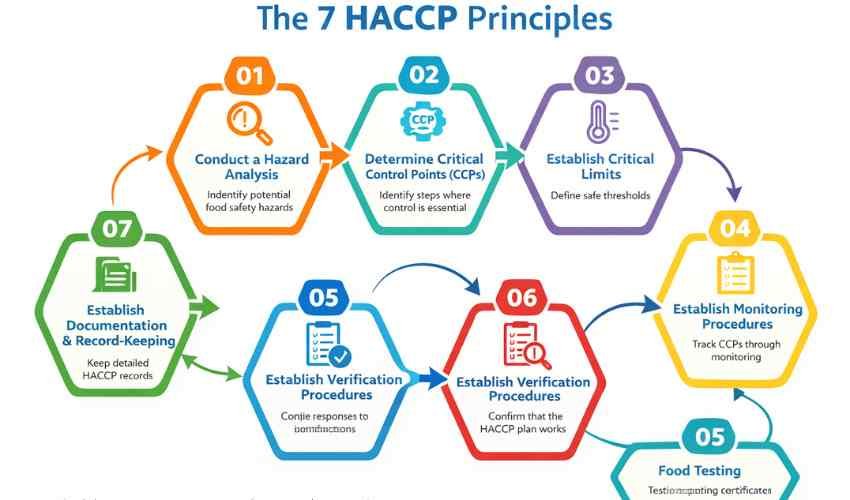
The 7 Principles of HACCP
To fully understand the HACCP definition, it’s important to know the HACCP 7 principles, which form the core of the system:
Conduct a Hazard Analysis – Identify potential food safety hazards.
Determine Critical Control Points (CCPs) – Identify steps where control is essential.
Establish Monitoring Procedures – Ensure CCPs remain under control.
Establish Corrective Actions – Define actions if limits are exceeded.
Establish Verification Procedures – Confirm the system works effectively.
Establish Documentation and Record-Keeping – Maintain food safety records.
For a detailed explanation of each principle, see our HACCP 7 Principles guide
Why HACCP Training Is Important
Effective implementation of HACCP requires proper HACCP training for employees at all levels. Trained staff are better equipped to:
Identify and assess hazards
Monitor critical control points
Maintain accurate documentation
Respond quickly to deviations and food safety risks
HACCP training helps employees understand hazard analysis, control measures, monitoring, corrective actions, and their responsibilities within the food safety system. Training should be appropriate to each employee’s role and the requirements of the business.
HACCP vs. Final-Product Testing
HACCP focuses on preventing and controlling significant food safety hazards during the process rather than relying solely on testing finished products.
Finished-product testing can still be an appropriate verification or monitoring tool in some situations, but it does not replace effective preventive controls.
Need Help Strengthening Your Food Safety System?
Need help applying HACCP to your food business? Arnika provides HACCP consulting in Canada for food manufacturers, processors, importers and other food businesses.
Conclusion
HACCP stands for Hazard Analysis and Critical Control Points. It is a preventive approach that helps food businesses identify, evaluate, and control significant food safety hazards.
Understanding the meaning of HACCP is only the first step. Effective implementation requires appropriate prerequisite programs, hazard analysis, monitoring, corrective actions, verification, documentation, and trained personnel.
HACCP stands for Hazard Analysis and Critical Control Points.
Is HACCP mandatory in Canada?
HACCP is not a universal standalone legal requirement for every Canadian food business. However, HACCP-based hazard analysis and preventive controls are relevant to the food safety systems of many businesses, including those subject to applicable SFCR requirements. The exact requirements depend on the business, activities, products, and hazards.
Who needs HACCP training?
Employees whose responsibilities affect food safety may need HACCP training appropriate to their roles, including food safety coordinators, QA personnel, supervisors, managers, and relevant production staff.
What industries use HACCP?
Food manufacturing, meat and seafood processing, dairy, packaging, and food service operations.
How is HACCP different from final-product testing?
HACCP focuses on preventing hazards during production, while traditional methods rely mainly on final product testing.