

GMP Compliance Case Study: Preparing a Canadian Food Manufacturer for Certification
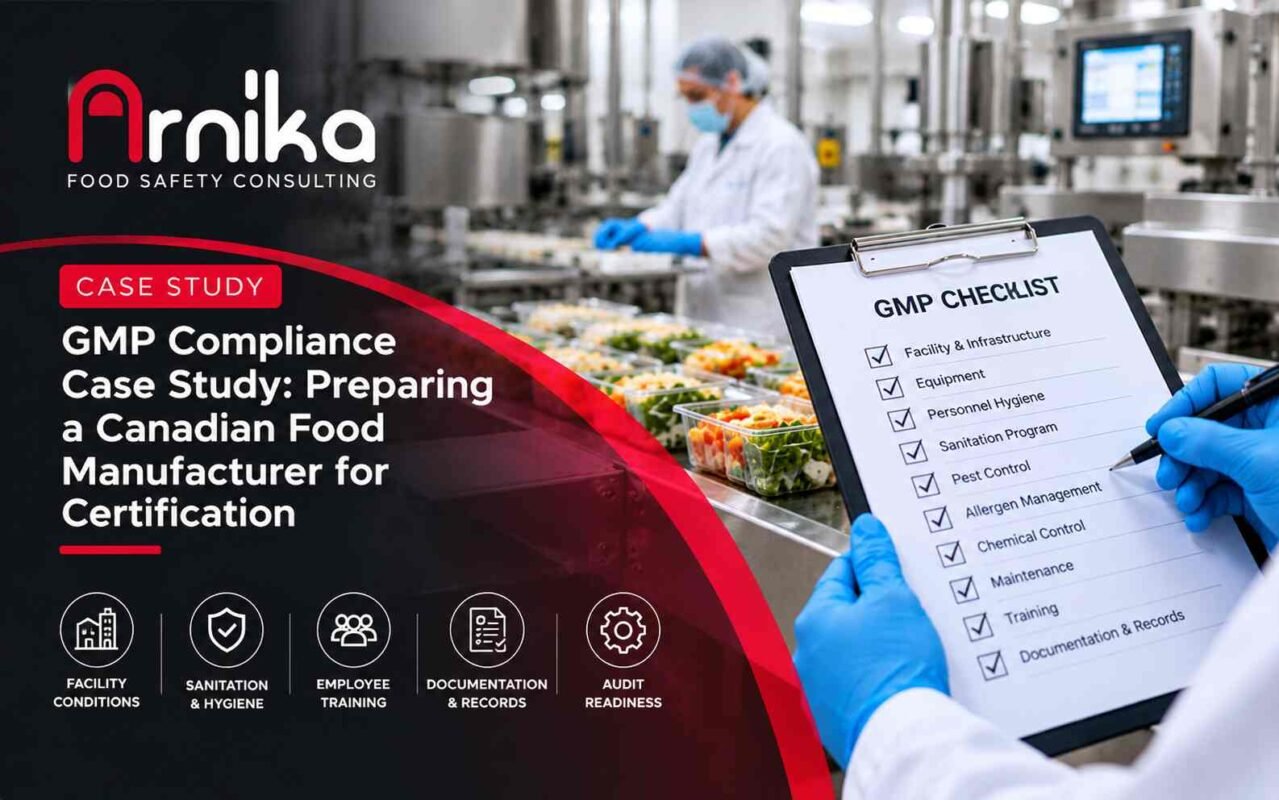
Preparing for a food safety certification audit requires more than updating documents shortly before the auditor arrives. Facility conditions, sanitation, employee practices, maintenance, pest control, allergen management and records all need to support a food safety system that is implemented in day-to-day operations.
This case study describes how Arnika supported an anonymized Canadian food manufacturer in assessing and strengthening its Good Manufacturing Practices (GMP) before a planned third-party certification audit. Client-identifying information has been removed or generalized.
The objective was to identify weaknesses early, prioritize improvements and help the manufacturer demonstrate that its food safety controls were implemented, documented and verified.
The Situation
The manufacturer had an established food safety system and was preparing for a third-party certification audit. Management wanted an independent assessment of whether the facility’s GMP practices and supporting programs would withstand detailed audit scrutiny.
The review covered facility conditions, equipment, personnel hygiene, sanitation, pest control, maintenance, chemical control, allergen management, receiving and storage, waste handling, employee training, documentation, corrective actions and verification.
The central question was: could the company demonstrate not only that procedures existed, but that they were followed and effective in practice?
How Arnika Approached the Project
1. Understanding the facility and conducting a gap assessment
The assessment began with the actual movement of people, raw materials, ingredients, work-in-process, packaging, finished products and waste through the facility. Layout and movement patterns were considered in relation to cross-contamination, allergen cross-contact, product protection, sanitation and material control.
Arnika compared documented procedures and programs with actual conditions on the production floor. The gap assessment considered infrastructure—including floors, walls, ceilings, doors, drainage, lighting and ventilation—as well as equipment condition, cleanability, maintenance, personnel practices, sanitation, receiving, storage and supporting programs. Findings were organized to give management a prioritized view of GMP readiness.
2. Reviewing prerequisite programs and operational controls
Existing prerequisite programs were reviewed to determine whether they were current, appropriate, implemented, monitored, documented and verified. Areas included sanitation, pest control, personal hygiene, preventive maintenance, allergen management, chemical control, supplier approval, receiving, storage, waste management and employee training.
These foundational controls support the wider food safety system. Arnika’s guidance on Prerequisite Programs and HACCP explains how these elements work together.
3. Assessing facility, equipment and sanitation
Facility conditions were considered for issues that could contribute to water accumulation, pest entry, difficult cleaning, condensation or product contamination. Equipment review included condition, food-contact surfaces, cleanability, lubrication, preventive maintenance, temporary repairs and calibration where applicable.
The sanitation review considered what must be cleaned, how and how often it is cleaned, chemical controls, responsibilities, verification methods and recordkeeping. The assessment distinguished completion of a cleaning task from evidence that cleaning was effective. Depending on the operation and risk, verification methods may include visual inspection, ATP testing, microbiological testing, allergen testing or environmental monitoring.
4. Reviewing personnel, allergens, pests and chemicals
Employee hygiene practices included handwashing, protective clothing, hair restraints, illness controls, employee behaviour and movement between areas. The assessment considered whether employees had appropriate procedures, facilities, supervision and training.
Allergen management was reviewed in relation to ingredient identification, storage, segregation, production scheduling, equipment cleaning, changeovers, label control and cross-contact prevention. Pest-control arrangements were considered for device placement, inspection frequency, activity, follow-up and records. Chemical controls included identification, labelling, storage, separation from food, access and employee handling practices.
5. Reviewing receiving, storage, training and records
Receiving and storage controls included incoming ingredient inspection, packaging integrity, supplier information, product identification, lot coding, applicable temperature controls, allergen segregation, stock rotation and product protection.
Training was considered in relation to employee responsibilities, including GMP, hygiene, sanitation, allergens, HACCP, corrective actions and recordkeeping. Documentation and records were reviewed for currency, completeness, legibility, consistency, control and retrievability. Records considered included sanitation, pest control, maintenance, training, receiving, monitoring, corrective actions, verification and calibration.
6. Prioritizing corrective actions and addressing recurring issues
The assessment findings were organized by risk and priority. The corrective-action approach connected each finding with its risk, root cause, action, responsible person, deadline and verification. This helped management focus on issues that could affect food safety or the effectiveness of the GMP system.
Recurring sanitation issues, equipment problems, incomplete records or repeated employee errors require more than another reminder. The underlying cause may involve an inadequate procedure, insufficient training, equipment design, supervision, resources or verification. Arnika’s article on root cause analysis in food manufacturing provides further guidance.
7. Preparing for certification and conducting a mock audit
After priority gaps were addressed, a pre-certification review was used to assess facility conditions, employee practices, records, sanitation, maintenance, pest control, allergen controls, corrective actions and HACCP implementation.
A mock audit tested whether the manufacturer could connect procedures with implementation, records and verification. Typical questions included asking employees to show sanitation procedures and records, explain cleaning verification, demonstrate allergen controls and describe what happens when a control fails.
The final review focused on whether corrective actions had been implemented and sustained—not simply marked complete. Evidence over time is important when demonstrating that improvements have become part of normal operations.
The Outcome
The manufacturer entered the certification process with a stronger and more structured GMP system and a clearer understanding of how facility conditions, prerequisite programs, HACCP, employees, records and verification work together. The project also helped the organization focus on demonstrating implementation rather than relying on written procedures alone.
The source material does not identify the certification scheme, report the final audit result or confirm that certification was achieved. This case study therefore describes the preparation and improvements reported in the source, without claiming a successful certification outcome.
Key Lessons
- Certification preparation should begin early enough to address systemic weaknesses.
- A documented procedure is not proof that a control is consistently implemented.
- Facility design, equipment condition, maintenance and sanitation are part of the food safety system.
- Employees need practical training and must understand the procedures relevant to their work.
- Corrective actions should address causes and be verified for effectiveness.
- GMP and prerequisite programs provide an important foundation for HACCP.
GMP Compliance and Certification
Regulatory GMP and preventive-control obligations are not necessarily identical to the requirements of a particular third-party certification scheme. The applicable requirements depend on the certification standard, scope, product, industry and customer expectations. Organizations preparing for SQF, BRCGS, FSSC 22000 or another scheme should assess the current requirements that apply to their specific scope.
For broader context, see Arnika’s GMP guide, GFSI guide and certification support.
How Arnika Can Help
Arnika supports Canadian food manufacturers with GMP gap assessments, GMP program development, sanitation and prerequisite program reviews, HACCP implementation, internal audits, mock audits, corrective-action support, employee training and certification preparation.
Learn more about Arnika’s food safety consulting services, certification services and food safety training.
Frequently Asked Questions
What is GMP compliance?
GMP compliance means applying appropriate Good Manufacturing Practices to help ensure food is produced, handled, stored and protected under controlled and sanitary conditions.
Why is GMP important before certification?
GMP and prerequisite programs provide foundational controls for food safety. Certification audits may assess whether these controls are documented, implemented, monitored and maintained.
What does a GMP gap assessment involve?
It compares current facility conditions, employee practices, procedures, records and supporting programs with applicable requirements and the organization’s certification objectives.
What areas are reviewed during a GMP assessment?
Depending on the operation, a review may cover facility conditions, equipment, sanitation, hygiene, pest control, maintenance, allergens, chemical control, receiving, storage, training, documentation and corrective actions.
What is the difference between GMP and HACCP?
GMP focuses on foundational manufacturing and hygiene practices. HACCP is a systematic approach to identifying and controlling specific food safety hazards. Strong GMP and prerequisite programs support effective HACCP implementation.
Should a company conduct a mock audit before certification?
A mock audit can help identify gaps in documentation, employee knowledge, implementation, records and corrective actions before the certification audit.
How long does GMP certification preparation take?
There is no single timeline. It depends on the operation’s size and complexity, the maturity of its food safety system, the certification scheme and the number and significance of gaps.
Can Arnika help with GMP certification preparation?
Yes. Arnika supports Canadian food businesses with GMP assessments, prerequisite programs, HACCP, internal audits, mock audits, employee training, corrective actions and certification preparation.