

BLOG
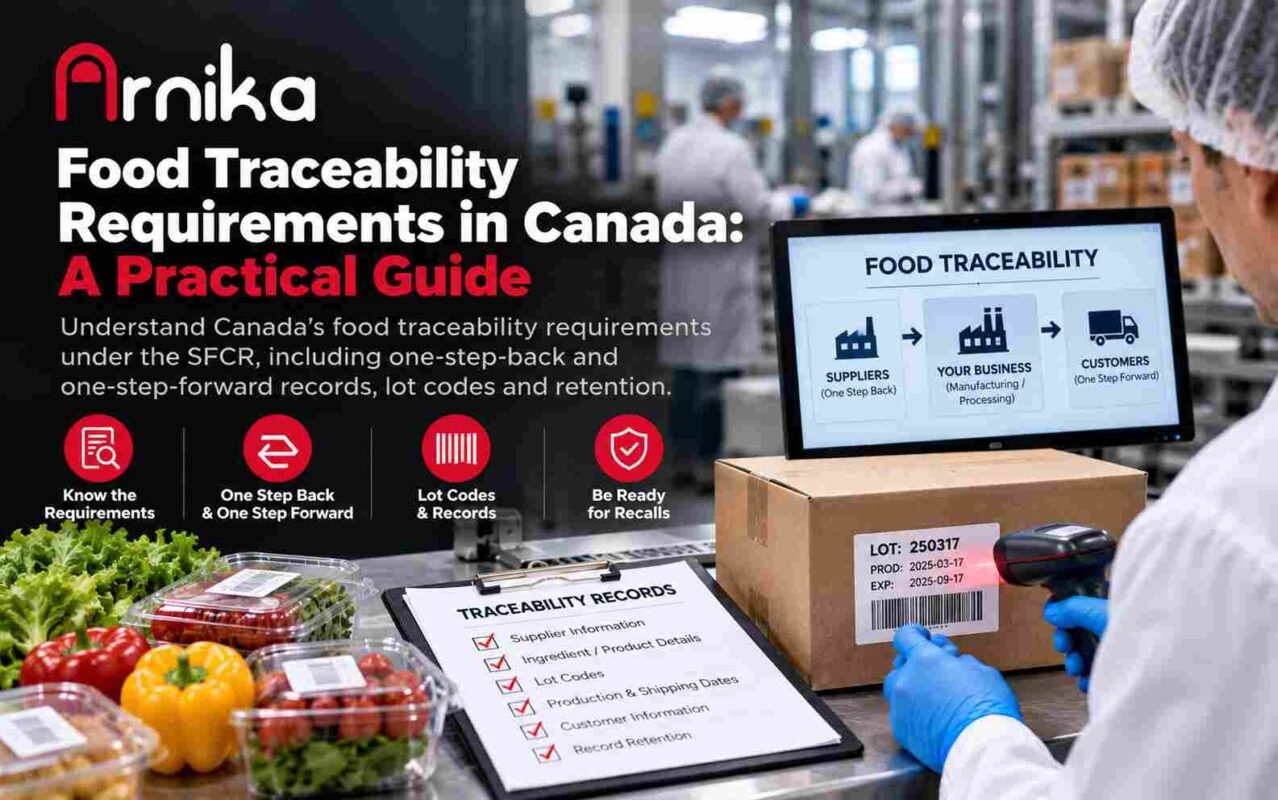
Food Traceability Requirements in Canada are an essential part of an effective food safety system. For Canadian food businesses, traceability helps identify where food came from, where it was sent, and which products may be affected if a food safety problem occurs.
Under the Safe Food for Canadians Regulations (SFCR), certain food businesses must maintain traceability information that allows food to be tracked one step back to the immediate supplier and one step forward to the immediate customer.
Effective traceability can help businesses respond more quickly to food safety incidents and limit the scope of recalls.
But traceability requirements are not exactly the same for every food business.
They depend on the activities your business performs, the food involved, and whether specific SFCR requirements apply.
Reviewed by Reza Eslami, CEO & Co-Founder of Arnika and Food Safety & Regulatory Compliance Consultant.
What Is Food Traceability?
Food traceability is the ability to track the movement of food or food commodities through the supply chain.
In simple terms:
One step back:
Where did you get the food or ingredient?
One step forward:
Who did you provide the food to?
This system allows a business and regulators to identify potentially affected products during a food safety investigation or recall.
CFIA explains that traceability requirements under the SFCR are based on the Codex approach of tracking food forward to the immediate customer and backward to the immediate supplier.
Who Needs to Meet Food Traceability Requirements in Canada?
Traceability requirements apply to a broad range of food businesses.
Depending on the circumstances, they can apply to businesses that:
- Import food
- Export food
- Send or distribute food across provincial or territorial borders
- Manufacture food for interprovincial trade or export
- Process, treat, preserve, grade, package, or label food for interprovincial trade or export
- Grow or harvest certain fresh fruits and vegetables for interprovincial trade or export
- Slaughter food animals for applicable interprovincial or export trade
- Store and handle imported edible meat products for CFIA inspection
- Sell food to consumers at retail
CFIA specifically notes that traceability requirements apply to a broader scope of businesses than some licensing and preventive-control requirements.
Restaurants and similar businesses that sell food as meals or snacks are generally excluded from the SFCR traceability requirements.
Because the requirements depend on your activities, businesses should verify their situation using CFIA’s traceability guidance and interactive tool.
What Does “One Step Back and One Step Forward” Mean?
This is one of the most important concepts in food traceability.
One Step Back
Your records should identify the immediate person or business that provided the food to you.
For example:
Ingredient supplier → Food manufacturer
The manufacturer should be able to identify:
- Supplier
- Supplier address
- Date the ingredient was received
- Food or ingredient received
- Applicable lot code or identifier
One Step Forward
The business should also be able to identify the immediate customer to whom the food was provided.
For example:
Food manufacturer → Distributor
Records should identify:
- Customer
- Customer address
- Date the product was provided
- Product
- Lot code or other applicable identifier
CFIA’s regulatory guidance sets out these one-step-back and one-step-forward documentation requirements.
What Information Should Traceability Records Include?
For applicable businesses other than retail, traceability documentation generally needs to identify the food using information such as:
- Common name
- Lot code or other unique identifier
- Name and principal place of business of the person by whom or for whom the food was manufactured, prepared, produced, stored, packaged, or labelled
The records also need to provide the applicable one-step-back and one-step-forward information.
Where applicable, businesses must also identify and trace ingredients used to make the food back to the person who provided them.
This means that simply keeping invoices may not always be enough if the records do not contain the information necessary to meet the applicable traceability requirements.
Lot Codes and Food Traceability
Lot codes are an important part of an effective traceability system.
A lot code can help connect a finished product to:
- Production date
- Production line
- Batch
- Ingredients
- Packaging materials
- Processing records
- Distribution records
For applicable consumer prepackaged foods, the SFCR contains specific traceability-related labelling requirements, including requirements concerning lot codes or unique identifiers depending on the food and circumstances.
A good lot-code system should allow the business to identify the affected product quickly without unnecessarily expanding the scope of a recall.
How Traceability Supports Food Recalls
One of the biggest reasons traceability matters is recall effectiveness.
Imagine a manufacturer discovers that a particular ingredient may be contaminated.
Without good traceability records, the business may have difficulty determining:
- Which finished products used the ingredient
- Which production lots were affected
- When those products were manufactured
- Where the products were shipped
- Which customers received them
With effective traceability, the business can narrow the investigation.
For example:
Supplier lot → Production batch → Finished product lot → Customer
This can make it much easier to determine the potential scope of a recall.
CFIA explains that effective traceability can help businesses narrow the scope of recalls and remove unsafe food from the market more quickly.
For more information about recalls, see Arnika’s Food Recall Management in Canada guide.
How Long Must Food Traceability Records Be Kept?
Under the SFCR traceability requirements, applicable traceability documents generally must be kept for two years.
The records must also be accessible in Canada.
CFIA states that traceability records must be provided to the CFIA upon request, generally within 24 hours, unless a different period applies based on the circumstances.
Electronic records can be used.
CFIA’s guidance states that electronic traceability records provided to CFIA must be in a single file, in plain text, and capable of being imported into and manipulated by standard commercial software.
The practical lesson is simple:
Don’t just keep the records—make sure you can retrieve them quickly.
Electronic Traceability Systems
A traceability system does not have to be complicated.
Depending on the size and complexity of the business, records may be maintained using:
- ERP systems
- Inventory management software
- Barcode systems
- Spreadsheets
- Production-management software
- Shipping records
- Receiving records
- Paper documentation
The technology is less important than whether the system is accurate, complete, accessible, and capable of tracing the required information.
For a small operation, a well-designed spreadsheet may be sufficient for its applicable requirements.
For a large manufacturer with many ingredients, products, warehouses, and customers, an integrated electronic system may be more practical.
Traceability and Your Preventive Control Plan
Traceability is closely connected to a company’s broader food safety system.
For applicable businesses, the Preventive Control Plan (PCP) may contain procedures and records related to food safety controls, while traceability records provide information needed to track products through the supply chain.
The two systems should work together.
For example:
Supplier approval → Receiving → Ingredient lot identification → Production → Finished-product lot code → Shipping → Customer
This creates a connection between food safety controls and product movement.
CFIA identifies traceability as one of the key SFCR requirements alongside licensing and preventive controls/PCPs, although the exact applicability of each requirement depends on the business activity.
You can learn more about preventive controls in Arnika’s Preventive Control Plan Canada guide.
Traceability and HACCP
Traceability is also an important supporting element of a broader HACCP-based food safety system.
HACCP focuses on identifying and controlling food safety hazards.
Traceability helps the business determine which ingredients and finished products are connected to a particular event or hazard.
For example:
Hazard identified → affected ingredient lot → affected production batch → affected finished-product lot → affected customers
This connection becomes especially important during:
- Food complaints
- Product investigations
- Recalls
- Supplier issues
- Environmental findings
- Allergen incidents
- Foreign material investigations
A strong HACCP system should therefore operate alongside effective traceability and recall procedures.
How to Test Your Traceability System
Having written procedures is not enough.
Food businesses should periodically test whether they can actually trace a product.
A practical traceability exercise might select one finished-product lot and ask:
Can we identify:
☐ Production date?
☐ Product lot code?
☐ Ingredients used?
☐ Ingredient supplier?
☐ Ingredient lot numbers?
☐ Quantity produced?
☐ Quantity remaining in inventory?
☐ Customers who received the product?
☐ Dates shipped?
☐ Distribution locations?
☐ Related production records?
The objective is to determine whether your system works in practice, not just whether the procedure exists.
A traceability exercise can also identify gaps before a real recall occurs.
Common Food Traceability Problems
1. Missing Lot Codes
Without reliable lot identification, it can be difficult to isolate affected product.
2. Supplier Records Are Incomplete
Receiving records should provide enough information to trace applicable food and ingredients back to the immediate supplier.
3. Shipping Records Don’t Identify Lots
Knowing that 10 pallets were shipped is less useful if you cannot determine which product lots were shipped to which customers.
4. Manual Records Are Not Consistent
Different employees may record information differently, making traceability difficult.
5. Records Cannot Be Retrieved Quickly
A traceability system is much less useful if employees need several days to find the required information.
6. The System Has Never Been Tested
A business may believe its traceability system works until it attempts an actual trace exercise.
Food Traceability Checklist for Canadian Businesses
Use this checklist to review your system:
☐ Identify whether SFCR traceability requirements apply to your activities
☐ Identify products using appropriate common names and identifiers
☐ Maintain applicable lot codes or unique identifiers
☐ Maintain one-step-back supplier records
☐ Maintain one-step-forward customer records where required
☐ Maintain applicable ingredient traceability records
☐ Keep records for the required period
☐ Ensure records are accessible in Canada
☐ Make records retrievable quickly
☐ Establish procedures for traceability during a recall
☐ Test the system periodically
☐ Investigate and correct traceability gaps
CFIA’s current guidance provides the detailed requirements and commodity-specific considerations businesses should use when determining exactly what applies to them.
How Arnika Can Help
Arnika helps Canadian food businesses develop and strengthen practical food safety systems, including:
- Food traceability systems
- Traceability procedures
- Recall preparedness
- Preventive Control Plans
- HACCP systems
- Supplier controls
- Corrective actions
- Food safety audits
- CFIA inspection preparation
- Food safety training
Our food safety consulting services can help businesses identify gaps in their traceability system and improve their ability to respond to food safety incidents and recalls.
Frequently Asked Questions
What are the food traceability requirements in Canada?
Under the SFCR, applicable food businesses generally need to maintain records that identify food and allow it to be traced one step back to the immediate supplier and one step forward to the immediate customer, with specific requirements depending on the business activity.
What does one step back and one step forward mean?
One step back means identifying who provided the food to your business. One step forward means identifying who received the food from your business.
How long must traceability records be kept?
Under the SFCR traceability requirements, applicable documents generally must be kept for two years and be accessible in Canada.
Do restaurants need to maintain SFCR traceability records?
Restaurants and similar businesses that sell food as meals or snacks are generally excluded from the SFCR traceability requirements.
Does every food business need the same traceability system?
No. Requirements depend on the food business’s activities and the applicable SFCR provisions. CFIA provides an interactive tool and commodity-specific guidance to help businesses determine what applies.
Is traceability the same as a recall procedure?
No. Traceability identifies where food came from and where it went. A recall procedure describes how the business responds when food may present a risk and needs to be removed from the market.
The two systems should work together.
Conclusion
Food traceability is a critical part of food safety and recall preparedness in Canada.
For businesses subject to the applicable SFCR requirements, an effective system should allow food to be identified and traced through the supply chain, including the required one step back and one step forward information.
The most important question is not:
“Do we have traceability records?”
It is:
“Can we quickly identify exactly which product was affected, where it came from, and where it went?”
A well-designed traceability system helps businesses respond faster, narrow the potential scope of recalls, support food safety investigations, and demonstrate effective control of their operations.
For Canadian food manufacturers, processors, importers, distributors, and other applicable businesses, traceability should be an active, tested system—not simply a filing exercise.