What HACCP Stands For and Why It Matters in Food Safety
Food safety is one of the most important responsibilities in the food industry. Whether you’re a food manufacturer, processor, distributor, restaurant operator, or importer, understanding HACCP is essential for protecting consumers and meeting regulatory requirements. But what exactly does HACCP stands for?
More importantly, how does it help businesses prevent food safety hazards and comply with industry standards?
This guide explains the HACCPmeaning, how the system works, and why it has become the global foundation of modern food safety management.
What HACCP stands for?
It is a preventive food safety management system designed to identify, evaluate, and control hazards that could make food unsafe for consumers.
Unlike traditional inspection methods that focus on finding problems after production, HACCP focuses on preventing food safety risks before they occur.
The system is recognized worldwide and forms the foundation of many food safety standards, including:
SQF
BRCGS
FSSC 22000
ISO 22000
Safe Food for Canadians Regulations (SFCR)
Understanding the HACCP Meaning
To fully understand what HACCP stands for, it helps to break down the acronym:
Hazard Analysis
This involves identifying food safety hazards that could occur during production, storage, transportation, or distribution.
Potential hazards include:
Biological hazards (bacteria, viruses, parasites)
Chemical hazards (allergens, cleaning agents, pesticides)
Critical Control Points are stages where controls can be applied to prevent, eliminate, or reduce food safety hazards to acceptable levels.
Examples include:
Cooking temperatures
Metal detection systems
Pasteurization processes
Cooling procedures
Together, hazard analysis and critical control points form (HACCP full form) a proactive food safety system.
Why HACCP Is Important
HACCP is widely recognized because it helps businesses:
Protect consumers from foodborne illness
Reduce food safety risks
Improve product consistency
Meet regulatory requirements
Prepare for certification audits
Strengthen customer confidence
Support export market access
Many retailers and food buyers require suppliers to operate under HACCP food safety systems before doing business with them.
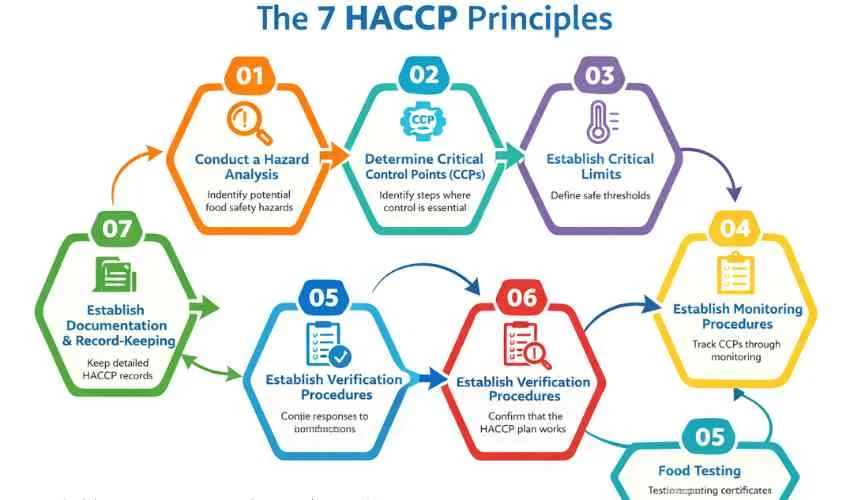
HACCP 7 Principles
Every HACCP system is built around seven internationally recognized principles:
Conduct a Hazard Analysis
Identify potential hazards at every step of production.
Determine Critical Control Points
Identify where controls are required to prevent hazards.
Establish Critical Limits
Set measurable limits such as temperature, time, or pH.
Establish Monitoring Procedures
Ensure CCPs remain under control.
Establish Corrective Actions
Define actions to take if a CCP exceeds acceptable limits.
Establish Verification Procedures
Confirm the HACCP system is functioning effectively.
Establish Documentation and Records
Maintain records that demonstrate compliance and traceability.
HACCP and Canadian Food Safety Requirements
In Canada, HACCP 7 principles are widely used to support compliance with the Safe Food for Canadians Regulations (SFCR).
Food businesses involved in manufacturing, processing, importing, exporting, and distributing food are often required to implement preventive control measures based on HACCP concepts.
A properly implemented HACCP system helps organizations:
Demonstrate due diligence
Improve audit readiness
Meet customer requirements
Support certification efforts
HACCP Certification and Audit Readiness
Although HACCP itself is a food safety system, many businesses seek HACCP certification or certification under HACCP-based standards.
Certification demonstrates that a company has implemented structured food safety controls and can successfully manage food safety risks.
Organizations often improve their chances of success by working with experienced HACCP consulting services to develop documentation, train employees, and prepare for audits.
How Arnika Helps Businesses Implement HACCP
At Arnika, we help food businesses across Canada develop, implement, and maintain HACCP-based food safety systems.
Our services include:
HACCP plan development
Hazard analysis
Staff training
Internal audits
Certification preparation
Regulatory compliance support
Whether you’re starting from scratch or improving an existing program, our team can help you build a practical and effective HACCP system.
Conclusion
Understanding what HACCP stands for is the first step toward building a strong food safety culture.
Hazard Analysis and Critical Control Points provides a preventive, science-based framework that helps food businesses identify risks, protect consumers, and comply with industry requirements.
As food safety expectations continue to grow, HACCP remains one of the most effective tools for ensuring safe food production and maintaining consumer trust.
The purpose of HACCP is to prevent food safety hazards before they occur rather than relying solely on final product testing.
Is HACCP mandatory in Canada?
Certain sectors, such as Ready-to-Eat meat, Dairy products, and egg producers, and regulatory programs require preventive controls based on HACCP principles. Requirements vary depending on the type of food business.